
At 10:00 hrs on July 3, 2026, engineers at the Satish Dhawan Space Centre in Sriharikota clamped a rocket motor to a test stand, lit it, and let it burn — not for the usual handful of seconds a solid stage typically fires, but for ten hours straight. The motor never left the ground. That was the point.
The test article is the solid motor for SOLVE, the Sub-Orbital Launch Vehicle for Experiments, a new test vehicle the Indian Space Research Organisation has built to answer a deceptively narrow but critical question: when a capsule carrying Indian astronauts comes screaming back from orbit, will its parachutes actually work the way engineers think they will?
According to ISRO's official release, the ground test at the agency's Static Test Facility met its performance parameters, clearing a checkpoint on the path to Gaganyaan, India's first crewed spaceflight program.
A Motor Borrowed, Then Rebuilt
SOLVE isn't a from-scratch rocket. Its solid stage is derived from the strap-on booster used on the PSLV, India's workhorse launcher — but it has been substantially reworked for this new job. ISRO modified the motor with a slow-burn-rate propellant formulation and added a secondary-injection thrust-vector-control nozzle, a steering mechanism that redirects the exhaust plume by injecting a secondary fluid into the nozzle flow rather than physically gimbaling the whole engine.
Why the redesign? A standard PSLV strap-on is built to deliver a hard, fast kick during ascent. SOLVE needs something closer to a controlled, extended lofting burn — enough thrust to carry a full-scale Gaganyaan crew module to altitude, but shaped and steered precisely enough to set up a clean separation event. That distinction is why the ground test ran for hours rather than seconds: validating a slow-burn propellant means watching how it performs over a duration much closer to its actual flight profile, not just confirming it can produce thrust at all.
What SOLVE Is Actually For
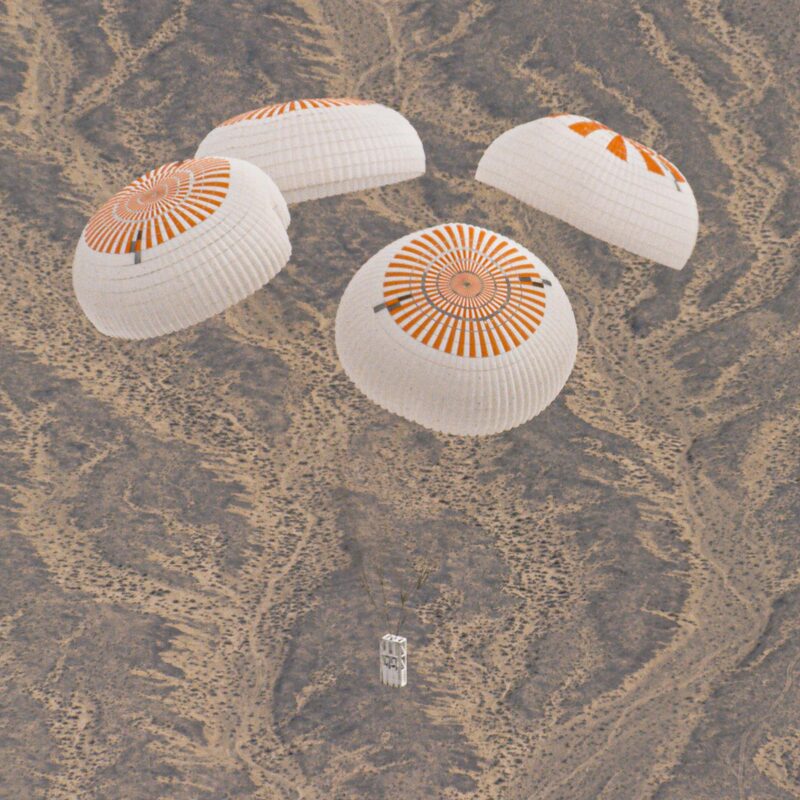
Once operational, SOLVE's job is to loft a Gaganyaan crew module to an altitude of 10 to 17 kilometers, at which point the module separates from the booster. From there, the real experiment begins: a sequence of ten parachutes deploys in stages to slow the module's descent, culminating in a splashdown at sea.
Ten parachutes deploying in sequence is not a detail to skim past. A crewed capsule's descent system is arguably the single highest-stakes piece of mechanical choreography in the entire mission — drogue chutes to stabilize and slow the module after the violence of reentry or a high-altitude abort, followed by main canopies to bring descent velocity down to something survivable at splashdown. Every stage in that sequence has to fire in order, inflate correctly, and share load properly with the stages before and after it. A test vehicle purpose-built to throw a real crew module through that exact sequence, under realistic aerodynamic and altitude conditions, is how you find the failure modes before there's a person strapped inside.
Where This Fits in the Roadmap
The SOLVE trial is being described as validation ahead of Gaganyaan's uncrewed demonstrator flight, which is planned for later in 2026. That flight, in turn, is one more rung in ISRO's phased, human-rating roadmap — the incremental sequence of tests the agency is working through before it commits to putting Indian astronauts on top of a rocket.
That phased approach is standard practice for any human spaceflight program, and for good reason: the components that keep astronauts alive — abort systems, parachutes, life support — are exactly the components you cannot afford to discover a flaw in during a crewed flight. Ground firings like this one are unglamorous compared to a launch, but they're where a huge share of that risk gets retired.
Why It Matters
Gaganyaan is India's bid to put its own astronauts into orbit on an indigenously built human spaceflight system, and the parachute deceleration system is one of the mission's most unforgiving single points of failure — there is no second chance if it fails at the wrong moment. The SOLVE test vehicle exists specifically to de-risk that system by exercising it, full-scale, under realistic flight conditions, before any astronaut depends on it. A successful ten-hour ground firing of the motor that will loft SOLVE doesn't guarantee the parachute sequence will work perfectly on a real test flight, but it clears one of the concrete technical hurdles standing between where ISRO is now and the uncrewed demonstrator flight planned for later this year — itself a precursor to the crewed mission that is the entire point of the Gaganyaan program.
