
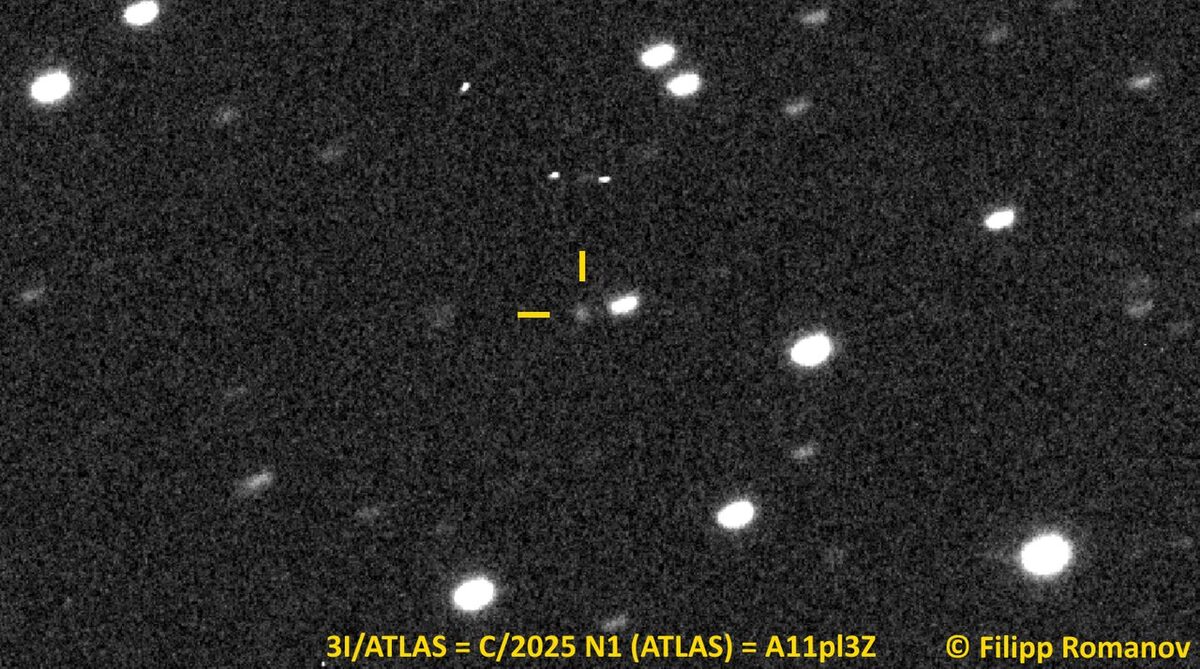
Almost everything you can see in the night sky belongs to our solar system or our galaxy's general population of stars. Once in a great while, something passes through that belongs to neither — an object that formed around another star, was flung out into the dark between the stars, and drifted for perhaps millions or billions of years before falling, by pure chance, through our cosmic backyard. In 2025 we caught one in the act. The object designated 3I/ATLAS is only the third interstellar visitor ever confirmed, and it has become one of the most intensely studied comets in history.
How we know it's not from here
3I/ATLAS was discovered on July 1, 2025, by the ATLAS survey — a network of telescopes built to spot moving objects — and its nature was given away by its path. Everything gravitationally bound to the Sun travels on a closed orbit, an ellipse. Interstellar interlopers travel on hyperbolic trajectories: they come in too fast to be captured, whip around the Sun once, and leave forever. 3I/ATLAS has an orbital eccentricity of roughly 6.1, far beyond the value of 1 that separates bound from unbound. There is no ambiguity. This object came from interstellar space and is just passing through. The "3I" in its name marks it as the third such interstellar object, after 1I/'Oumuamua in 2017 and the comet 2I/Borisov in 2019.
A chemistry that formed elsewhere
Unlike the tumbling, enigmatic 'Oumuamua, 3I/ATLAS is unmistakably a comet — it is actively venting gas and dust as the Sun's warmth sublimates its ices, wrapping it in a glowing coma. That activity is a gift, because the material streaming off it is a direct sample of the stuff another planetary system was built from. And the samples are strange. Researchers reported that the comet's water bears an isotopic signature unlike anything measured in our own solar system's comets — a different fingerprint in the ratio of hydrogen's heavy and light forms, hinting that the ices condensed under conditions that never existed here. Observers have also tracked unusual structures in its tail, including jets that appear to wobble as the nucleus rotates, and at times a tail pointing toward the Sun rather than away from it.
The breadth of the campaign to study it is unprecedented for a comet. More than a dozen NASA spacecraft turned instruments toward 3I/ATLAS, and ground observatories worldwide joined in. During a rare alignment in January 2026, NASA's TESS planet-hunting telescope spent more than a hundred hours staring at it, and a near-opposition geometry let astronomers measure how its dust scatters light in ways that reveal grain structure and composition. NASA has released the data openly, inviting researchers everywhere to mine it.
That 3I/ATLAS is a comet, not a bare rock, is much of why it matters more than its predecessor. 'Oumuamua, the first interstellar object, was inert and gone almost before astronomers grasped what it was, leaving its very nature fiercely debated to this day. A comet, by contrast, advertises its composition: as it warms, it sheds the very ices and dust it formed from, letting spectrographs read its chemistry directly rather than infer it from a faint reflected glint.
Why a passing comet is worth a global effort
The reason for the urgency is simple: we cannot go to another star, but for a few months an object from one came to us. Every other planetary system we study, we study across light-years, reading faint starlight. 3I/ATLAS let astronomers, in effect, hold a piece of an alien solar system up to their instruments and ask what it is made of. Each measurement is a data point on a question we otherwise can only theorize about — whether the chemistry that built our worlds is typical or peculiar. The visitor is already on its way back out, and it will never return. But the months it spent in range have produced a record that scientists will be analyzing for years, and surveys like the new Vera C. Rubin Observatory are expected to catch many more interstellar wanderers in the decade ahead. The era of meeting our galactic neighbors, one chance encounter at a time, has begun.
