
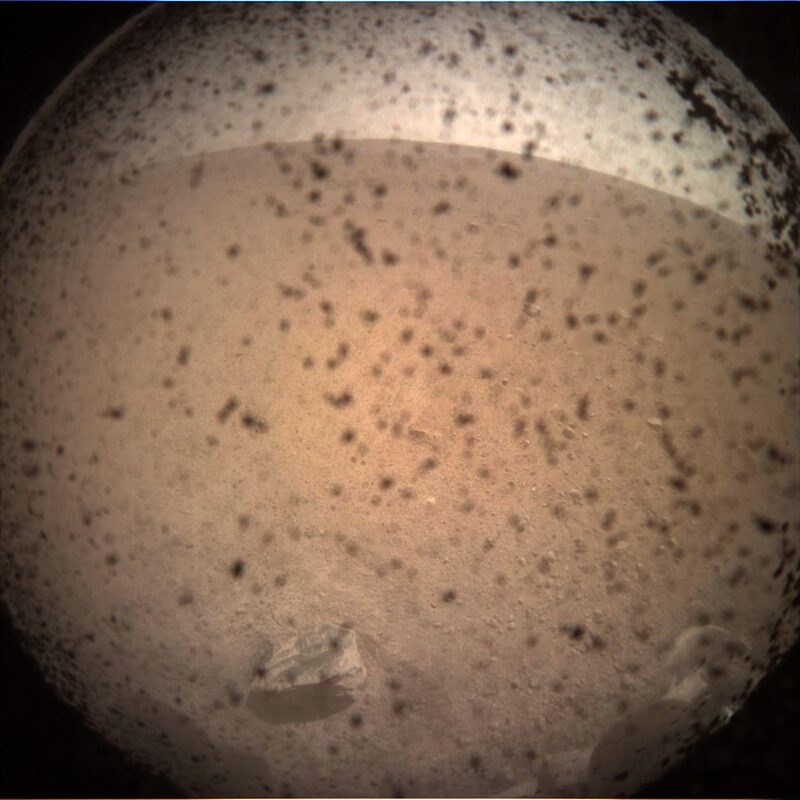
When InSight landed in Elysium Planitia on November 26, 2018, it carried something no Mars mission had brought before: a seismometer sensitive enough to detect the ground moving by a fraction of a hydrogen atom's width. Over the next four years, that instrument — the Seismic Experiment for Interior Structure, or SEIS — recorded 1,319 marsquakes, including several magnitude 5 events strong enough to propagate seismic waves through the entire planet. The data from those waves gave planetary scientists their first direct measurements of Mars's interior layering, and the measurements were surprising in almost every respect.
The core was the biggest shock. Pre-mission models, built on geochemical arguments and comparisons with Earth, predicted a dense iron core roughly 1,600 kilometers in radius. SEIS data placed the core radius at 1,830 kilometers — significantly larger and correspondingly less dense than predicted. A core that large and light must contain substantial amounts of lighter elements mixed with the iron: sulfur, oxygen, hydrogen, or carbon, in combinations that current models do not fully agree on. The large, light core also explains why Mars, unlike Earth, no longer has a global magnetic field — a big, slowly cooling iron core with dissolved lighter elements would have solidified its outer shell early and killed the dynamo billions of years ago.
Crust and mantle
The crust beneath InSight's landing site was found to be between 24 and 72 kilometers thick — a wide range reflecting genuine ambiguity in the seismic data, but broadly consistent with earlier geochemical estimates. What the data did reveal was internal structure: the crust appears to have two or three distinct layers rather than being a uniform slab. The uppermost layer, about 8 kilometers thick, shows higher seismic velocities suggesting it is denser and less fractured than the surface rocks. Below that, a distinct velocity change marks a compositional boundary. Whether this represents ancient volcanic layering or a more fundamental chemical discontinuity is not yet resolved.
The mantle, extending from the base of the crust to the top of the core, proved to be simpler in structure than Earth's mantle. Earth has a distinct transition zone at roughly 410 and 660 kilometers depth where olivine transforms into denser mineral phases under pressure. Mars shows no equivalent transition — its mantle appears to be mineralogically uniform down to the core-mantle boundary, which places constraints on the planet's interior temperature profile and suggests it has not undergone the deep convective mixing that shaped Earth's mantle.
Marsquakes and meteorite impacts
The seismic catalog InSight compiled is dominated by low-frequency events with long codas — different from typical tectonic earthquakes, more similar to moonquakes, reflecting the cold, rigid lithosphere of a tectonically quiet planet. The large magnitude 5 events in May 2022, the biggest recorded during the mission, sent waves refracting through the deep mantle and provided the clearest views of the core. A handful of marsquakes were later associated with confirmed meteorite impacts — the first time impact seismology has been performed on another planet — allowing an independent calibration of the seismic model.
InSight's power system, reliant on solar panels, gradually lost efficiency as dust accumulated. Despite attempts by mission operators to use the lander's scoop arm to pile dust near the panels so that wind might blow it off — a technique that partially worked — the panels could not generate enough power to maintain heating through the Martian winter. The mission ended on December 21, 2022, when contact was lost. But the seismic dataset it leaves behind, still being analyzed, represents the first chapter of planetary seismology beyond the Earth-Moon system. Future Mars missions with seismometers placed at different locations could triangulate quake sources with the precision that single-station analysis cannot achieve. A network of even three stations, distributed across the planet, would transform Martian seismology from a statistical discipline into a precise one — mapping the interior of a second planet the way terrestrial seismograph networks have mapped Earth's for more than a century.