
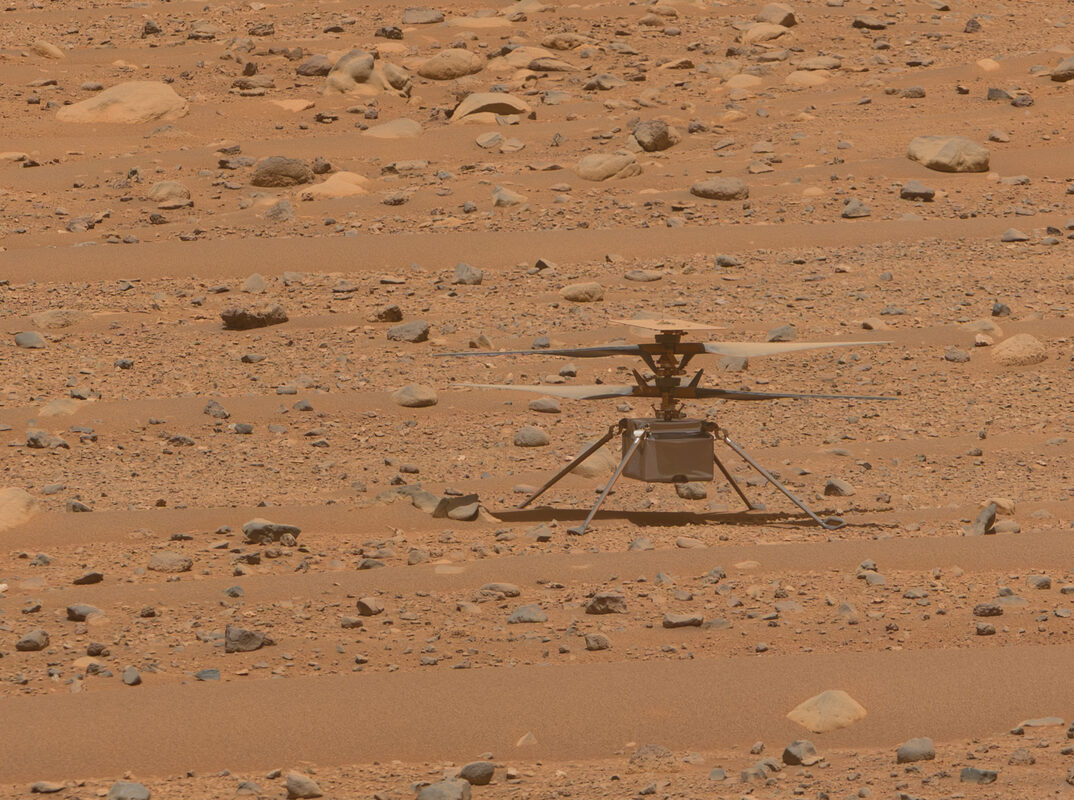
The certificate that the Wright Brothers' plane carried on its first flight in 1903 — a small swatch of muslin from the Flyer's wing — was attached to Ingenuity's solar panel when it lifted off the Martian surface for the first time on April 19, 2021. The gesture was deliberate: NASA's Jet Propulsion Laboratory was betting that what Kitty Hawk was to powered flight on Earth, Jezero Crater would be to powered flight in the solar system. The bet paid off in ways the mission designers had not fully anticipated.
Ingenuity was a technology demonstration — a helicopter weighing 1.8 kilograms, with two counter-rotating carbon-fiber blades spanning 1.2 meters, designed to prove that rotorcraft could fly in the Martian atmosphere. The atmosphere at Mars's surface is about 1 percent the density of Earth's at sea level, equivalent to flying at roughly 30 kilometers altitude on Earth — higher than any helicopter has ever flown here. To generate lift in that thin air, Ingenuity's blades had to spin at 2,400 revolutions per minute, about five times faster than a typical helicopter. The entire power system was limited by what a small solar panel could generate and what a small lithium battery could store through the Martian night.
From five flights to seventy-two
The original plan called for five flights over thirty days. The first four flights were increasingly ambitious: hovering, lateral movement, longer range. The fifth was the final demonstration. But Ingenuity survived all five flights with its systems intact, the Perseverance rover's primary science mission was proceeding on a timeline that left Ingenuity operational, and NASA took the obvious step: keep flying. The technology demonstration became an operational scout.
Over the next two and a half years, Ingenuity flew reconnaissance sorties ahead of Perseverance, identifying traversable paths, scouting scientifically interesting outcrops that would have taken the rover days to reach and then might have proven impassable, and imaging the terrain from perspectives that neither Perseverance's cameras nor orbiting spacecraft could match. Flight 25, in April 2022, covered 704 meters in 161.3 seconds — the longest single flight of the mission. By late 2022, Ingenuity had served as an operational scout for Perseverance's delta traverse, imaging the edge of the ancient river delta that the mission had been targeting since landing. The aerial images resolved features at scales that changed which outcrops Perseverance chose to approach.
The end, and what came next
On January 18, 2024, during its 72nd flight, one or more rotor blades struck the ground during landing — the first time in the mission that a blade had contacted the surface unintentionally. Post-flight images showed damage severe enough to ground the helicopter permanently. The final flight covered 12 meters horizontally and lasted 4.2 seconds; the mission had by that point accumulated over two hours of total flight time and covered more than 17 kilometers of ground.
Ingenuity's legacy is primarily conceptual: it demonstrated that the engineering challenges of Martian rotorcraft are solvable with existing technology. NASA's Mars Sample Return campaign had already incorporated the concept into its architecture before Ingenuity's final flight — the Sample Recovery Helicopters planned for the campaign drew directly on Ingenuity's design, scaled up and modified for a different operational role. ESA and JAXA have both studied aerial vehicle concepts for Venus and Titan respectively, with Ingenuity's data informing rotor design for those extreme environments. On the day of the first flight, the mission team noted that they were the Wright Brothers of interplanetary aviation. The 72nd flight confirmed it. The lesson Ingenuity demonstrated is not just about helicopters — it is about the value of aerial mobility in planetary exploration. A rover constrained to the surface can see only what its cameras reach; a rotorcraft can scout terrain days in advance, identify impassable terrain before a rover wastes time approaching it, and image targets at angles no surface vehicle or orbiter can match. Future planetary missions that do not include aerial components will need to justify that omission.
