
The problem with cosmic rays is that they bend. The galaxy is threaded with magnetic fields, and any charged particle — proton, helium nucleus, iron nucleus — crossing billions of light-years picks up small deflections from each field it encounters. By the time it reaches Earth and registers in a detector, its direction tells you nothing about where it came from. Cosmic rays hit Earth's atmosphere continuously, at energies ranging from modest to almost incomprehensibly vast, and for more than a century astronomers have been unable to point at the sky and say: there, that is where this one was born.
Neutrinos solve this problem. Neutrinos are produced in the same collisions that produce cosmic rays — when protons slam into ambient gas or radiation near their source, pions are created, and pions decay into neutrinos and gamma rays. Neutrinos carry no charge, are deflected by no magnetic field, and travel from source to detector in a straight line. If you can detect neutrinos from a direction in the sky with enough statistical significance, you have located the cosmic ray factory. The catch is that detecting neutrinos requires enormous volumes of matter, because neutrinos interact only via the weak force — they pass through Earth almost as freely as through empty space.
IceCube
The IceCube Neutrino Observatory is a cubic kilometer of Antarctic ice, instrumented with 5,160 digital optical modules embedded in the ice sheet at depths between 1,450 and 2,450 meters below the surface of the South Pole. When a sufficiently energetic neutrino interacts with ice (or the rock below it), it produces a charged secondary particle that travels faster than light in the ice — generating Cherenkov radiation, a bluish cone of light. The optical modules detect this light, and the arrival times and intensities of the signals across the array reconstruct the direction and energy of the original neutrino. The deeper ice is ancient and optically clear; it took decades of drilling and two years of deployment to instrument the full cubic kilometer.
In 2017, IceCube detected a 290-TeV neutrino — IceCube-170922A — that arrived within 0.2 degrees of a known blazar, TXS 0506+056, at the moment that gamma-ray observatories detected a flare from the same source. The coincidence was significant enough to announce the first probable astrophysical neutrino source. But TXS 0506+056 was a single event, and the statistical confidence was moderate. The picture changed in 2022.
NGC 1068
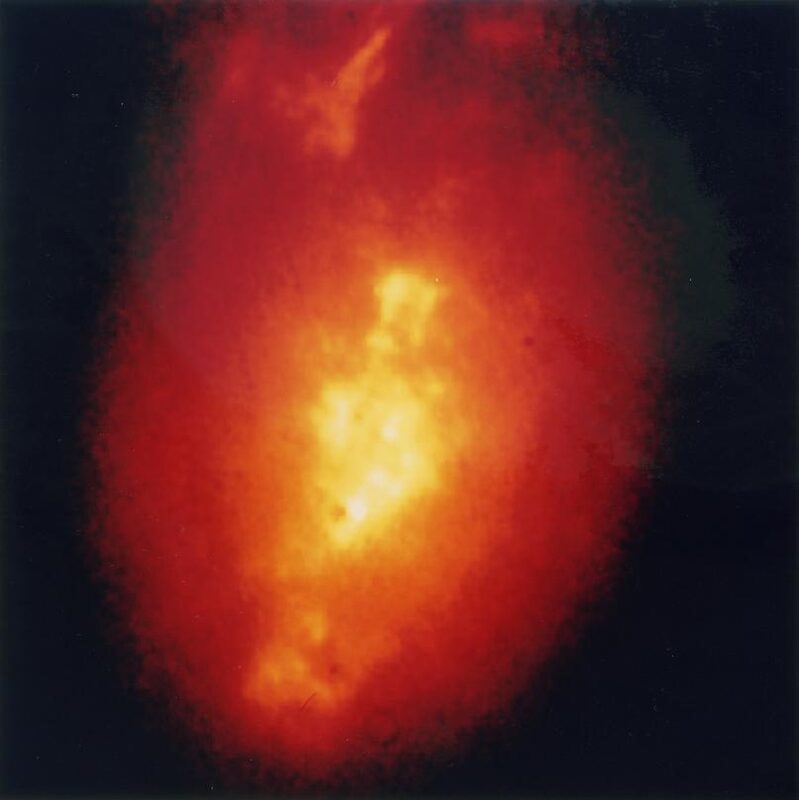
In a paper published in Science in November 2022, the IceCube Collaboration reported a 4.2-sigma excess of neutrinos from the direction of NGC 1068, a nearby Seyfert 2 active galaxy 47 million light-years away. NGC 1068 — also known as M77, visible in modest telescopes in Cetus — hosts a supermassive black hole at its center, buried under dense gas and dust that obscures the direct view of the accretion disk. It is one of the most studied galaxies in the sky and one of the brightest at X-ray wavelengths accessible despite the obscuration.
Eighty high-energy neutrino events were attributed to NGC 1068 over ten years of IceCube observation. The source produces far more neutrinos than gamma rays — a ratio inconsistent with simple models of proton-photon interactions in the jet and more consistent with proton-proton collisions in the dense gas surrounding the obscured nucleus, where gamma rays are rapidly absorbed but neutrinos escape freely. This "hidden accelerator" picture had been predicted by theorists as one possible cosmic ray source, and NGC 1068 is the first case where the neutrino data is strong enough to test it.
What comes next
IceCube-Gen2, the planned upgrade, will extend the instrumented ice volume to eight cubic kilometers and add surface arrays for air-shower detection. At this scale, the expected neutrino event rate increases by a factor of roughly five, and the number of detectable point sources rises from a handful to dozens. The cosmic ray origin question will not be answered by a single source — it will be answered by a population census, mapping which classes of astrophysical objects produce which fraction of the cosmic ray flux at which energies.
Victor Hess, who discovered cosmic rays in 1912 and received the Nobel Prize in 1936, could not have imagined the instrument that would eventually begin to answer his question — a telescope built inside a glacier at the bottom of the world, watching for blue flashes of light in ancient ice. It took a century. The answer is partial and provisional, as most good scientific answers are. NGC 1068 is one cosmic ray factory. There are others.
