
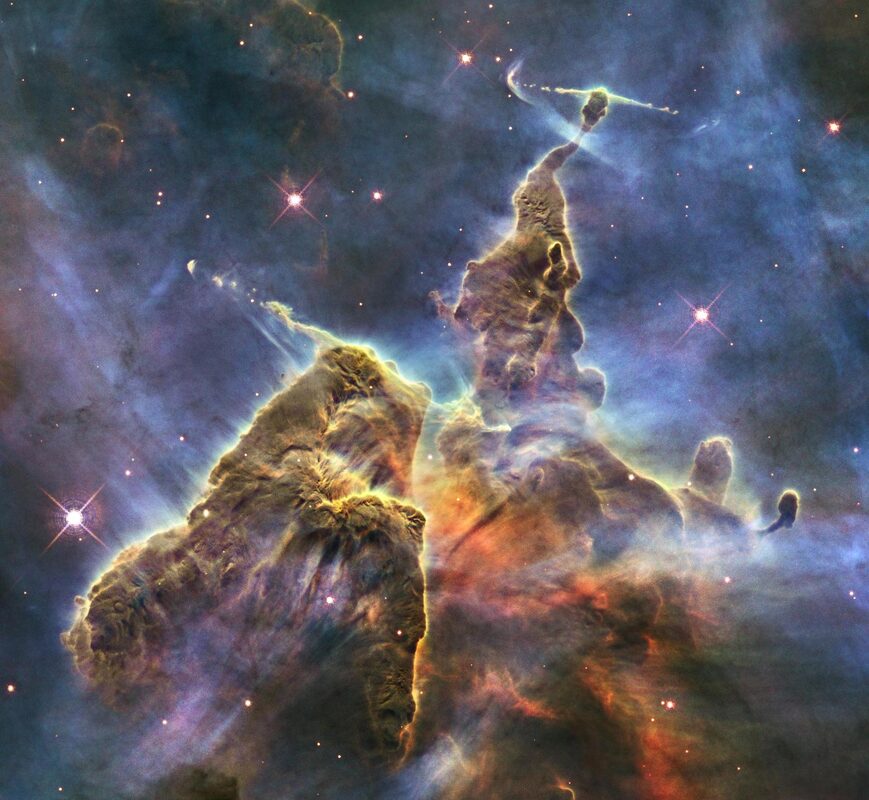
This year, just in time for Halloween, NASA and ESA released images of a dark pillar of dust deep inside the Carina Nebula. Seen from the right angle, it looks like a cat sitting with its back to us and its head turned over one shoulder. A single red point of light serves as its eye.
The joint release on 29 October 2026 pairs a visible-light image from the Hubble Space Telescope with near- and mid-infrared views from the James Webb Space Telescope. The cat is a fun hook. The more useful part is that the same patch of sky has been observed at very different wavelengths, and each set of images shows things the others don't.
Where the cat lives
The Carina Nebula is about 7,500 light-years away. It is a busy star-forming region, and Universe Today notes that it hosts some of the most massive stars in the Milky Way. One of them is Eta Carinae, a stellar system with many stars, two of which have a combined luminosity more than 5 million times the Sun's.
Stars that large put out huge amounts of ultraviolet radiation and drive strong stellar winds, and those shape everything around them. According to ESA, the Cat's Head pillar has likely been sculpted over time by exactly that radiation and those winds. As this stellar feedback erodes the surrounding gas and dust, denser material within the pillar resists erosion, or as the agency puts it, "at least for now."
That qualifier matters. NASA's version of the release calls the region a temporary scene that will eventually disperse as stars form and evolve over time. The cat is not a permanent fixture. It is a snapshot of a structure that is being taken apart.
What Hubble sees
The Hubble image was taken with its Wide Field Camera 3 (WFC3) in visible light. Its filters pick up emission from oxygen, hydrogen and sulfur, along with starlight scattered by dust. In this view the pillar is opaque: a dark brown shape set against glowing gas.
Hubble shows three main features:
- The eye. A glowing red spot that ESA says may mark a young star still partly embedded in the dust.
- The body. A dense, dark pillar of dust that visible light can't get through.
- The yellow ridge. A hazy yellow outline along the right side of the pillar. It is consistent with gas being ionised by ultraviolet light from nearby massive stars, potentially driving photoevaporation, where energetic radiation heats the gas and essentially evaporates it. Universe Today describes this edge as the likely site of that process.
That yellow rim is a sign of erosion in progress. It is where radiation from the nearby massive stars meets the pillar and wears it down.
What Webb sees
Infrared light passes through dust that blocks visible light, so Webb's view looks different. In the NIRCam near-infrared image, the filament becomes more transparent and its complex surface structure becomes discernible. A dense scattering of stars shows up, which ESA describes as blue and yellow in the colour composite, with some still enshrouded in dust to various degrees.
Webb's near-infrared view also shows two things the Hubble image does not emphasise. The first is a faint, jet-like feature near the cat's belly. ESA says it could indicate an outflow associated with a young star, and that the star may be nearby, perhaps within the cat or just to its right. Newborn stars often fire narrow jets of material as they grow, so a jet in this spot would fit with active star formation. The release is careful to treat it as a possibility, not a confirmed detection. The second is a set of background galaxies, visible beyond the nebula, as Universe Today and NASA both note.
Webb's MIRI instrument goes further into the mid-infrared. At these longer wavelengths the image traces emission from warm dust and carbon-based molecules excited by starlight, including polycyclic aromatic hydrocarbons. ESA also points to a bright source to the right of the pillar, likely an infant star embedded in dust, with a narrow filament that appears to cross it, though the image alone cannot establish whether the two are physically related.
NASA's release includes slider comparisons that set the Hubble WFC3 image against the Webb NIRCam view. The agencies call the two telescopes' observations "complementary views." That's a fair description: Hubble shows the pillar's dark body and the ionised gas around it, while Webb shows more of its structure and the stars hidden within and beyond it.
Why It Matters
Pillars like this one are where astronomers can watch star formation and stellar feedback happen side by side. Massive stars form, flood their surroundings with radiation, and erode the clouds around them. The Cat's Head appears to show several of these effects at once: a possible embedded young star, a possible jet, an eroding surface, and many dust-enshrouded stars that infrared light reveals.
ESA says the two telescopes' complementary views are helping astronomers learn more about the elusive, chaotic and complex process known as star formation. Comparing wavelengths is a big part of that. Visible light shows the ionised gas and the boundaries where radiation is doing its work. Near-infrared shows many stars that are hard to see otherwise. Mid-infrared maps warm dust and carbon-based molecules. Studying the same object at all three gives a more complete picture than any one view could, which is why it helps to have both Hubble and Webb working.
There's also the matter of time. NASA says the scene will eventually disperse, so what we see is a temporary stage in the life of this part of the Carina Nebula.
The Halloween timing is a hook, but the images show real things happening: a young star possibly shining through the dust, a pillar being worn down from outside, and distant galaxies visible through the nebula.
