
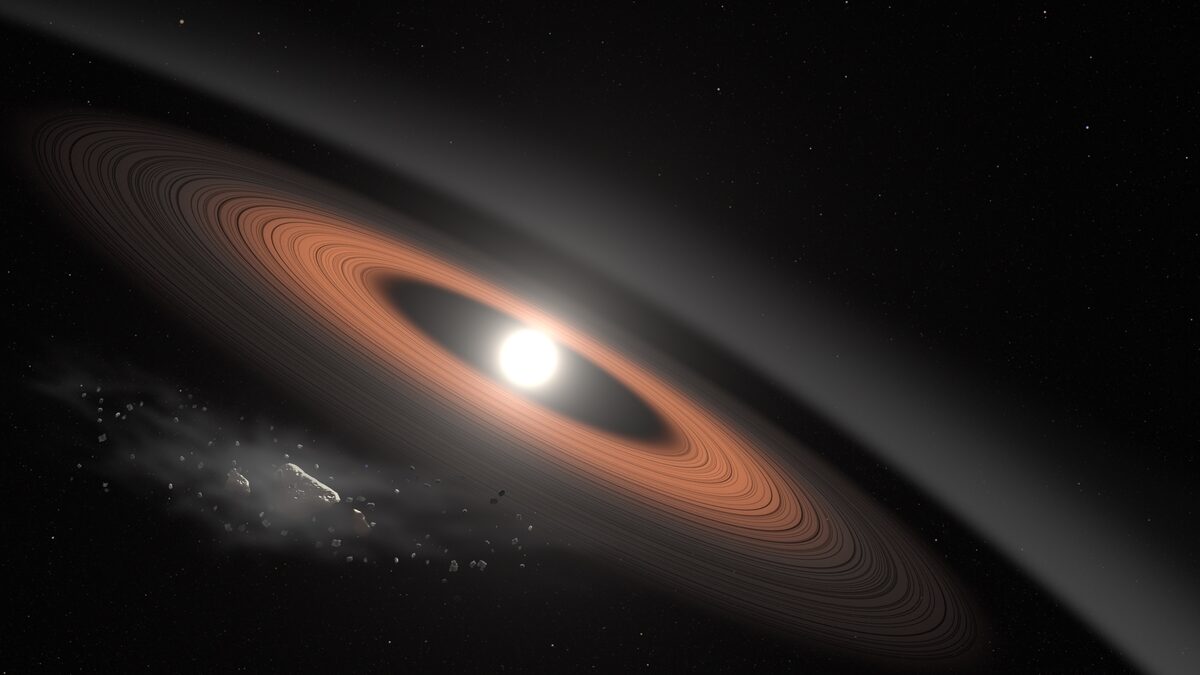
Before this week, astronomers knew of 21 white dwarfs with discs of gas around them. In every one, the spectra showed the same pattern: emission lines split into two peaks. A paper published Oct. 26, 2026 in Nature Astronomy adds a 22nd system that doesn't fit. Its lines have four peaks, and the authors say the simplest explanation is two separate gas rings, each possibly kept in shape by its own planetary body.
The star goes by WD J132800.85-145019.95, or WD J1328-1450 for short. Nicola Gentile Fusillo of the University of Trieste led the team that found it.
A dead star with a messy afterlife
A white dwarf is the dense core a star like the Sun leaves behind once its fuel runs out. As Universe Today explains, that transition is hard on any planets nearby: a Sun-like star swells on its way to becoming a white dwarf and engulfs its inner planets. The debris from those lost worlds can settle into a disc around the remnant.
Dusty discs like this are common. Gas is much rarer. Only 21 gaseous discs were known before this discovery, and background work suggests there may be a reason for that. A Gemini/GMOS survey of 13 white dwarfs with infrared excess, a telltale of warm dust, found no calcium II emission in any of them, according to a study of the current gas-disc sample accepted to RMxAA in October 2025. The authors of that study, which compiled the largest sample yet of white dwarfs with and without gas discs, say the result suggests the gas phase may be short-lived compared with the dusty stage. So any gas disc may be a brief window into the process.
Reading four peaks
The discovery comes from spectroscopy taken with the X-shooter instrument on ESO's Very Large Telescope. In a rotating ring of gas, one side moves toward the observer and the other moves away, so each emission line is Doppler-split into two peaks. That double-peaked profile is the signature all 21 earlier gas discs share.
WD J1328-1450 shows quadruple-peaked emission in both ionized calcium (Ca II) and neutral oxygen (O I). The team's interpretation is two concentric gaseous rings orbiting at different speeds, each producing its own pair of peaks. The inner ring runs from about 0.14 to 0.34 solar radii from the star. The outer ring extends from roughly 0.54 to 1.93 solar radii. There is a clear gap between the two.
The spectra also show absorption lines from calcium, magnesium and silicon in the star's atmosphere. The authors say these lines confirm that the star is accreting planetary material from a circumstellar dust disc. Universe Today adds that the inner ring appears enriched in magnesium while the outer ring is stripped of it, which may point to different source material, though that is far from proven.
The star itself is fairly typical. The paper gives an effective temperature of 17,424 ± 567 K, a surface gravity of log g = 7.76 ± 0.19 and a mass of 0.47 ± 0.09 solar masses, well within the range of the 21 other gaseous disc hosts.
Shepherds in the dark
The more provocative claim is about what keeps the two rings apart. Gentile Fusillo and colleagues propose that two distinct planetary bodies are shaping the structure. They estimate those bodies could range in size from a few kilometers across to roughly that of Pluto.
That size range is wide, and it reflects how indirect the evidence is. Nobody has seen these objects. Their existence is inferred from the shape of the gas. The paper itself notes that a single disc with a vertical extension that shadows the region between the rings could produce a similar outcome. Still, the proposal is concrete enough to test. In a press release quoted by Universe Today, Gentile Fusillo called the system "a rare glimpse of the violent, chaotic process by which a planetary system meets its end."
Why It Matters
The authors say plainly that the detection of a stable double disc presents a new challenge for current models of debris disc formation and evolution. Any successful model now has to explain how two separate gas reservoirs can exist together around one star and remain separated by a gap.
It also matters for what white dwarfs can tell us about planets more broadly. The metals in WD J1328-1450's atmosphere are, in effect, a chemical sample of rocky worlds. If the two-ring structure really traces two bodies, this system may hold more than one planetary fragment. Universe Today notes that astronomers have known of gaseous debris discs around white dwarfs for two decades, but how they form, what structures they develop and how they evolve over the long term is still not well understood. The discovery adds a specific geometry that future models and observations can test.
For now, the result rests on one system and one interpretation of its spectral lines. The four peaks are an observation; the two shepherding bodies are a hypothesis. Separating the two will take more data, but the case is clearly unusual among the gas discs found so far.
Artist's illustrations of the system are credited to ESO/L. Calçada.
