
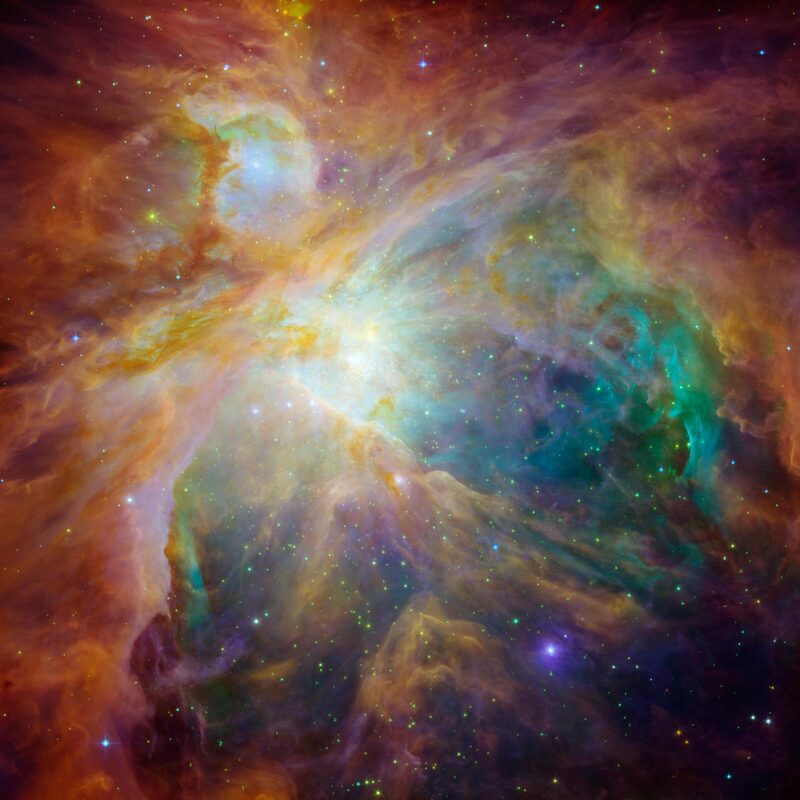
The Orion Nebula is the nearest large stellar nursery and one of the most studied objects in the sky. Its ages still don't add up. The stars of the Orion Nebula Cluster are roughly a million years old. The disks of gas and dust around many of those young stars, where planets may eventually form, are losing material so fast that they should have disappeared by now. The nebula's expanding shell of gas also looks too young for the stars that powered it.
A team led by Maite Wilhelm of Leiden University now proposes one cause for both problems. In a paper published in Astronomy & Astrophysics, titled "A triple-induced merger in theta1 Ori C solves the proplyd lifetime problem and the curiously young shell of M42," the researchers argue that the cluster's most massive star did not always shine as brightly as it does now. In their account, it became this bright fairly recently, when two stars merged.
Two clocks that disagree
The first problem involves proplyds, the evaporating protoplanetary disks that make the Orion Nebula famous in Hubble images. Ultraviolet light from nearby massive stars heats these disks and strips gas from them, a process called external photoevaporation. At the rate the disks are losing mass today, they should not have lasted a million years. Yet many of them are still there. Astronomers call this the proplyd lifetime problem.
The second problem is the nebula's expanding shell. According to Universe Today's summary of the work, the shell is moving outward at about 13 kilometers per second and has a radius of about 2.5 parsecs. Running that expansion backward gives an age of about 0.3 million years, a few hundred thousand years where a million would be expected.
Each discrepancy could be treated as a separate puzzle. The Leiden team takes the approach of asking whether one event could have reset both clocks.
A heavyweight with a complicated past
The proposed culprit is Theta-1 Orionis C1, an O-type star of more than 33 solar masses and the most massive member of the Orion Nebula Cluster. It currently has a binary companion, Theta-1 Orionis C2.
The researchers argue that C1 is the product of a merger. According to the paper's abstract, C1 formed from the merger of two binary stars, induced by von Zeipel-Lidov-Kozai oscillations driven by its present-day companion C2. This is a three-body effect in which an outer companion slowly perturbs an inner pair's orbit until its stars can collide. The Knowridge Science Report's account puts it more simply: a third star disturbed an orbiting pair and caused a collision, which produced a much brighter star.
The timing matters. The authors place the merger between the last episode of star formation and today, a few hundred thousand years ago rather than at the beginning. Before then, the radiation from the stars was weaker, so the surrounding disks could survive longer. After the merger, the extra luminosity led to stronger photoevaporation and accelerated the expansion of the shell.
This would explain why the proplyds look young: for most of the cluster's history, they were not being eroded as hard as they are now. Today's mass-loss rates would then reflect a recent change, not a steady rate that has run for a million years.
What the simulations show
The work is theoretical. No one has observed the proposed merger, and the paper does not claim a direct observation of one. The team instead ran Monte Carlo simulations to test whether the idea holds together physically.
According to the abstract, the simulations show that a sudden brightening a few hundred thousand years ago can reproduce the shell seen today while the age of the whole system stays close to the age of its stars. The authors also find that triple-star progenitors merge readily, on timescales even shorter than the scenario requires. In their analysis, a merger of this kind is a plausible event.
The proposal also accounts for two odd features of C1 itself. Universe Today notes that C1 has a tilted magnetic field and excess nitrogen, both of which can be explained by a merger. Knowridge cautions that these connections are suggestive rather than direct proof of a collision.
Co-author Simon Portegies Zwart, also at Leiden, said in a press release: "This is the first time we have witnessed the consequences of a major stellar collision in our own cosmic neighbourhood." Wilhelm, for her part, said the idea shows that subtle effects in triple-star systems can have a major impact on the environments in which stars form, and potentially even on planets that are still taking shape.
The part that doesn't fully work
The authors say plainly that the merger does not explain everything. The shell's current expansion requires a larger increase in stellar-wind luminosity than a simple merger can supply. Both the arXiv abstract and the Knowridge report make this point: the merger provides some of the push, but not all of it.
The paper suggests where the rest could come from. The disks that are photoevaporating release relatively cool gas. If a relatively large amount of that gas mixes into the hot bubble, it could supply the missing energy, and the authors identify a lower limit on how strong that effect must be. The resulting picture is that the merger brightens C1, the brighter C1 strips the disks faster, and the gas stripped from the disks helps drive the shell's expansion.
This second step is a proposal, not a demonstrated result. Knowridge notes that this part of the explanation still requires further investigation, and whether cool photoevaporative gas mixes into the hot bubble efficiently enough is something future modeling and observations will have to test.
Why It Matters
The Orion Nebula is the closest massive star-forming region to Earth, about 1,400 light years away, according to Universe Today, which makes its disks a natural place to study how planet-forming material survives near massive stars. If Orion's disks have been under heavy radiation for only a few hundred thousand years rather than a million, conclusions drawn from them about disk survival and planet formation in clusters may need to be revised. That is an inference from the paper's scenario, not a conclusion the sources state.
The study also shows how much a single massive star can affect its surroundings. Portegies Zwart says the work suggests stellar collisions may be much more common than previously thought. This work argues that one of them may have shaped the environment of the best-known stellar nursery in the sky, and that the event happened recently enough for its effects to still be visible in the gas and disks there.
Finally, the paper gives one explanation for several separate oddities: young-looking disks, a young-looking shell, and a massive star with an unusual magnetic field and chemistry. It also states the limits of that explanation, which makes the model easier to test.
Sources
- A Merger Solves a Puzzling Paradox in Orion (Universe Today, Oct 26, 2026)
- A triple-induced merger in theta1 Ori C solves the proplyd lifetime problem and the curiously young shell of M42 (arXiv:2609.38550)
- Ancient star collision may explain a mystery in the Orion Nebula (Knowridge Science Report, Oct 25, 2026)
