
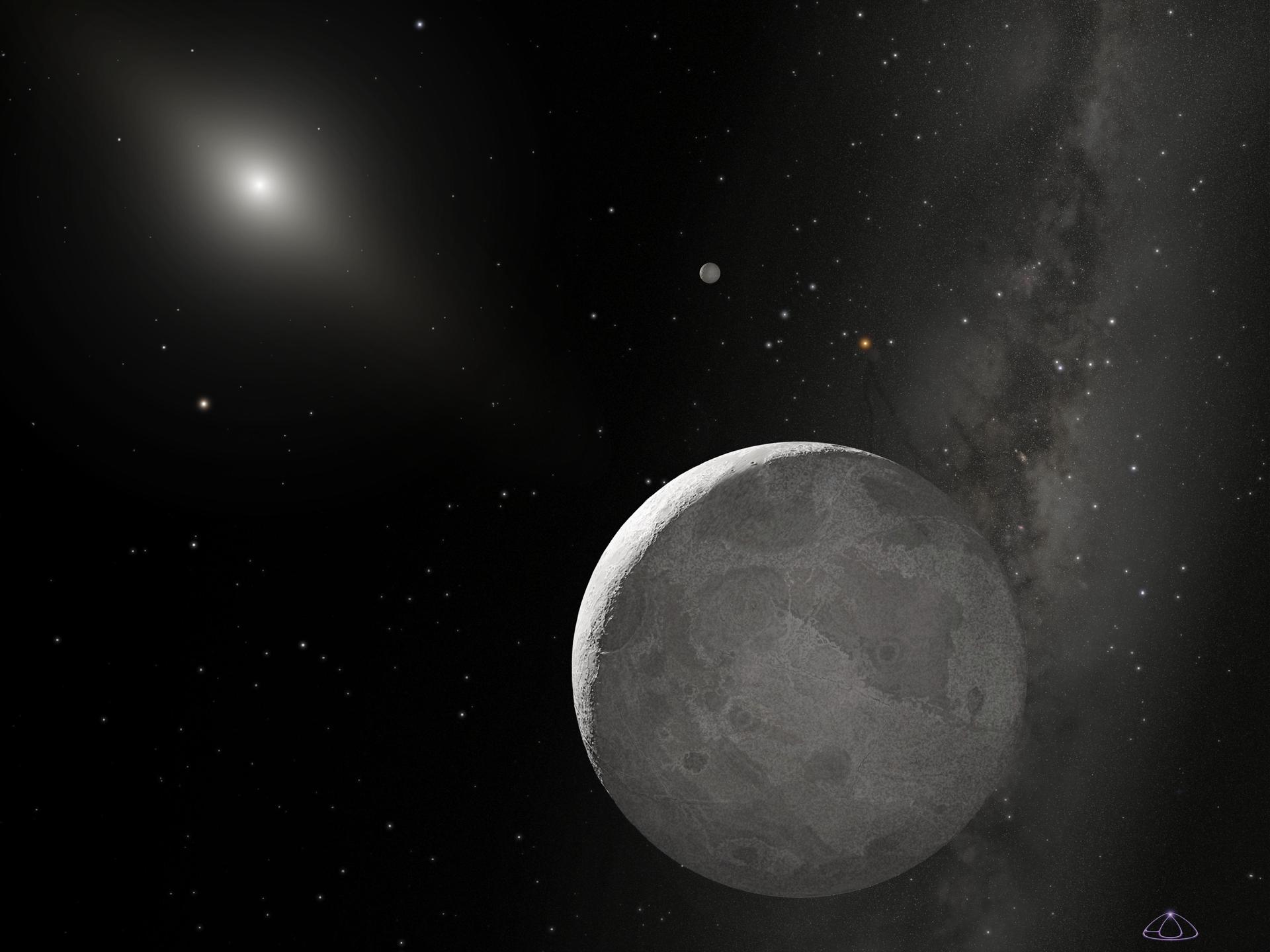
On 13 October, Matthew Holman of the Center for Astrophysics (CfA) was running a search code on data from the NSF-DOE Vera C. Rubin Observatory when a faint moving point turned out to be something unusual. "My first reaction was one of excited disbelief," Holman said in the NOIRLab announcement. Two weeks later, on 27 October, the Minor Planet Center published the object in a Minor Planet Electronic Circular as 2026 ED138. It is a trans-Neptunian object (TNO) about 46 astronomical units from the Sun, and it may be large enough to count as a dwarf planet.
It is the first dwarf planet candidate Rubin has reported. It probably will not be the last.
How It Was Found
The detection did not come from someone looking at images by eye. Holman found ED138 with a search code he built with Kevin Napier, run on Rubin observations taken earlier in 2026. The code's job is to pick out the slow drift of a distant body from many separate exposures and link those sightings into one consistent orbit. Far beyond Neptune that drift is tiny, and a lone detection proves almost nothing.
Once the first candidate orbit existed, Mario Jurić of the University of Washington, Rubin's Solar System Lead Scientist, went back through the data and found 20 more detections. In total, Rubin's Simonyi Survey Telescope recorded the object 30 times on 20 different nights between 4 March and 11 July 2026, according to NOIRLab.
Four months of data gives a solid start on an orbit. For something this far out, though, it covers only a sliver of the path. So the team searched older images. Using the Asteroid Institute's ADAM Precovery tool, they found the object in archival images from the Dark Energy Camera (DECam) going back to 2016. That stretches the observed arc to more than ten years and tightens the orbit a great deal.
The method matters as much as the find. Precovery, short for pre-discovery, is the step that turns a promising object into a well-determined one. It also depends on large public archives that were collected for other purposes years ago.
What Kind of Object Is It?
At about 46 au, ED138 is currently farther out than Pluto, which sits at roughly 40 au. Its orbit is tilted about 25 degrees to the plane of the solar system, which puts it among the "hot classical" TNOs. In this case "hot" is about orbital motion, not temperature. These are Kuiper Belt objects on orbits more inclined and stirred up than those of the calmer, flatter "cold" population.
The size estimate is the headline number, and also the least settled. Universe Today reports a preliminary diameter of 600 to 1,500 km, based on the object's brightness, its distance and an assumed albedo, meaning how much light the surface reflects. Albedo is the big unknown. A dark surface needs a large body to look this bright, while a bright, icy surface could manage it with a much smaller one. That is why the range spans more than a factor of two. Space.com gives the same span in imperial units, 373 to 972 miles, and says that at that size the object is probably big enough for its own gravity to pull it into a round shape. Being round in that way is the key physical test for a dwarf planet.
If it sits near the top of that range, Universe Today notes, ED138 would be one of the largest dwarf planets found beyond Neptune. If it sits near the bottom, it is still a substantial world, just a less unusual one.
A Small Club With a Long Waiting List
Officially, the list of dwarf planets is short. Space.com counts five confirmed: Pluto, Ceres, Eris, Haumea and Makemake. Holman put it this way: "If confirmed as a dwarf planet, ED138 would join a very small family of worlds."
The "if confirmed" matters. Calling something a candidate is how this field works, not a hedge. Showing that an object is round usually takes better size and shape measurements than survey photometry can give. Until then, ED138 is in the same position as many other large TNOs: likely a dwarf planet, not yet confirmed as one.
That waiting list sits inside a much bigger population. Universe Today notes that the Minor Planet Center has numbered 1,006 TNOs, and more than 4,000 others carry only provisional designations. The region beyond Neptune is also not one uniform belt. Astronomers divide it into the Kuiper Belt, the scattered disk, detached objects and the Sednoids, each defined by how its orbits relate to Neptune and how far they swing from the Sun. ED138's moderate distance and inclined orbit place it in the Kuiper Belt's hot classical group, not among the more extreme outer populations.
Why It Matters
One bright TNO is not, on its own, a big change in our picture of the solar system. What it shows about Rubin is more significant.
The observatory is built to survey the whole available sky over and over. Because of that, the data that revealed ED138 was not collected to hunt for dwarf planets. It was data Rubin collected earlier in 2026, during the run-up to its main survey, that a search code could go through months later. Faint, slow-moving objects in the outer solar system have always been hard to find. You need repeated looks at the same patch of sky, spread over weeks, to separate a distant body's motion from noise. Rubin produces that kind of coverage simply by doing its normal work.
ED138's discovery also shows the pipeline the field will depend on. That means a survey telescope, an independent linking code, a second scientist searching for extra detections, and an archive search that adds a decade of history. Each step could have failed. The fact that they all worked suggests Rubin's data can deliver well-characterized outer solar system objects, not just a list of faint moving points.
It also raises a practical question. If routine early data held a body that might be 1,500 km across, the census of large TNOs is probably not finished. A world of that size, still unknown in 2026, shows how incompletely the outer solar system has been surveyed until now.
The next steps are plain but important. Further observations should improve the orbit and, more crucially, the size. Firmer albedo and diameter measurements will decide whether ED138 joins Pluto and Eris as a recognized dwarf planet or stays one of many large, probably round candidates. In the meantime, the team has presented the object at the Division for Planetary Sciences meeting, and the orbit is published for anyone to follow up.
Sources
- NSF-DOE Vera C. Rubin Observatory Reveals Its First Dwarf Planet Candidate in Our Solar System (NOIRLab, 27 Oct 2026)
- The Rubin Observatory Finds Its First Dwarf Planet Candidate (Universe Today, 28 Oct 2026)
- Astronomers found a mysterious object beyond Neptune, and it could be a new dwarf planet (Space.com)
