
Gamma-ray bursts are supposed to be brief. The name describes the event: a flash of high-energy light that marks the violent death of a star, followed by an afterglow that fades over days and weeks. The "central engine" behind the burst is the newborn compact object that powers the jet. In the standard picture it does its work quickly and then goes quiet.
GRB 220706A did not go quiet. A paper posted to arXiv on 18 September by Benjamin P. Gompertz and 32 co-authors reports that the burst, first detected in July 2022, kept flaring in X-rays for about 51 days after the trigger. The authors call this the latest central-engine activity seen in any gamma-ray burst. A second paper, posted on 22 October by Yuri Sato and Rin Oikawa, offers an explanation that breaks with the usual collapsing-star picture: a massive star torn apart by a black hole. Popular coverage, including a Techno-Science piece on 24 October, followed over the next few days.
A quiet start
Early observations gave no hint of anything unusual. A NASA GCN Circular from July 2022 records that the GROND instrument on the MPG 2.2-meter telescope at La Silla in Chile looked at the field 17.5 hours after the Swift trigger. It spent 20 minutes on target in 1.2-arcsecond seeing and found no optical or near-infrared transient inside the Swift/XRT error circle. The 3-sigma limits were deep: g' fainter than 25.2, r' fainter than 24.9 and i' fainter than 24.2 (AB magnitudes), with near-infrared limits of J > 21.7, H > 21.0 and K > 19.9. The circular was signed by A. Nicuesa Guelbenzu and S. Klose of TLS Tautenburg and A. Rau of MPE.
So on day one there was no obvious optical afterglow. In hindsight, the story of GRB 220706A was going to unfold slowly.
Fifty-one days, or twenty-seven
The Gompertz paper puts the burst at redshift z = 0.8577. The redshift matters as much as the duration because of cosmological time dilation. Clocks at that distance appear to us to run slow by a factor of 1 + z, about 1.86. The 51 days of X-ray flaring seen from Earth therefore correspond to about 27 days in the explosion's own frame.
Even after that correction, 27 days is far outside the normal range. Techno-Science reports that it extends the previous rest-frame record by about 21 days, which implies the earlier record was only about 6 days and that the new one is more than four times longer. Flaring is also different from a long afterglow. A smoothly fading afterglow can come from a jet that ran into its surroundings long ago. Repeated flares are usually read as a sign that something at the center is still feeding the outflow: still accreting, still launching.
A supernova that is too bright
The burst also seems to have had a supernova, and an unusually luminous one. The Gompertz team reports a likely accompanying supernova with a peak absolute magnitude of about −20.25, or brighter once dust is accounted for. That puts it alongside SN 2011kl, which accompanied the ultra-long GRB 111209A, and makes it consistent with the class of superluminous supernovae. Techno-Science stresses that the true brightness is uncertain because of dust absorption, so the exact figure has room to move. The direction of the uncertainty favors something brighter, not fainter.
The comparison with SN 2011kl is the useful part. The Gompertz abstract notes that bursts at the extremely long end of the duration distribution may be a separate population of "ultra-long" GRBs, and that their durations are hard to reconcile with the engine timescales expected from the compact Wolf-Rayet stars usually assumed to produce standard long bursts. GRB 220706A now looks like an extreme case in that debate.
The problem with collapsars
In the textbook model of a long gamma-ray burst, a massive, rapidly rotating star stripped of its outer layers collapses at the end of its life. The model explains a great deal, but it faces a timing problem here.
Techno-Science sums up the problem plainly. The usual stripped-massive-star collapse models rely on a relatively compact star, which does not naturally supply matter and energy for several weeks. A prolonged supply of matter to the central object is one of the options on the table. The outlet also notes that none of the proposed explanations accounts for every observation, and that the results come from a preprint that has not yet been peer-reviewed.
A star shredded by a black hole?
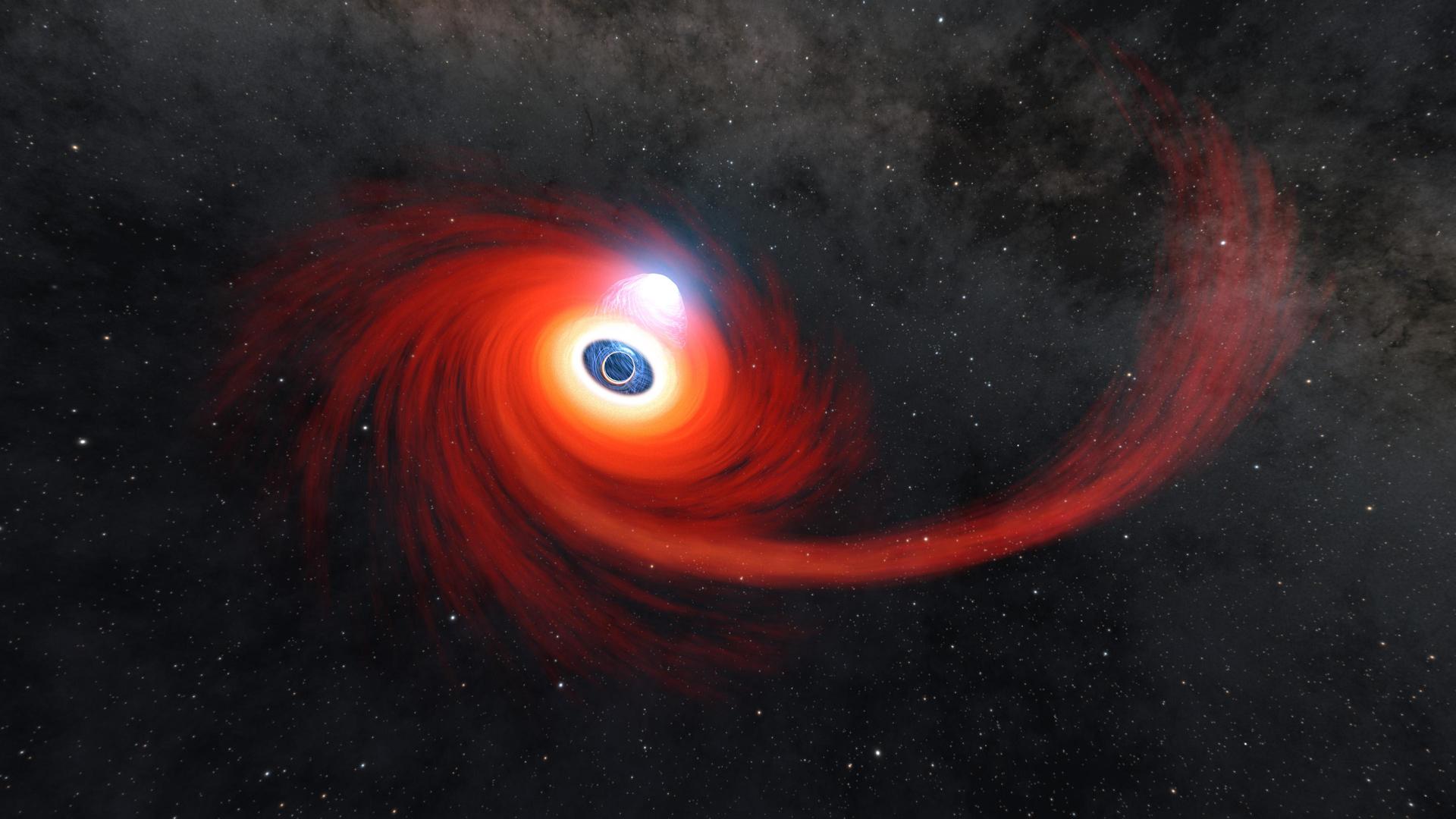
Sato and Oikawa take a different route. In a nine-page paper, they start from the same two observational facts: X-ray flaring to about 51 days and a luminous optical thermal component on a timescale of about 106 seconds, roughly 11.6 days. They argue that the event was a tidal disruption, not a collapsing star.
In their scenario, a blue supergiant of about 50 solar masses and about 20 solar radii was disrupted by a black hole of about 105 solar masses. That puts the black hole in the intermediate-mass range, much heavier than a stellar remnant and much lighter than the supermassive black holes in galactic cores. Shocks between streams of stellar debris drive an early inflow of some of the debris, which may carry preexisting magnetic flux toward the black hole and power an initial relativistic jet through the Blandford-Znajek mechanism, which extracts rotational energy from a spinning black hole through magnetic fields. The remaining debris circularizes into an accretion disk, and its thermal emission would account for the bright late optical component. To power a jet capable of producing the inferred gamma-ray luminosity, the authors say they need a magnetic field of about 105 gauss near the black hole before the disruption.
The model is also testable. Sato and Oikawa note that continued fallback of stellar debris could keep the central engine active beyond the observed X-ray flaring, so further X-ray monitoring of the source would test the idea.
Why It Matters
GRB 220706A pushes on a model that has worked very well for long gamma-ray bursts. If a stellar-collapse engine can somehow run for 27 days in its own frame, the physics of matter supply and accretion in these explosions needs revisiting. If it can't, some events that astronomers file as gamma-ray bursts may be something else: tidal disruptions by intermediate-mass black holes.
Either outcome would be informative. A tidal-disruption explanation would turn a strange burst into a probe of intermediate-mass black holes, and it would raise the question of how a 50-solar-mass blue supergiant came to be close enough to one to be disrupted. A collapsar explanation would require the engine to be fed far longer than standard models easily allow. The luminous supernova adds a constraint that any model has to satisfy.
For now, the honest summary is the one Techno-Science gives: several candidate explanations, and none that fits everything. The next round of answers depends on whether the source is still doing something in X-rays, and on whether the next ultra-long burst gets watched closely from the start.
Sources
- GRB 220706A: a gamma-ray burst with a month-long engine and a luminous supernova (Gompertz et al., arXiv)
- Prompt Jet Launching and Delayed Thermal Disk in Tidal Disruption Event for Prolonged Activity GRB 220706A (Sato and Oikawa, arXiv)
- Never-before-seen: a 27-day cosmic explosion (Techno-Science, Oct 24, 2026)
- GCN Circular 32339: GRB 220706A, GROND observations (NASA GCN)
