
The universe is 13.8 billion years old. Except, depending on how you measure it, it might be 13.4 billion years old. That doesn't sound like much of a difference until you realize those two numbers come from completely independent methods, each refined over decades, each carrying extremely small error bars — and they flatly disagree with each other. The gap has not closed as instruments have improved. If anything, it has sharpened. Cosmologists call it the Hubble tension, and while the phrase sounds like a minor technical quibble, it may be the most important unresolved problem in modern physics.
The two clocks at the heart of the problem
At issue is the Hubble constant, denoted H₀, which describes how fast the universe is expanding. Specifically, it gives the recession velocity of a galaxy per unit of distance — in practice, expressed in kilometers per second per megaparsec. Get H₀ right and you can work backward through cosmic time to determine when the expansion started, which gives you the age of the universe. The problem is that the two most robust measurement strategies arrive at different values of H₀, and neither side is obviously wrong.
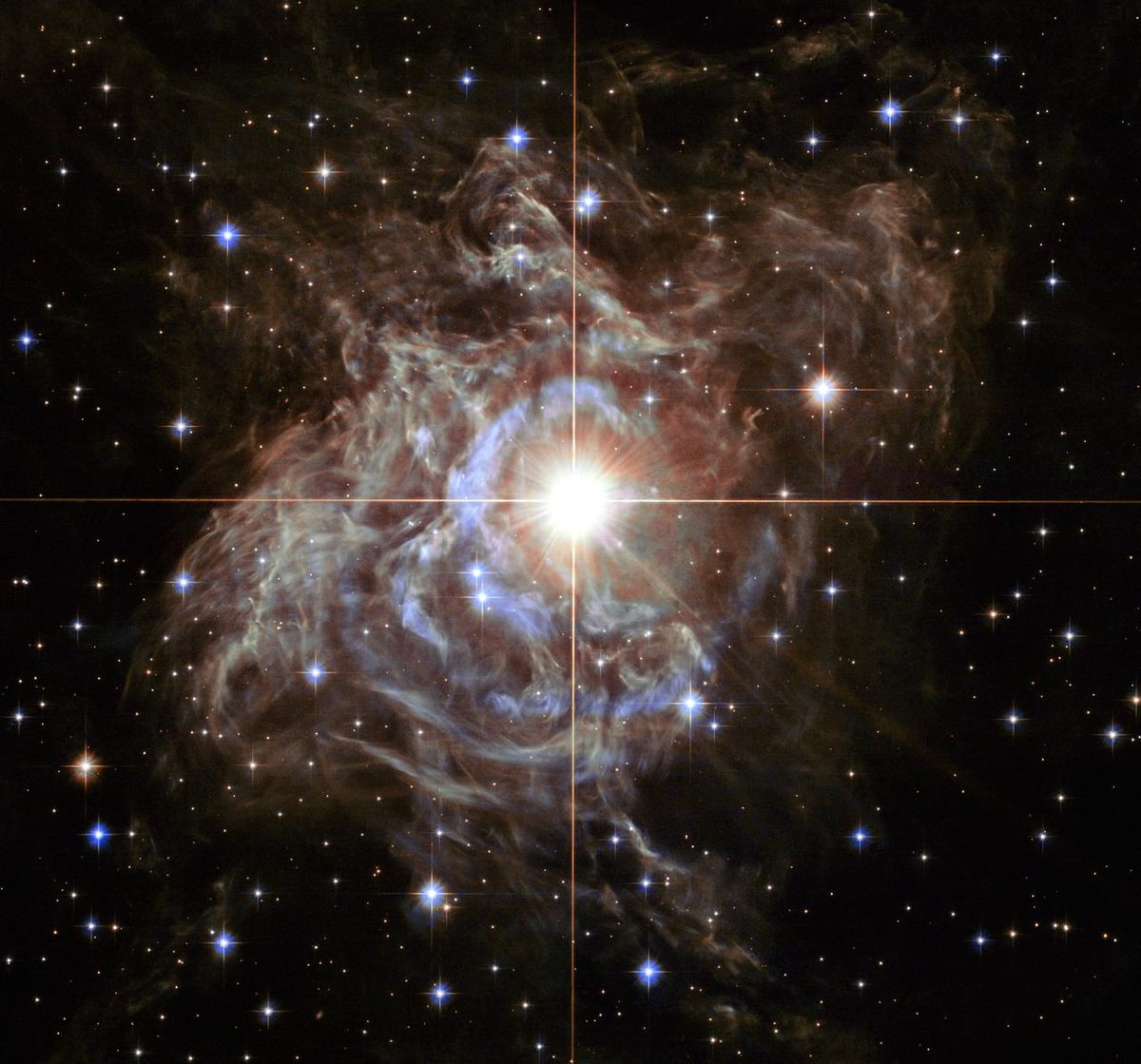
The first approach is called the cosmic distance ladder. It works from the ground up: astronomers calibrate distances to nearby stars using parallax, then use those calibrated distances to standardize the brightness of Cepheid variable stars, then use Cepheids to calibrate Type Ia supernovae, which are bright enough to be seen billions of light-years away. Each rung of this ladder extends the reach of the previous one. The Hubble Space Telescope Key Project pioneered this approach in the 1990s, and the SH0ES (Supernovae H0 for the Equation of State) collaboration has refined it to a remarkable degree. Their current best value, incorporating James Webb Space Telescope data published in 2023, sits at approximately 73 kilometers per second per megaparsec, with an uncertainty of about 1 percent.
The second approach runs in the opposite direction. Instead of measuring the universe as it is today, it models the universe as it was roughly 380,000 years after the Big Bang — the moment the cosmos cooled enough for hydrogen to form, releasing a flood of photons that we now detect as the cosmic microwave background (CMB). The patterns imprinted in that ancient light, analyzed in extraordinary detail by the Planck satellite, encode the geometry and contents of the early universe. Feed those parameters into the Standard Model of cosmology (the so-called ΛCDM model, for Lambda-Cold Dark Matter) and you get a predicted expansion rate. Planck's value: approximately 67.4 km/s/Mpc, also with roughly 1 percent uncertainty.
Sixty-seven versus seventy-three. A 6-kilometer-per-second-per-megaparsec gap that, at this level of precision, represents a roughly 5-sigma discrepancy — the threshold physicists typically require before declaring something statistically significant enough to call a discovery. The two measurements are not compatible. One or both must be wrong, or the standard model of cosmology is missing something.
Why neither side can simply concede
The natural first response to any such discrepancy is to look for systematic errors — miscalibrated instruments, flawed assumptions buried in the analysis, contamination from dust. This has been the dominant mode of the debate for nearly a decade, and it has produced exactly nothing. The JWST was in part hoped to reveal that the SH0ES Cepheid calibrations were off, perhaps because crowded stellar fields had fooled the Hubble Space Telescope's optical resolution. Instead, Webb confirmed the Hubble-era measurements. The Cepheid-based H₀ did not budge.
On the CMB side, alternative analyses of the Planck data using different statistical methods or different subsets of the frequency bands consistently return the same low value. The Atacama Cosmology Telescope (ACT) and the South Pole Telescope have produced independent CMB analyses that agree with Planck to high precision. The early-universe measurement is robust.
A third class of measurements has entered the contest as a tiebreaker. Baryon acoustic oscillations (BAOs) — the fossilized imprint of sound waves that rippled through the early universe before recombination — leave a characteristic scale in the large-scale distribution of galaxies that can serve as a "standard ruler." The DESI (Dark Energy Spectroscopic Instrument) collaboration released its first-year BAO results in 2024, combining galaxy surveys across billions of light-years. Their H₀ values tend to favor the lower, Planck-compatible range, which deepens the puzzle rather than resolving it: if both the CMB and BAO measurements cluster around 67–68, and the distance ladder consistently delivers 73, the problem is in the late universe specifically.
That geographic specificity is telling. The Hubble constant is not truly a constant — it describes the expansion rate at a given epoch. What appears to be a disagreement between two H₀ values may actually be a sign that the expansion rate has changed in ways the standard model does not predict. Something may have happened between the recombination era and today that ΛCDM doesn't account for.
The zoo of proposed explanations
Theoretical cosmologists have not been idle. The literature has accumulated dozens of proposed modifications to ΛCDM that could resolve the tension, and they range from the conservative to the genuinely exotic. Early dark energy models posit a brief period before recombination when an additional energy component accelerated expansion slightly, shrinking the sound horizon in the CMB and shifting Planck's inferred H₀ upward. Interacting dark matter models allow dark matter to exchange energy with dark radiation in the early universe, altering the growth of structure. Some proposals invoke a phase transition in the dark sector. Others suggest that dark energy — the component driving the current acceleration of expansion — is not a cosmological constant but a dynamical field that has evolved over time, with implications for late-universe expansion that a static Λ would miss.
The DESI BAO data, intriguingly, showed hints that dark energy may in fact be evolving — that the equation-of-state parameter w, which equals −1 for a pure cosmological constant, may be shifting. The statistical significance of that finding was not overwhelming (roughly 2–3 sigma), but it was enough to fuel serious theoretical attention. If dark energy is dynamical, the calibration chain that converts CMB observations into an H₀ prediction would need revision, potentially closing some of the gap.
None of these proposals has achieved consensus. Each resolves one tension while typically creating pressure elsewhere — on the matter power spectrum, on the S8 parameter describing the clumpiness of matter, or on other cosmological observables. The standard model is not merely straining at one seam; it may be straining at several, and the Hubble tension is the largest and most visible tear.
Why this is the right kind of problem to have
Physics advances when its best theories crack. The ultraviolet catastrophe that classical physics couldn't explain led to quantum mechanics. The failure to detect the luminiferous aether led to special relativity. Anomalies are not embarrassments — they are the productive edge of a discipline. The Hubble tension is that edge right now.
The coming years will be decisive. The Euclid space telescope, launched by ESA in 2023, is conducting a deep survey of galaxy shapes and clustering that will deliver high-precision BAO and weak gravitational lensing measurements over billions of light-years. The Vera C. Rubin Observatory, entering operations in Chile, will map billions of galaxies and identify thousands of Type Ia supernovae per year, providing an independent distance ladder with unprecedented statistical power. The Nancy Grace Roman Space Telescope, NASA's wide-field infrared mission, will add Cepheid calibrations in previously unreachable galaxies. If the tension persists through all of these, the case for new physics will become essentially undeniable.
It is worth sitting with that prospect for a moment. A 6-kilometer-per-second-per-megaparsec discrepancy — a number that sounds like a rounding error in everyday terms — may be telling us that the universe contains something we have never detected, never theorized in final form, and never imagined the shape of. The disagreement between two numbers is not a failure of cosmology. It is cosmology doing its job.
