
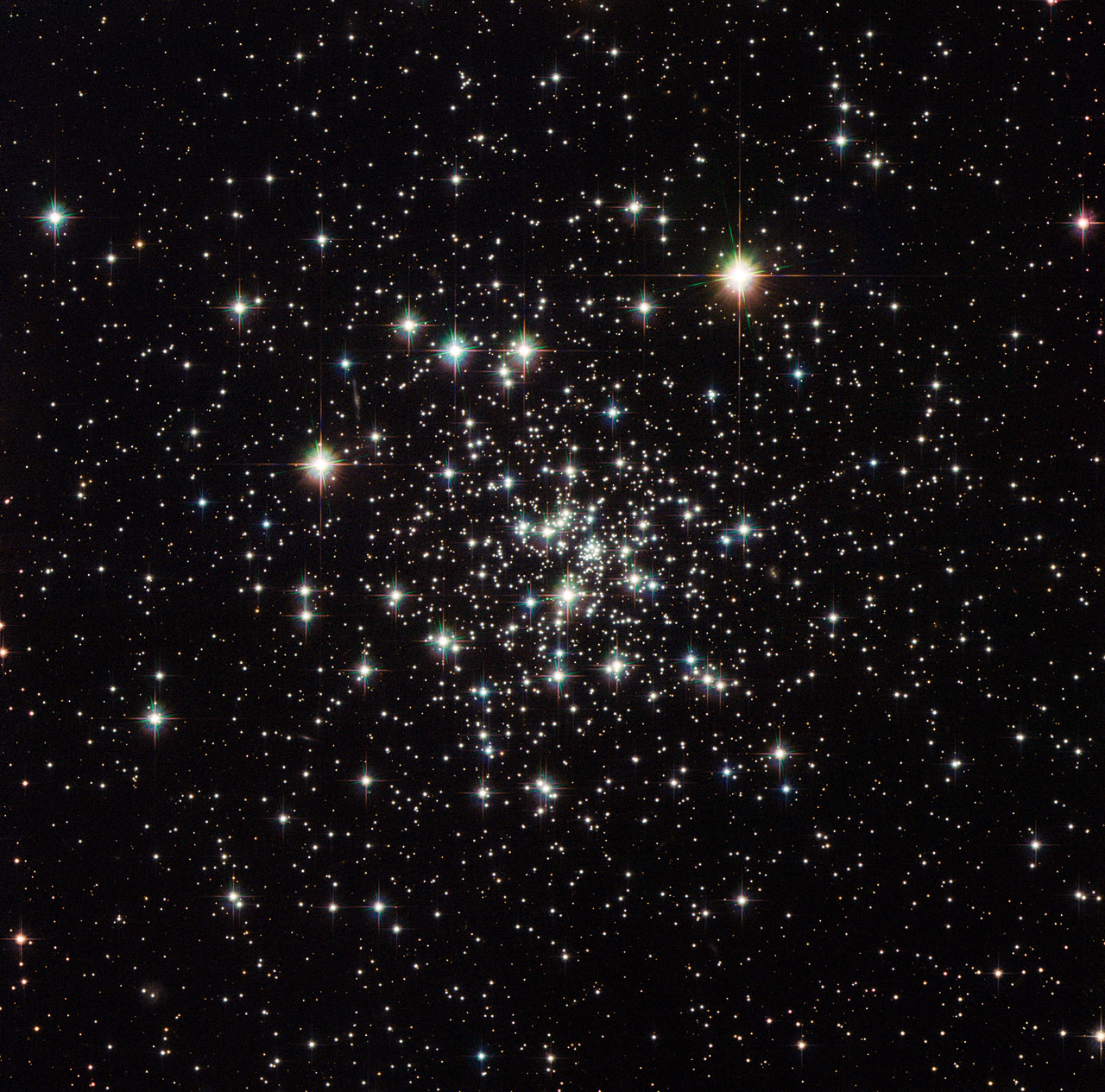
NASA marked the United States' 250th anniversary on July 4, 2026, the way it usually marks big occasions: with a telescope and a well-timed color palette. The agency released a set of images built around a red-white-and-blue color scheme, drawing on data from Hubble, Chandra, and Webb — three flagship observatories that don't often get billed together on the same poster. The centerpiece is a portrait of NGC 6426, a dim, ancient globular cluster in the Milky Way's outer halo, paired with a sweeping view of the much brighter Messier 3. Four new Chandra X-ray images rounded out the release.
It's a holiday gimmick with real science underneath it. The colors in the NGC 6426 image aren't decorative — they're a temperature map, and that map happens to reveal something genuinely interesting about how the cluster formed.
An Old, Overlooked Cluster Gets Its Close-Up
NGC 6426 is not one of the marquee names in the Milky Way's collection of roughly 150 known globular clusters. It's faint, it's distant, and it sits out in the galaxy's outer halo rather than in the crowded, more frequently imaged bulge. But its age is what makes it worth the exposure time: NASA dates the cluster at approximately 13 billion years old, putting its formation not far removed from the early universe itself. That makes NGC 6426 one of the Milky Way's oldest globular clusters, a fossil population that has been orbiting largely undisturbed since the Milky Way itself was still assembling.
Globular clusters like this one are prized by astronomers precisely because they're chemically simple in principle — tight, gravitationally bound balls of stars that mostly formed together, in one burst, from one reservoir of gas. NGC 6426's stars show the low metallicity — meaning a low abundance of elements heavier than hydrogen and helium — that's typical of clusters this old, since the gas that formed them hadn't yet been enriched by many generations of dying stars.
Except the "mostly formed together" part isn't quite the whole story here.
What the Colors Actually Show
The red-white-blue scheme applied to the Hubble image is a straightforward mapping of stellar temperature onto color: blue stars are hotter and shorter-wavelength emitters, red stars are cooler and longer-wavelength. That's not an artistic choice unique to this release — it echoes the same physics amateur astronomers use when they eyeball a star's color to guess its surface temperature — but pushing it toward a literal red/white/blue palette for the anniversary made an existing astrophysical signal easier to see at a glance.
And the signal is this: NASA reports evidence for two chemically distinct populations of stars within NGC 6426, indicating that a slightly younger, more metal-rich group of stars was enriched with material from the explosive deaths of the cluster's earlier stars. That's a well-documented phenomenon in globular cluster research generally, and it complicates the tidy picture of a cluster as a single-generation stellar family. The presence of two distinct populations within NGC 6426 is read as evidence of earlier supernova enrichment during the cluster's history — meaning the cluster wasn't simply a single burst of star formation from pristine gas. Some of its stars formed later, from gas that had already been seeded with heavier elements forged and scattered by earlier supernovae within the cluster's own history. The cluster carries a record of at least two chapters, not one.
Messier 3, for Scale
Alongside the NGC 6426 portrait, NASA released a companion wide view of Messier 3 (M3), an ancient globular cluster showing more than 500,000 stars in a single frame. M3 isn't new to astronomy — it's a frequent target precisely because it's bright and richly populated — but pairing it with the far dimmer NGC 6426 does useful work for a general audience: it's a visual reminder of just how faint and comparatively sparse NGC 6426 is, and how much effort it takes to resolve a cluster that old and that far out into individual, color-classified stars.
Three Telescopes, One Anniversary
The Hubble star-cluster images were the headline piece, but they weren't the whole release. According to reporting from Space.com, the anniversary imagery drew on contributions from Chandra and Webb as well, with four new Chandra X-ray images released alongside the Hubble portraits. Chandra sees in X-rays, tracing hot gas, stellar remnants, and high-energy phenomena that are invisible to Hubble's optical instruments or Webb's infrared ones; folding its data into the same red-white-blue framing let NASA build a multi-wavelength show under a single patriotic banner rather than three separate press releases.
That's a fairly elegant piece of outreach math: three telescopes that operate in different parts of the electromagnetic spectrum, each doing what it's built to do, assembled into one narrative for a single news cycle.
Why It Matters
Strip away the July 4th styling and NGC 6426 is a legitimate scientific target. Globular clusters are among the best-preserved records of the early universe available to observational astronomy — dense enough to have survived billions of years of galactic tidal forces largely intact, but old enough to encode conditions from close to the Milky Way's formation. Finding two chemically distinct populations within one cluster is part of a broader, ongoing puzzle in stellar astrophysics: multiple-population globular clusters are common enough that they've forced astronomers to abandon the simplest models of cluster formation and grapple with self-enrichment, multiple star-formation episodes, and the messy real history of how these systems came together.
There's also a more mundane but no less real value in an event like this: it's an easy, low-cost way to get real telescope data and real astrophysics in front of people who wouldn't otherwise click on a globular-cluster paper. A press release timed to a national holiday, wrapped in a familiar color scheme, is doing exactly what NASA's public-facing science communication is supposed to do — using a hook to deliver something scientifically substantive underneath it.
