
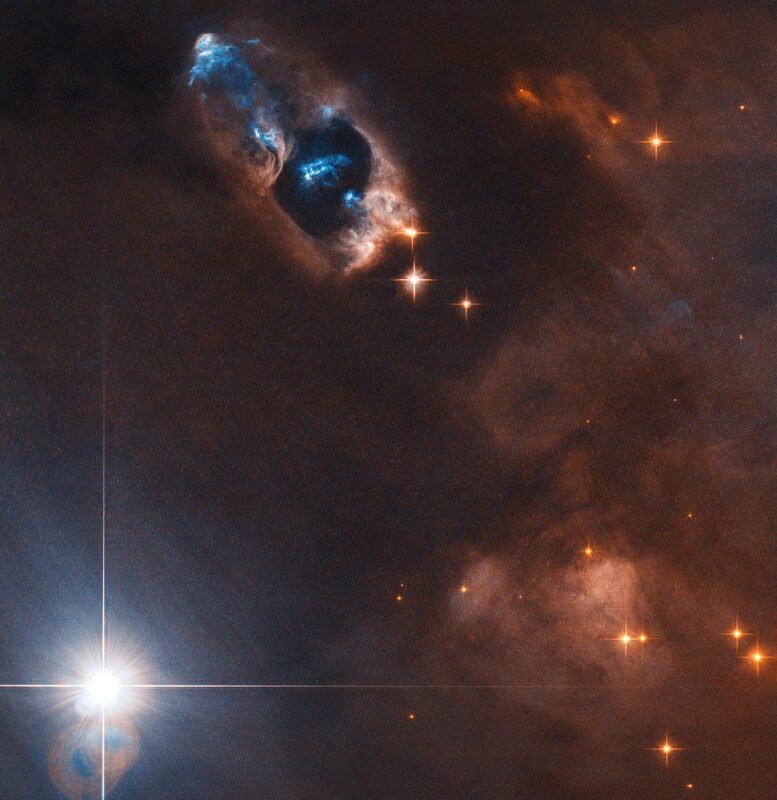
Stars are not supposed to eat neatly. That much has been suspected by astronomers for decades, but catching a young star mid-bite has always been difficult — protostars build up their mass while still wrapped in the dense, dusty envelope of gas they were born from, and that envelope blocks visible light almost completely. A new infrared image from the James Webb Space Telescope, released July 2, 2026, gives the idea its most direct visual support yet.
The target is FS Tau, a young multiple-star system about 450 light-years away in the Taurus-Auriga molecular cloud, one of the nearest and most closely studied stellar nurseries to Earth. The system's protostars are infants by stellar standards — somewhere between 1 million and 3 million years old, compared with the Sun's 4.6 billion years. Webb's near-infrared instruments cut straight through the dust that would otherwise hide the region entirely, and in doing so, exposed something researchers hadn't clearly seen before: gaps.
A Binary, a Loner, and a Trail of Broken Light
FS Tau is really two systems captured in one field of view. FS Tau A is a close binary pair — two young stars orbiting each other, together carrying only about half the mass of the Sun despite still being deep in their formative years. Some distance away sits FS Tau B, a single orange-hued protostar that is the one doing the interesting work in this image. FS Tau B is driving a pair of outflows — fast-moving streams of gas launched along the star's rotation axis that plow into the surrounding cloud and light it up.
Those outflows aren't smooth, continuous sheets of glowing gas, which is what a steadily accreting protostar would be expected to produce. Instead, Webb's image shows distinct gaps interrupting the outflow structure — segments where the emission drops off before picking up again farther out. According to NASA and the Space Telescope Science Institute, which released the image, those gaps are best explained not as jets that switched off and on, but as the visible trace of a star that fed in fits and starts.
Why Gaps Mean Bursts
The logic connecting a gap in an outflow to a pause in feeding comes down to timing. A protostar's outflows are powered by the same process that's dumping material onto the star itself: gas and dust spiraling in from a surrounding disk, funneled by magnetic fields, with some of it flung back out along the star's rotation axis rather than landing on the surface. If the accretion rate onto the star were constant, the outflow should be a continuous stream. If instead the star accretes in bursts — brief, intense episodes of infall separated by quieter lulls — each burst launches its own pulse of outflowing gas, and those pulses travel outward at different speeds and times, arriving as separated clumps rather than an unbroken sheet.
That's essentially what the FS Tau B image shows: interruptions consistent with separate ejection events rather than one steady exhaust. It's indirect evidence, read from the aftermath rather than caught in the act, but it's a rare visual counterpart to a mechanism astronomers have inferred for years from other, less direct observational signs, including the fact that protostars as a population are dimmer, on average, than steady accretion would predict.
An Old Question, Newly Sharpened
Episodic accretion has been a leading, if unresolved, idea in star-formation theory for a while now. It offers a tidy explanation for something that has puzzled modelers: protostars appear to spend much of their observed lives accreting more slowly, on average, than models predict they need to in order to build up their final mass in the time available. If most of the mass instead arrives during short, intense bursts — separated by long quiet stretches where the star is accreting only modestly — the discrepancy resolves itself. The star spends most of its youth in the "quiet" state, occasionally punctuated by a growth spurt.
What Webb offers here isn't proof of the mechanism behind those bursts, which remains debated — instability in the inner disk, gravitational interactions with a binary companion, or clumps of material funneled inward by magnetic fields are all candidates. What the FS Tau image adds is a concrete, visible record of the bursts' consequences, preserved in the structure of the outflow itself, in a system close enough and clear enough for Webb to resolve the detail.
The image also does what Webb infrared images of star-forming regions tend to do as a matter of course: it shows what visible light misses entirely. The dust enshrouding FS Tau is opaque enough that the system is essentially invisible to optical telescopes, and background galaxies dotting the deep sky further behind the cloud show up cleanly in Webb's field, an incidental reminder of how much dust stands between us and this stage of stellar life.
Why It Matters
How stars acquire their final mass shapes practically everything that follows — the mass of the star determines its temperature, lifespan, and eventual fate, and the process happening in the surrounding disk simultaneously seeds the material that becomes planets. If accretion really is dominated by short bursts rather than steady infall, it means a star's growth curve, and possibly the architecture of any planets forming around it, is punctuated by violent, relatively brief events rather than proceeding gradually. Confirming episodic accretion with direct structural evidence, rather than only indirect brightness variations, gives modelers a physical yardstick to test their theories against, and gives astronomers one more nearby, well-resolved example to study as Webb continues to turn its infrared eye on the dustiest, most hidden stages of stellar birth.
Sources
- NASA's Webb Reveals Stars Sparking to Life in Cosmic Celebration
- Cosmic fireworks as infant stars celebrate their independence in stunning JWST photo — Space.com
- Outflow Gaps in Webb's FS Tau Image Reveal Stars Grow in Episodic Bursts — Tech Times
- NASA's Webb Reveals Stars Sparking to Life in Cosmic Celebration — Newswise
