
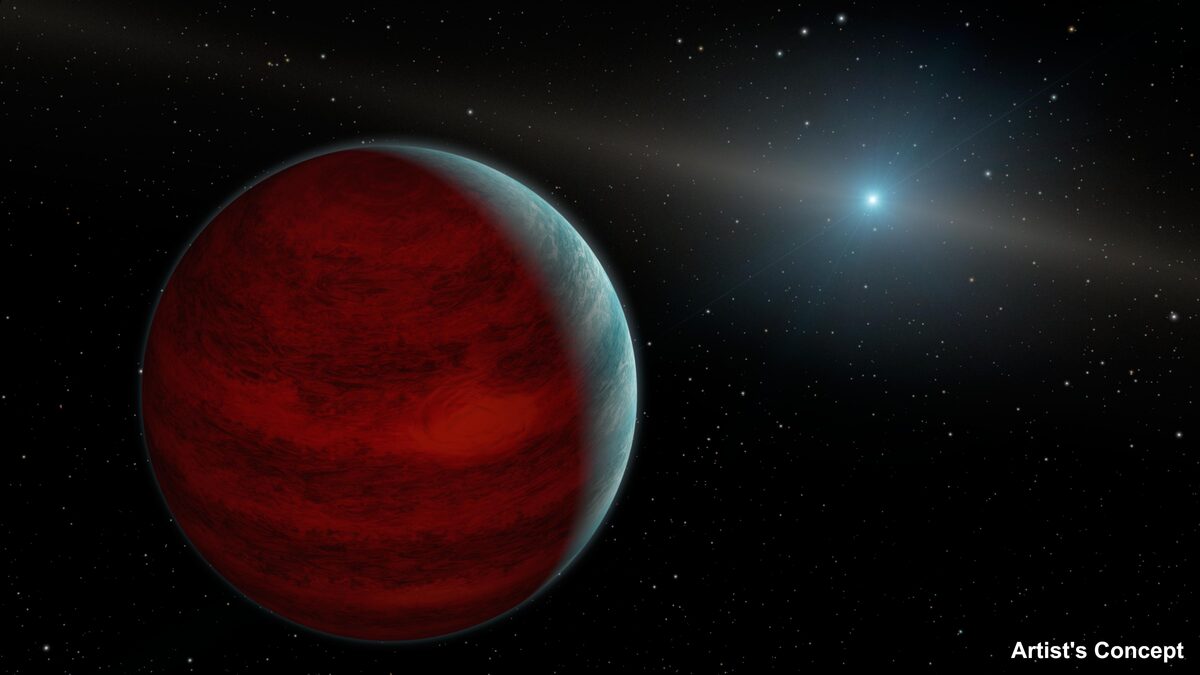
Roughly five billion years from now, the Sun will swell into a red giant, shed its outer layers, and collapse into a white dwarf — an Earth-sized ember of degenerate matter slowly cooling in the dark. What happens to the planets that survive that ordeal has mostly been a matter of theory. Now astronomers have a real example to study, and it's stranger than most models predicted.
Using the James Webb Space Telescope, an international team led by Ryan MacDonald of the University of St. Andrews has detected methane, hydrocarbon haze, and thermal emission in the atmosphere of WD 1856 b, a Jupiter-sized planet locked in a 34-hour orbit around the white dwarf WD 1856+534. It is the first time astronomers have confirmed an atmosphere on any planet transiting a dead star. The findings were published July 1 in Nature.
"We saw the telltale signatures of small cloud particles and hydrocarbons, most likely methane, which is the first time we have seen an atmosphere on a planet transiting a dead star," said co-author Victoria Boehm, describing a result that both confirms the planet held onto a thick, chemically active atmosphere and raises a harder question: how did it get so close to its star's corpse in the first place?
A planet that shouldn't be there
WD 1856 b was first flagged in 2020 by NASA's TESS mission and confirmed with the Spitzer Space Telescope, but those observations could only establish its size and orbit — not what it was made of. The planet sits about 80 light-years from Earth (roughly 25 parsecs, per the Nature paper) and is genuinely bizarre by orbital-mechanics standards: it circles its star roughly 50 times closer than Earth orbits the Sun, completing a full year in just 34 hours. Despite its Jupiter-like diameter — about seven times the width of its tiny host star — the planet weighs in at 4 to 11 Jupiter masses.
None of that should be possible if the planet had always occupied that orbit. When a Sun-like star dies, it expands into a red giant first, and anything orbiting as closely as WD 1856 b now does would have been engulfed and destroyed long before the star ever became a white dwarf. So the planet must have arrived after the fact.
The system itself is old — about 9.4 billion years, according to the Nature paper — and the leading model described in that paper holds that WD 1856 b started out on a much wider orbit and migrated inward sometime between 3 and 5.5 billion years after its star died. That migration, likely driven by gravitational interactions with other bodies in the system, would have generated significant frictional heating, which helps explain a temperature the JWST team didn't expect: about 260°F (126°C), warmer than a planet parked that far from a cooling white-dwarf ember has any obvious right to be.
What JWST actually saw
The detection itself is a technical feat as much as a scientific one. As WD 1856 b passed in front of its white dwarf, JWST's NIRSpec instrument, operating in PRISM mode, captured the faint fingerprint of starlight filtering through the planet's atmosphere — a technique called transmission spectroscopy. Because the host is a white dwarf rather than a full-sized star, the geometry is unusually favorable: the planet blocks a much larger fraction of the tiny stellar disk during transit than it would passing in front of a Sun-like star, making subtle atmospheric signals easier to tease out.
That data revealed two things layered together: absorption features consistent with methane and small aerosol particles — the hydrocarbon haze — plus a nightside thermal glow, the planet's own heat leaking out from its dark side. The mix of methane and haze is reminiscent of Saturn's moon Titan, giving WD 1856 b what the research team has described as a Titan-like coloration, though scaled up to a world the size of Jupiter and cooked by proximity to a stellar remnant.
Why It Matters
White dwarfs are the fate awaiting the vast majority of stars, including the Sun. What survives around them — and in what condition — is a direct preview of the far future of planetary systems like our own. Until now, that future was sketched almost entirely from theory: models of tidal disruption, debris disks, and the occasional white dwarf whose spectrum showed it was slowly consuming the shredded remains of asteroids or planets it had torn apart.
WD 1856 b changes that. It's not debris — it's an intact, atmosphere-bearing planet that has demonstrably lived through its star's death and, on top of that, migrated into a much tighter orbit afterward. That combination tells researchers that giant planets can survive the trauma of stellar death, retain complex, chemically rich atmospheres, and later get rearranged by dynamical interactions with whatever else is left in the system. For a solar system that will one day leave behind a white dwarf Sun with Jupiter, Saturn, and their moons still in the picture, this is the closest thing astronomers have to a real-world case study of what might come next — including the possibility that a giant planet could still end up parked uncomfortably close to what remains of its star, heated not by starlight but by its own violent migration.
It's also a proof of concept for the observational method: catching atmospheric chemistry on a planet transiting a white dwarf is difficult and had never been done before. Now that it has, WD 1856 b becomes a template for searching other white dwarf systems for surviving planets — and for reading their atmospheres as clues to a chapter of stellar and planetary life that, until this month, existed mostly on paper.
