
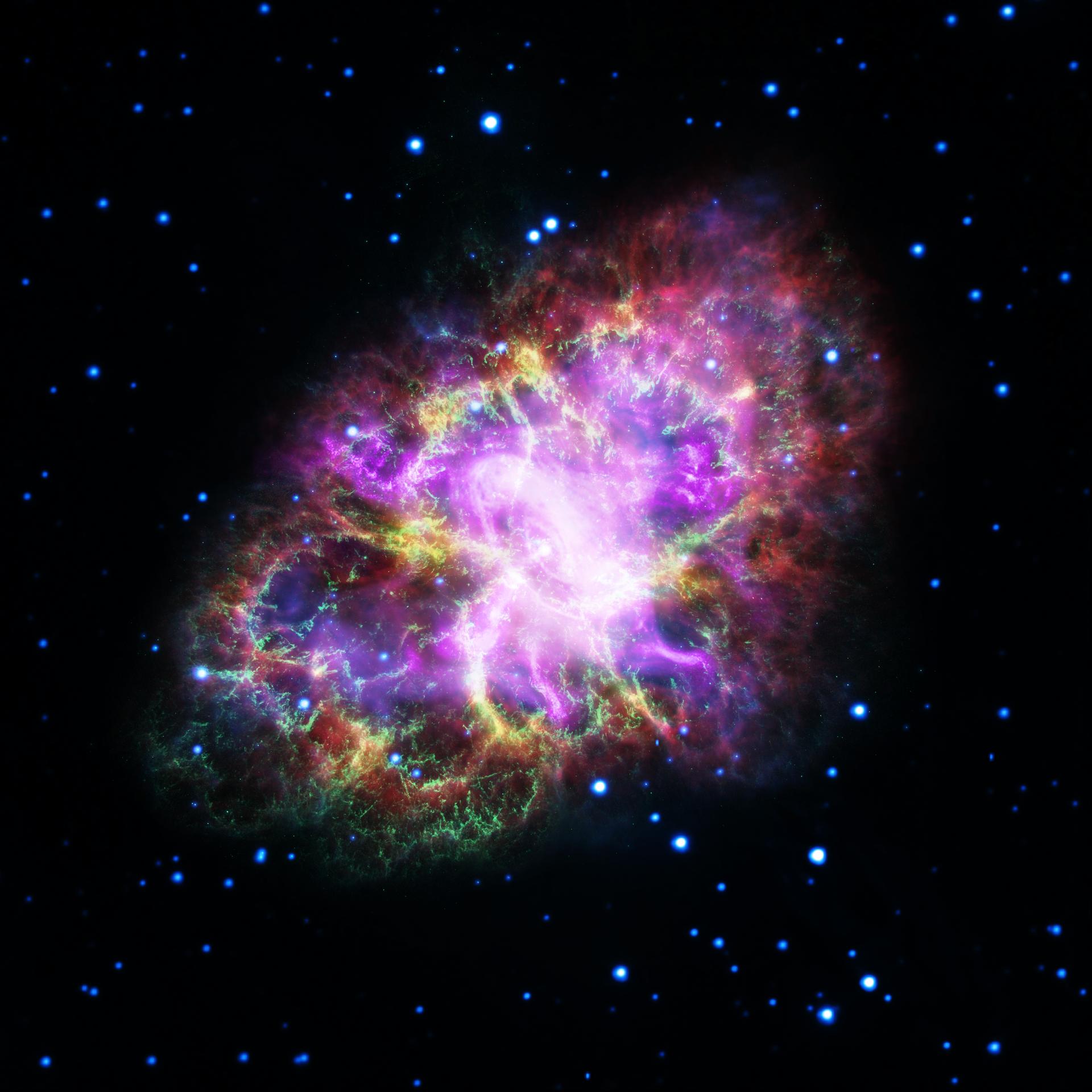
Fireworks are a one-night affair. NASA's contribution to America's 250th birthday is built to last a bit longer. On June 30, 2026, the agency released a set of four composite images — plus three accompanying sound translations — that layer data from three of its flagship observatories into red-white-and-blue portraits of the cosmos, timed to circulate through the July 4 holiday.
The project is a joint production of the Chandra X-ray Observatory, the James Webb Space Telescope, the Hubble Space Telescope, and ground-based observatories. Each instrument sees a different slice of the electromagnetic spectrum, and rather than picking one, NASA stacked them, assigning colors to X-ray, infrared, ultraviolet and optical light so the layers resolve into a single image. The result, as Space.com's Brett Tingley put it in a July 1 writeup, reads like "gorgeous cosmic fireworks" — though the science underneath is considerably more durable than a Roman candle.
What's in the Collection
The four targets span an enormous range of cosmic scale and subject matter:
Cassiopeia A, the wreckage of an exploded star, gets the most detailed treatment. Chandra's X-ray data appears in blue and purple, tracing the supernova's outward-racing blast wave, while Webb's infrared observations show up in red and white. Together they map where heavier elements forged in the explosion — iron, calcium, oxygen — now sit within the expanding debris field.
NGC 3603, a dense star-forming nebula, combines Chandra X-ray data (rendered in red and white) with Hubble's optical, infrared and ultraviolet observations. The region is a stellar nursery packed with young, massive stars whose radiation and winds carve the surrounding gas — and whose X-ray emission Chandra alone can pick out from the crowd.
M94 (also cataloged as NGC 4736), a nearby spiral galaxy, pairs Chandra X-ray data — shown here in red, orange and blue — with ground-based visible-light imaging, giving a sense of how energetic, X-ray-bright phenomena are distributed across a full galactic disk.
And ZwCl 0024+1652, a distant galaxy cluster, rounds out the set as the odds-on cosmological heavyweight of the group: NASA's release describes it as showing evidence of dark matter, identified using specially processed Hubble imaging, alongside Chandra X-ray data showing the cluster's superheated gas alone outweighs all of its visible galaxies combined — the kind of mass mismatch that points to invisible matter at cluster scale.
Sound, Not Just Sight
The Chandra X-ray Center, which hosts the full "Red, White, and Blue Collection" on its own photo album at chandra.harvard.edu, didn't stop at images. The release, also dated June 30, 2026, includes three data sonifications — translations of the imaging data into sound, a technique Chandra's team has used on past releases to render astronomical data accessible to blind and low-vision audiences, and to give sighted audiences a different way to experience the same underlying measurements.
Why It Matters
It's tempting to file this under "nice picture, happy birthday," and there's no pretending the red-white-and-blue color scheme is a rigorous scientific choice rather than a calendar-driven one. But the underlying technique — combining X-ray, infrared, ultraviolet and optical data into a single multiwavelength composite — is exactly how working astronomers actually study these objects, holiday or not.
A supernova remnant like Cassiopeia A looks like a static blob in visible light alone. Add Chandra's X-ray view of its blast wave and Webb's infrared read on where the newly forged elements have ended up, and it becomes a timeline: an explosion still playing out, element by element, long after the initial blast. A galaxy cluster like ZwCl 0024+1652 looks like an unremarkable smear of light in any single band; it's only by combining what's visible with what has to be inferred gravitationally that its dark matter content becomes legible at all. Multiwavelength astronomy isn't decoration on top of the science — for objects like these, it largely is the science.
The sonifications matter for a related reason: they're a reminder that "data" and "image" aren't synonyms. An image is one representation of a dataset, chosen for eyes that see in visible light; sound is another, and for audiences who can't use the first, it isn't a consolation prize — it's an equally legitimate way in.
There's also a simpler point worth making about timing. NASA didn't manufacture new data for a birthday — it repackaged the ongoing, unglamorous work of three space telescopes and a network of ground-based observatories into a form that fits a national holiday news cycle. That's a fair trade: real science gets a wider audience for a week, and the audience gets a genuine look at how astronomers actually build these images, rather than a synthetic photo-op.
The Fine Print
None of the four images is a single exposure. Each is a stack of separate observations — sometimes from instruments studying the same object years or decades apart — reprocessed and color-mapped so the layers register against each other. That's standard practice for Chandra, Hubble and Webb releases generally, holiday-themed or not; the "red, white and blue" framing here is a curatorial choice about which existing datasets to feature and how to color-map them, not a claim that the universe is patriotically tinted.
Worth noting, too: NASA's own numbering and color assignments differ slightly object to object — Cassiopeia A pairs Chandra-blue with Webb-red, while NGC 3603 and M94 pair Chandra with Hubble or ground-based optical data instead. That's a reflection of which telescopes have actually pointed at which targets, not an inconsistency in method.
The full collection, along with the sonifications, remains available on the Chandra X-ray Center's site, and NASA's own science pages carry the same release with additional background on each object.
