
Ejnar Hertzsprung, a Danish chemical engineer turned astronomer, published a pair of papers in 1905 and 1907 in a photographic journal that most astronomers did not read. Henry Norris Russell, a Princeton astrophysicist, presented the same relationship at a 1913 meeting of the Royal Astronomical Society, in a graph that became immediately famous. Both had noticed that when you plot the intrinsic brightness of a star against its color — or equivalently, its temperature — the stars do not scatter randomly. They organize into distinct patterns. Most stars fall along a diagonal band. Others cluster at predictable locations away from it. The diagram that bears both their names is not merely a classification scheme; it is a snapshot of stellar evolution, a lifecycle chart written in light.
The diagonal band is called the main sequence. It runs from cool, faint red stars at the lower right to hot, luminous blue stars at the upper left. The band is where stars spend most of their lives, burning hydrogen into helium in their cores. A star's position on the main sequence is determined almost entirely by its mass: more massive stars are hotter, bluer, and far more luminous. The mass-luminosity relationship is steep — a star ten times the mass of the Sun is roughly 3,000 times more luminous — which means that massive stars burn their fuel so fast they live for only a few million years, while the Sun will last about 10 billion and the smallest red dwarfs will burn for trillions.
Beyond the main sequence
Stars do not stay on the main sequence forever. When hydrogen in the core is exhausted, the core contracts and the outer layers expand. The star grows larger and cooler on the surface while its luminosity increases — it becomes a red giant or, for the most massive stars, a red supergiant. On the HR diagram, these stars appear in the upper right: high luminosity, low temperature. The upper right branch is called the giant branch or, in its evolved form, the asymptotic giant branch. After this phase, low- and intermediate-mass stars (including the Sun) shed their outer layers as a planetary nebula, leaving behind a white dwarf — a hot, compact remnant that cools slowly over billions of years. White dwarfs appear at the lower left of the HR diagram: high temperature but low luminosity, small and faint. Massive stars end their lives explosively, as core-collapse supernovae, leaving neutron stars or black holes.
The HR diagram also contains a region called the instability strip, a diagonal band crossing the giant branch at intermediate temperatures where certain types of pulsating stars — Cepheid variables and RR Lyrae stars — reside. Stars in the instability strip undergo periodic brightness variations driven by opacity changes in their outer layers; as the layers heat up, they become more opaque and trap radiation, expanding the star; as they cool, they become transparent, contracting it. The resulting pulsation period is directly related to the star's luminosity — a relationship discovered by Henrietta Swan Leavitt in 1912 that became the first rung of the cosmic distance ladder.
What the diagram reveals about stellar populations
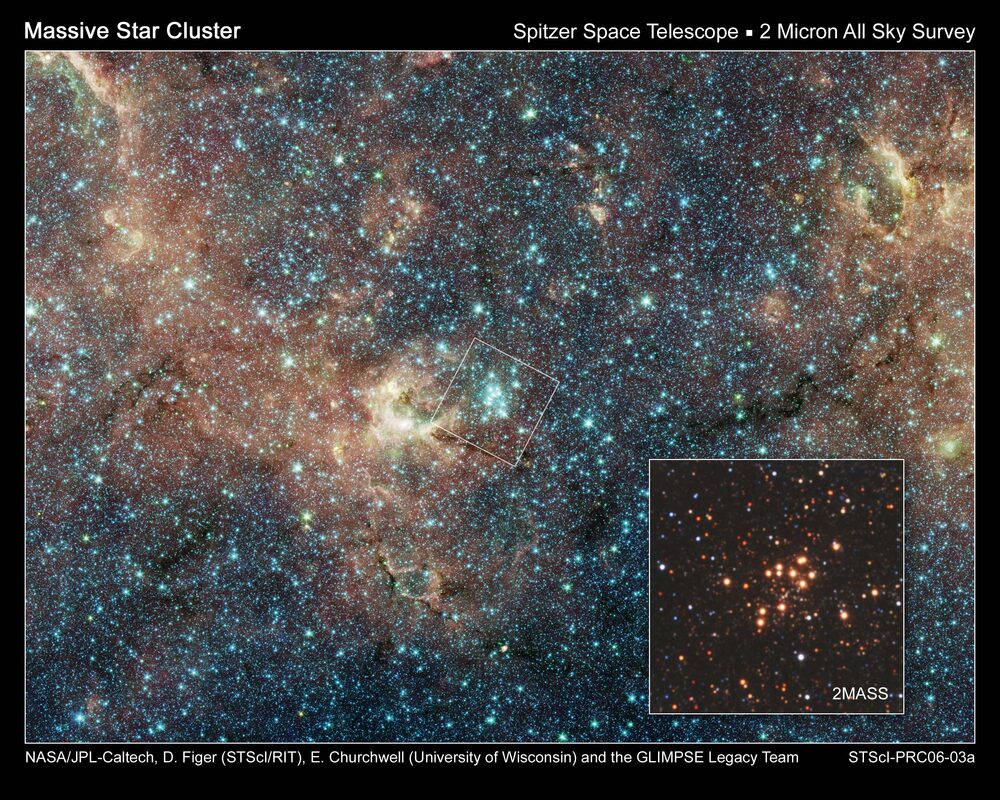
Star clusters display HR diagrams that reveal their ages. A young cluster shows a full main sequence; an old cluster has a turnoff point where the upper main sequence has evolved away into giants, because the most massive stars have already died. The position of the main sequence turnoff is a direct measure of the cluster's age. This technique — isochrone fitting — is one of the primary methods for dating stellar populations, calibrating the ages of ancient globular clusters, and anchoring the cosmic time scale. The most ancient globular clusters are 12 to 13 billion years old — consistent with a universe that formed 13.8 billion years ago. Two men with a simple diagram established one of astronomy's most powerful tools, and it has not stopped being useful since.
