
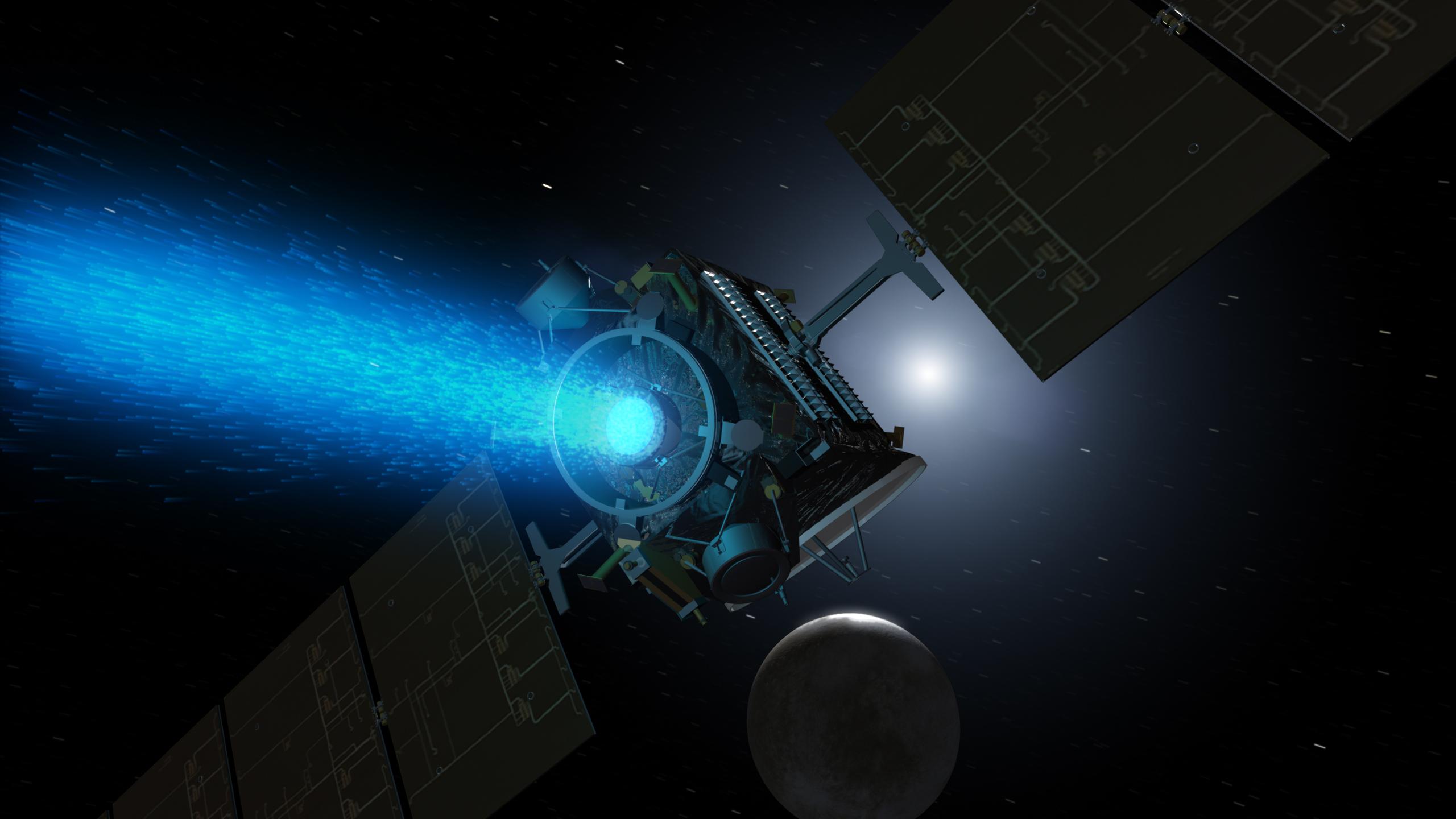
When a flotilla of spacecraft raced past Halley's Comet in 1986 — Giotto, the two Vega probes, Sakigake and Suisei — each encounter lasted a matter of hours. The comet was moving one way, the spacecraft the other, and physics gave nobody a say in the matter. Seventy-five years later, when Halley comes back around the Sun in 2061, a team of Italian aerospace researchers wants a rerun with a very different ending: a spacecraft that arrives early, matches the comet's pace, and simply stays.
A trajectory-design study posted to arXiv on September 2, 2026, and covered by Universe Today on September 8, lays out how that could actually be done. The paper, from Roberto Flores, Alessandro Beolchi, Chiara Pozzi, Mauro Pontani, Ivano Bertini, Cesare Barbieri and Elena Fantino, proposes a route built from two unpowered gravity assists — one at Jupiter, one at Saturn — stitched together with deep-space low-thrust propulsion. The authors call it "the first rendezvous mission concept achievable with well-proven technology," meaning it leans on hardware that has already flown: standard radioisotope thermoelectric generators (RTGs) for power and a Hall-effect thruster for propulsion, rather than anything still on a drawing board.
Why a Flyby Isn't Good Enough Anymore
Halley is not an easy target. Its orbit runs retrograde — backward relative to the planets — and is tilted 162 degrees from the plane the rest of the solar system roughly shares. A flyby mission can punch through that geometry at high relative speed and grab data for a few hours, which is exactly what happened in 1986. Matching orbits with the comet is a different problem entirely, and Universe Today's write-up of the new paper acknowledges that, for precisely that reason, "getting there will still not be easy."
The payoff for solving it is substantial. As the Universe Today piece puts it, "the spacecraft itself could stay in the vicinity for months, rather than hours, allowing planetary scientists to get close-up data." Months of proximity means watching the nucleus wake up as it approaches the Sun — tracking outgassing, dust production, and surface change in a way no flyby ever could.
The Route: Two Planets, No Fuel, Then an Ion Engine
The trick to reaching Halley without an enormous fuel budget is to let Jupiter and Saturn do the work of bending the trajectory, essentially for free. Both gravity assists in the new design are unpowered — the spacecraft doesn't burn propellant during the flybys themselves, it just uses the planets' gravity to reshape its path. The propulsion budget instead goes into deep-space low-thrust arcs: long, gentle burns from a Hall-effect thruster that gradually shape the orbit into something that can match Halley's rather than just cross it.
According to Universe Today's account of the paper, the study identifies optimal launch windows around August 2036 and September 2037, with rendezvous expected around 2060 — about a year before Halley's perihelion — following a transit of more than 20 years. That is not a typo: a two-decade-plus cruise is the price of reaching a retrograde, steeply inclined target using assists and low thrust instead of a much larger, more expensive propulsion system.
The spacecraft in the paper's proof-of-concept designs would weigh around 2,000 kg including propellant, carrying a 750 kg science payload — sized, the authors argue, to fit within existing launch vehicle capabilities rather than requiring something new. The mission is also explicitly timed to arrive before the comet's high-activity phase kicks in, so instruments can characterize Halley's nucleus and surroundings as they wake up rather than showing up to a coma already in full bloom.
Building on Earlier Work
This isn't the first pass at the problem from this group. Astrobiology.com's coverage points to an earlier, related paper (arXiv:2502.12816) from an overlapping author team — Barbieri, Beolchi, Bertini, Fantino, Flores, Pozzi and others — that sketched a related concept called "Case Jupiter 1," using a single Jupiter gravity assist to reach the comet beyond Saturn's distance, before water-ice sublimation begins around 4 AU from the Sun. That earlier design deliberately went without solar panels, so the spacecraft could survive and operate inside Halley's dusty coma without arrays to damage or clean. It also flagged a closing window: launching before 2040 — "less than 15 years from now," in that paper's own framing — to maximize the mission's scientific return, rather than an absolute cutoff below which rendezvous becomes impossible.
The new double-gravity-assist paper effectively builds a second, more refined route on top of that groundwork, trading a single Jupiter flyby for a Jupiter-and-Saturn combination paired with low-thrust arcs — the two proof-of-concept trajectories the authors present are meant to demonstrate feasibility, not lock in a final design.
Why It Matters
Halley's Comet is the best-studied comet in history and also one of the least understood at close range, because every previous close look was over before real science could get past the "hello." A rendezvous mission would let researchers watch a Halley-class comet nucleus transition from dormant to active over months, rather than inferring that process from a blur of flyby images and models. That matters for understanding what comets are actually made of, how they lose mass as they approach the Sun, and by extension what the early solar system's building blocks looked like before planets swept most of them up.
It also matters as a case study in mission planning under a hard deadline nature sets, not an agency. Halley returns to the inner solar system on its own schedule regardless of budget cycles, and the trajectories described in the new paper require launch by the late 2030s and a cruise of 20-plus years to make the 2061 date. If a real mission is going to fly, the authors' emphasis on using only flight-proven RTGs and a Hall-effect thruster is a pointed argument: this doesn't require a technology breakthrough, it requires a decision — and the runway to build, launch, and fly for two decades before the comet shows up is already shrinking. Miss the mid-2030s launch windows the paper identifies, and there may not be another realistic shot before 2061.
