
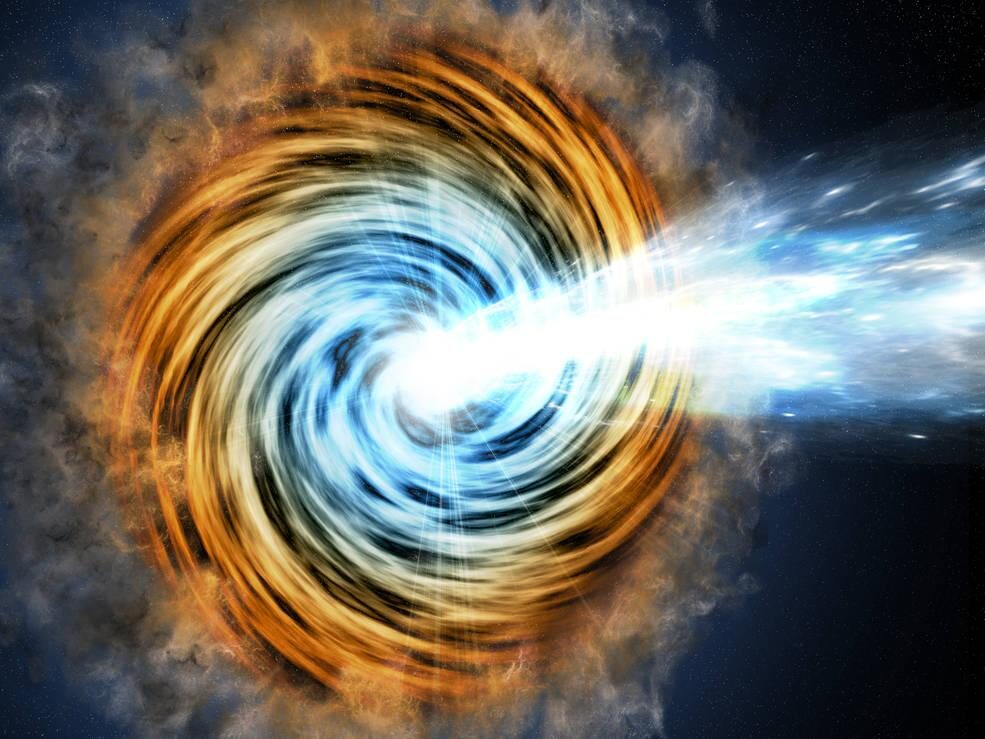
Black holes that feed on a companion star sometimes throw out discrete blobs of plasma, called jet ejections, which show up as sudden flares in radio telescopes. Astronomers usually spot them after they have already happened. Toshihiro Kawaguchi of the University of Toyama and Kazutaka Yamaoka of Nagoya University think that can change. In a paper published in The Astrophysical Journal on November 5, 2026, they report that the X-ray behavior of these systems changes in a consistent way days before a jet appears. They suggest using those changes to put out a "jet forecast."
The paper is titled "Jet Forecast: Timing of Discrete Jet Ejections of Stellar-mass Black Holes Anticipated via X-Ray Properties." The preprint was posted to arXiv on September 28, 2026, under high-energy astrophysics and plasma physics. It runs 12 pages with four figures. Universe Today covered the work on November 12.
From one black hole to four
The new paper extends a 2025 study of a single system, XTE J1859+226, which the authors examined during its 1999-2000 outburst. That earlier work hinted that the X-rays changed in a recognizable way before the jets launched. The obvious question was whether this was a quirk of one black hole or a general pattern.
To find out, Kawaguchi and Yamaoka added three more stellar-mass black hole binaries: XTE J1550-564, GX 339-4, and MAXI J1820+070. For each one they examined X-ray and radio data, following two X-ray quantities and lining them up against when jets appeared.
The first quantity is the inner disk radius, Rin. This is the distance from the black hole at which the hot accretion disk appears to end. The second is the rms variability, a measure of how strongly the X-ray brightness flickers. According to the abstract, jets are launched when Rin rapidly approaches the ISCO, the innermost stable circular orbit. Inside that point, matter can no longer orbit stably and plunges toward the black hole.
The result was consistent across all four. "All the four sources turned out to show the precursors of jet ejections (drops in Rin and rms) 1-10 days before radio activities," the authors write. In every system, ahead of the jet activity, the disk's inner edge moved inward and the X-ray flicker died down.
What did not happen
The things the authors did not find are just as interesting. A simple way to picture a jet launch is a sudden surge of matter falling onto the black hole, with the excess thrown back out. If that were how it worked, the accretion rate should jump just before each ejection.
The data do not show that. The paper reports no huge jumps in accretion rate before the ejections. XTE J1859+226 showed a hint of an enhancement of roughly 20 percent just before its jets. Universe Today notes that this is only a hint and that better observations are needed. Across the outburst, the accretion rate in that system was decaying exponentially, with an e-folding time of about 30 days. That means it dropped by a factor of e roughly every month. The jets appeared while the supply of matter was slowly shrinking.
The authors also checked whether these systems were accreting above the Eddington limit, the threshold balanced between the inward pull of gravity and the outward push of radiation. Some jet models depend on that extreme regime. But two of the four systems, XTE J1859+226 and MAXI J1820+070, launched jets while accreting below the Eddington limit.
From this, Kawaguchi and Yamaoka conclude that jet models which need either a boost in accretion or super-Eddington rates are unlikely. The trigger seems to be tied to the geometry of the inner disk, specifically its edge moving in toward the ISCO, rather than a burst in the amount of fuel.
How a forecast would work
The practical proposal is simple. If an X-ray monitor sees both Rin and rms variability keep falling, and Rin is about to reach the ISCO, the authors suggest circulating alerts as a "jet forecast." Radio and other observatories could then schedule Target-of-Opportunity observations, the short-notice requests that let telescopes break from their planned schedules for a transient event.
A lead time of one to ten days is a wide window, but it matters. The paper notes that it is unforeseeable when a jet will emerge, so dense data around the moment of ejection have been gathered only in rare cases. Even a rough warning would give facilities time to point at a source before the ejection rather than after. Kawaguchi said such a forecast would let astronomers concentrate observing facilities on the expected timing of jet ejections, speeding up understanding of jet physics.
Why It Matters
Jets shape their surroundings, and how they are launched is still an open question. Stellar-mass black hole binaries are useful laboratories because their outbursts and jet ejections unfold over days and weeks, which makes it possible to follow several events in a single system. If a reliable X-ray signal comes before ejection, it serves two purposes at once.
First, it is a physical clue. It points toward the inner disk's position as the trigger and argues against models that rely on accretion surges or super-Eddington flows. Second, it is an operational tool. It could turn jet launches from events astronomers find afterward into events they can plan for, so instruments are already watching when the ejection begins.
There are limits. The sample is four systems. The accretion-rate result for XTE J1859+226 is only a hint, not a firm measurement. The forecast idea also depends on X-ray monitoring good enough to track Rin and rms as an outburst unfolds. The real test will come when the method is used on an outburst as it happens, and a jet either shows up within the forecast window or does not.
Sources
- Jet Forecast: Timing of Discrete Jet Ejections of Stellar-mass Black Holes Anticipated via X-Ray Properties (The Astrophysical Journal)
- arXiv:2609.34947, Jet Forecast: Timing of Discrete Jet Ejections of Stellar-Mass Black Holes
- Astrophysicists Want to Forecast When a Black Hole Launches Its Jets (Universe Today)
