
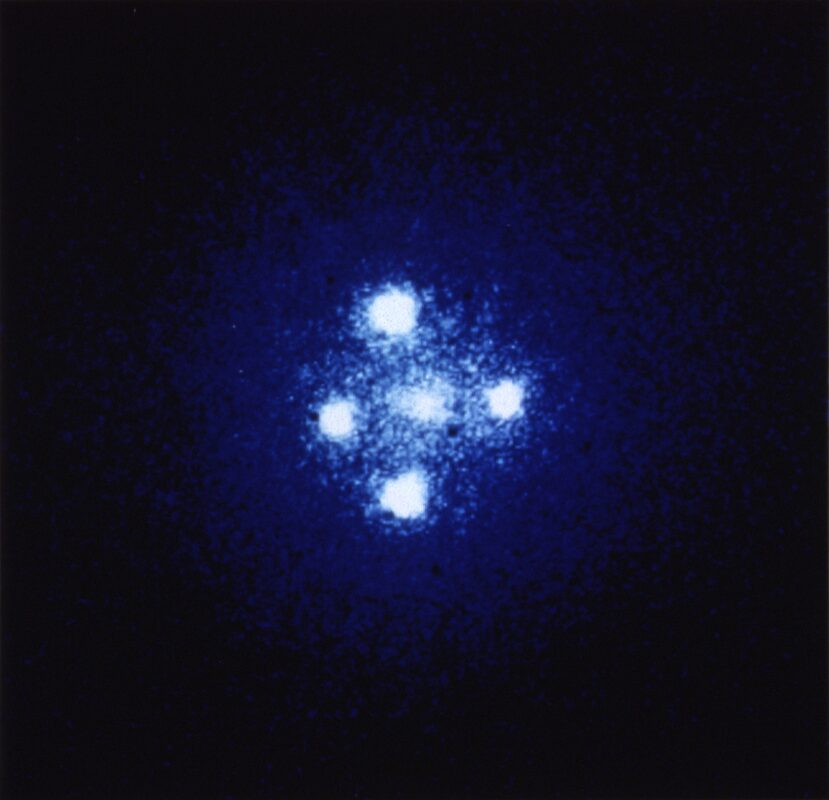
In 1919, Arthur Eddington sailed to the island of Príncipe off the west coast of Africa to photograph a total solar eclipse. His goal was to measure whether light from background stars was deflected by the Sun's gravity by the amount Einstein's general theory of relativity predicted — approximately 1.75 arcseconds for light grazing the solar limb, twice the amount Newtonian gravity predicted. It was. The measurement made Einstein famous and general relativity credible. It also inaugurated a scientific technique that would not reach full maturity for another 70 years, when telescopes became sensitive enough to use gravity as an optical instrument routinely.
Gravitational lensing works because mass curves spacetime, and light follows the curvature of spacetime. A massive object between a distant source and an observer bends the source's light toward the observer, in exactly the way a glass lens bends light — but without glass, without manufacturing, and at scales from stellar masses to galaxy clusters. The mathematics of lensing geometry is straightforward general relativity; the practical challenge is collecting enough photons from sources distorted by objects billions of light-years away.
Strong lensing: rings and arcs
When a massive foreground object aligns almost perfectly with a background source, strong lensing can produce an Einstein ring — a complete or nearly complete circle of light around the lensing mass. The first Einstein ring was discovered in 1988 by radio observations of MG 1131+0456. Since then, Hubble and now Webb have found hundreds, and they are spectacular: luminous blue arcs smeared around dark lensing clusters, multiply-imaged quasars, and entire background galaxies distorted into thin curved ribbons.
Cluster lensing is particularly powerful. A massive galaxy cluster, containing hundreds to thousands of galaxies plus an enormous reservoir of dark matter (which contributes most of the lensing mass), acts as a natural cosmic telescope. The cluster magnifies background sources by factors of 10 to 100, allowing observation of galaxies at redshifts that would otherwise be inaccessible. Webb's first deep-field image, released in July 2022, used the cluster SMACS 0723 as a gravitational lens and revealed galaxies seen as they were over 13 billion years ago. Some of those galaxies are small, irregular, forming stars at rates not seen in the nearby universe — direct observational evidence for the early universe's rapid assembly of structure.
Weak lensing: mapping invisible matter
When lensing is not strong enough to produce arcs or rings, it still produces a coherent statistical signal: background galaxies are slightly stretched in directions tangent to the lensing mass. No individual galaxy is noticeably distorted, but a statistical average over thousands of galaxies reveals the effect. This weak gravitational shear is the most sensitive probe of the dark matter distribution on large scales available to observational astronomy.
Dark matter cannot be seen directly — it emits no light. But it bends light exactly as luminous matter does, in proportion to its mass. By measuring the weak lensing distortion pattern across large swaths of the sky, surveys like the Dark Energy Survey, the Kilo-Degree Survey, and now Euclid are constructing three-dimensional maps of the dark matter distribution through the universe. The maps are compared against predictions of cosmological models: where structure grew, how fast, and at what epoch. Tensions between lensing measurements and cosmic microwave background predictions of the same quantities are one of the most active areas of current research — possibly pointing toward extensions of standard cosmology, possibly reflecting unresolved systematic uncertainties in the measurements themselves.
Microlensing: finding what cannot be seen
Microlensing occurs when a compact foreground mass (a star, a free-floating planet, a black hole) passes in front of a background star. The alignment is never precise enough to produce a ring, but the background star temporarily brightens as the foreground mass magnifies it, then fades. The light curve shape encodes the mass and velocity of the lens. Microlensing surveys — the OGLE project in Chile, the KMTNet network — have discovered hundreds of exoplanets by this method, including some of the best current evidence for free-floating Jupiter-mass planets that are not bound to any star. The Roman Space Telescope's primary science program includes a dedicated microlensing exoplanet survey expected to find thousands of new planetary-mass objects across the galaxy.
Eddington photographed an eclipse to test a theory. The result was a technique. Every mass concentration in the observable universe is now, in principle, a lens — something between us and a fainter thing we want to see, bending and brightening rather than blocking. The universe has been generous with lenses, and we are learning, slowly, to use all of them.
Sources
- Abell 2218 — Wikipedia (the canonical strong lensing cluster showing Einstein arcs and rings)
- Gravitational lens — Wikipedia (strong, weak, micro lensing; history; applications)
- Einstein ring — Wikipedia (geometry, discovery history, and catalog of known examples)
- NASA — Hubble Space Telescope mission overview (gravitational lensing as a core science program)
