
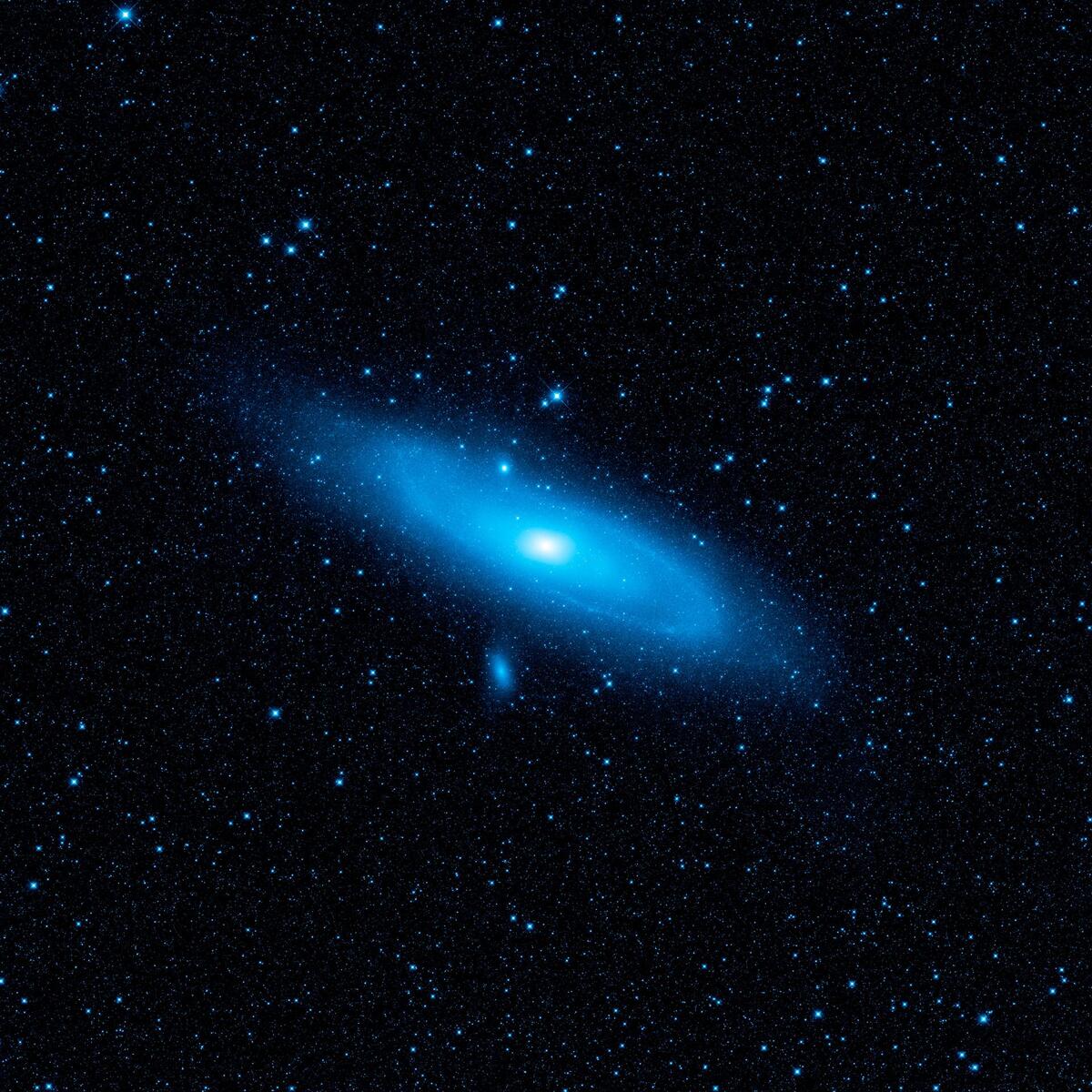
Sometime in mid-autumn, on a moonless night, find a dark field and let your eyes fully dark-adapt. Look northeast, roughly between the Great Square of Pegasus and the W-shape of Cassiopeia. With dark-adapted eyes and a clear sky, you will see a faint oval smudge — an elongated glow, noticeably non-stellar, spanning two or three apparent moon-widths across. You are looking at M31, the Andromeda Galaxy, and you are seeing it with your naked eye across 2.5 million light-years of intergalactic space.
This is galaxy season, and it runs from September through November in the Northern Hemisphere. The Local Group's three significant spiral galaxies — our own Milky Way, Andromeda (M31), and Triangulum (M33) — are all positioned high enough in the autumn sky for serious observation. For a moderately dark site and a pair of 10×50 binoculars, the autumn evenings offer more accessible extragalactic science than any other time of year.
Finding M31
The easiest naked-eye approach starts with the Great Square of Pegasus, four moderately bright stars forming a distinctive asterism in the eastern sky during September evenings. From the northeastern corner of the Square (Alpheratz, also designated alpha Andromedae), step two stars to the northeast along Andromeda's stellar chain: Mirach, then Almach. From Mirach, make a right turn — two stars north through a fainter pair — and you've landed within a degree of the galaxy's core.
Under dark skies, M31 is unmistakable to the naked eye. Binoculars reveal a brighter central nucleus surrounded by a gradually fading disk. The full angular extent of M31 — over 3 degrees across — means no single binocular or low-power eyepiece field captures the whole object; you are seeing only the brighter inner regions even in 7×50s. A wide-field refractor at 20× to 40× will show the full disk extent, the two satellite galaxies M32 and M110, and on excellent nights, subtle mottling in the spiral arms that indicates the presence of dust lanes.
M32 and M110: The Satellites
M32 is a compact elliptical galaxy easily visible in small telescopes as a condensed knot just south of M31's nucleus. Its apparent compactness is slightly deceptive: M32 is a genuinely dense object, a stripped elliptical that may have once been a larger galaxy before tidal interactions with M31 removed its outer envelope. It shows almost no internal structure because its stellar population is old and uniformly distributed.
M110 is larger and lower in surface brightness, sitting to the northwest of M31's core. It requires darker skies and better conditions than M32. Under magnification, some observers report subtle mottling — dark patches that are dust clouds within M110 itself, an unusual feature for an elliptical galaxy and evidence for recent star formation triggered by M110's interaction with M31.
M33: The Triangulum Challenge
M33 is simultaneously one of the sky's larger objects and one of its most challenging to observe. Its large angular size — over an hour of arc across — combined with its low surface brightness means the galaxy's light is spread so thinly that many observers struggle to see it from suburban sites. The standard advice: find it from a dark location with low magnification and averted vision, and do not expect the sharply defined oval that photographs suggest.
From a genuinely dark location with 10×50 binoculars, M33 reveals itself as a large, faint, circular glow with very little central concentration — a face-on spiral that we see almost directly above. A 6-inch telescope at 50× on a good night resolves the disk with subtle arm structure and reveals NGC 604, a giant HII region in M33's outer disk that is one of the largest star-forming nebulae known — comparable in physical scale to the Tarantula Nebula in the Large Magellanic Cloud.
The Collision That's Coming
The galaxies you're looking at are not merely decorative. The Local Group is a gravitationally bound system of roughly 80 galaxies, dominated by the Milky Way and Andromeda. The two giants are approaching each other at approximately 110 kilometers per second and will begin their merger in roughly 4.5 billion years — a slow-motion collision that will ultimately produce a large elliptical galaxy. M33 is also a member of the Local Group but has a less certain fate: some models suggest it will merge with M31 before the Andromeda-Milky Way collision; others show it surviving as a satellite for billions of years longer.
None of that matters on a clear October night when you're lying in a field with binoculars, dark-adapted, and the light that entered your eye left those galaxies before modern humans existed. Galaxy season, at its best, is that kind of moment.
