
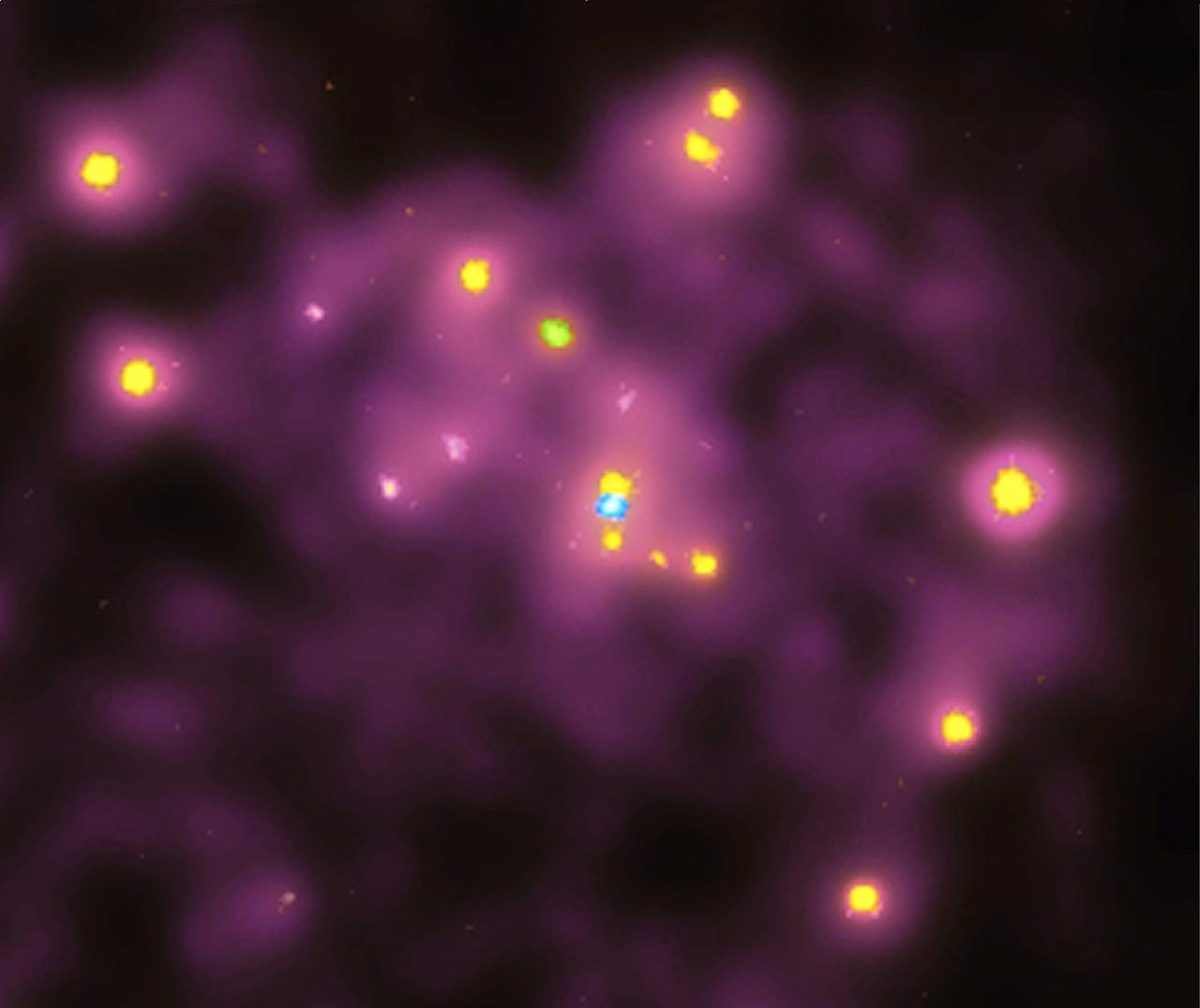
Twenty-six thousand light-years away, in a direction obscured by so much dust and gas that no optical telescope has ever seen it directly, there is a black hole four million times the mass of the Sun. For most of human history, its existence was only inferred — a massive, invisible gravitational anchor around which the entire Milky Way pivots. When astronomers finally confirmed Sagittarius A* through decades of tracking stellar orbits, they expected something dramatic. What they found instead was, by black hole standards, profoundly quiet. That picture is now changing.
Over the past several years, coordinated observing campaigns using the Chandra X-ray Observatory, the Very Large Array, the GRAVITY interferometer at the Very Large Telescope, and the Spitzer and NEOWISE infrared missions have caught Sgr A* in states of elevated emission — what astronomers call flares — with a frequency and brightness that has forced a revision of the standard model of galactic-center quiescence. The black hole at the middle of our galaxy is not the dormant, well-behaved object it once appeared to be. It is merely constrained, feeding intermittently on whatever material happens to drift within reach, and the results are spectacular on timescales short enough for humans to observe in real time.
The anatomy of a galactic-center flare
Sgr A* sits inside a chaotic neighborhood. The central parsec of the galaxy contains hot ionized gas, stellar winds from massive young stars, molecular clouds, and a diffuse sea of plasma collectively called the accretion zone. The black hole does not pull matter in the way a drain pulls water — the geometry is far messier. Material loses angular momentum and spirals inward through a process governed by magnetohydrodynamic turbulence, and at the inner edge of this accretion flow, within a region just a few times the Schwarzschild radius of the hole, magnetic fields get compressed and twisted until they snap. The energy released in these reconnection events — the same fundamental physics that drives solar flares — heats electrons to relativistic temperatures, producing a cascade of synchrotron radiation detectable from Earth as a brightening across near-infrared and X-ray wavelengths that can last anywhere from minutes to a few hours.
The flares are not subtle. During the most intense events observed by Chandra, Sgr A*'s X-ray luminosity has jumped by factors of a hundred or more above its quiescent baseline, before subsiding back to near-silence over the course of an hour or two. In the near-infrared, the GRAVITY instrument — which uses optical interferometry to achieve angular resolution equivalent to a telescope thousands of kilometers across — has resolved actual orbital motion within the flaring region: hot spots of plasma looping around the black hole at a significant fraction of the speed of light, tracing paths consistent with circular orbits just outside the innermost stable circular orbit. Watching material orbit a black hole at relativistic speeds in real time is not something the previous generation of astronomers expected to do. GRAVITY made it routine.
2019 and the year Sgr A* woke up
The clearest evidence that something had changed came in 2019, when Tuan Do and colleagues at UCLA published observations made with the Keck Observatory showing that Sgr A* had entered its brightest near-infrared state ever recorded. On May 13, 2019, the galactic center brightened to twice the flux of any previously observed flare, an event so anomalous that it prompted an immediate multi-wavelength response. The working hypothesis was that the cause was gravitational: the star S0-2, whose close passage around Sgr A* in 2018 had already been extensively monitored, may have stripped gas from its outer layers during periapsis, delivering a fresh supply of material to the accretion zone with a delay matching the 2019 brightening. A second candidate — a dusty object called G2 that made its own close approach in 2014 — had also been expected to trigger enhanced activity, though the results then were ambiguous. The 2019 flare suggested that the delivery of tidal debris from stellar encounters operates on timescales of months to years, making the galactic center a dynamically responsive system rather than a static one.
This framing matters because it connects episodic flaring to the larger question of Sgr A*'s feeding history. The central black hole is extraordinarily underluminous for its mass — it radiates at something like ten orders of magnitude below its theoretical Eddington limit, the maximum luminosity for a given mass. On galactic timescales, this is almost certainly not typical. X-ray reflection nebulae in the central molecular zone — giant molecular clouds whose X-ray luminosities cannot be explained by their own stellar populations — appear to be echoes of a past period when Sgr A* was orders of magnitude more active, perhaps a few hundred years ago. The Fermi bubbles, two colossal lobes of gamma-ray emission extending roughly 25,000 light-years above and below the galactic plane, are widely attributed to a more vigorous accretion episode within the past few million years. What we observe today is an afterglow of a much more energetic machine.
What the Event Horizon Telescope adds
In 2022, the Event Horizon Telescope collaboration released the first image of Sgr A* itself — a ring of glowing plasma surrounding a dark central region approximately 50 microarcseconds across, consistent with the predicted shadow of a four-million-solar-mass black hole at the galactic center distance. The image was harder to obtain than the collaboration's earlier image of M87*: Sgr A* is dramatically smaller in angular size on the sky, and it flares on timescales of minutes, meaning the accretion structure changes visibly during the hours-long integration required to build up sufficient signal. The EHT team had to develop new imaging algorithms that could account for a source that was literally moving while they were trying to photograph it. That the image was obtained at all is a testament to how much the technical infrastructure of very-long-baseline interferometry has matured.
The EHT image also confirmed what had been inferred from indirect evidence: the plasma immediately surrounding Sgr A* is structured, magnetized, and dynamic. Follow-up observations are now being planned with next-generation arrays — the ngEHT and the proposed Black Hole Explorer space-VLBI mission — that would achieve higher time resolution and cadence, effectively turning the galactic center into a real-time laboratory for strong-field general relativity. The flares that briefly brighten Sgr A* across the electromagnetic spectrum are not noise to be filtered out; they are the signal, encoding information about magnetic topology, particle acceleration, and the geometry of spacetime at the edge of a black hole.
None of this makes Sgr A* dangerous to Earth. The galactic center is far enough away that even the most violent flare delivers a negligible flux of high-energy radiation by the time it reaches the solar system. What the renewed attention does reveal is that our galaxy's central black hole is a living system, one whose moods can be read if you watch it with the right instruments at the right time. For astronomers equipped with the current generation of telescopes, the wait between revelations is getting shorter.
