
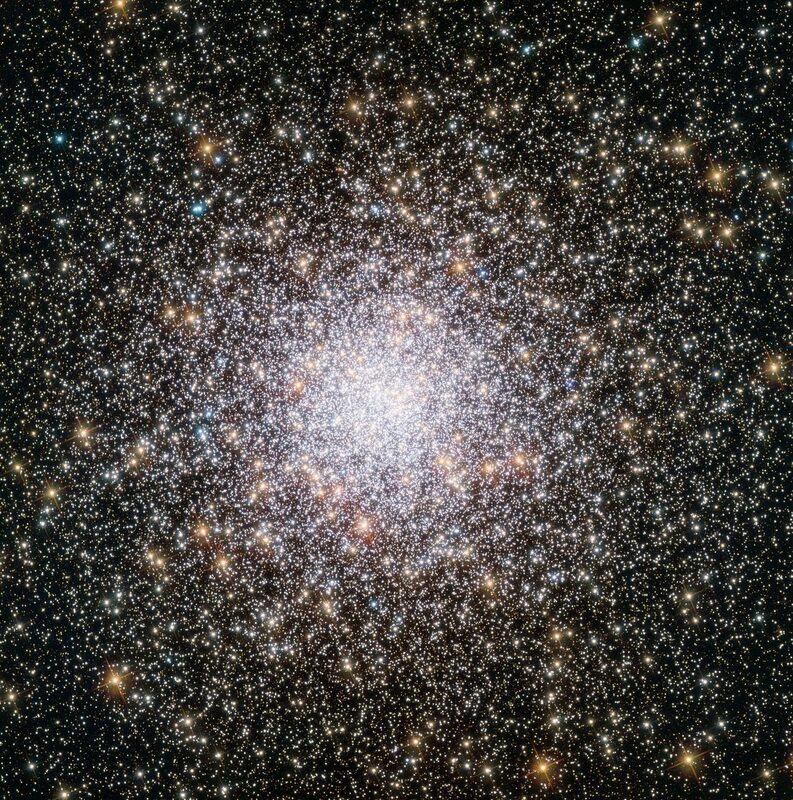
For most of the last several decades, astronomers modeling everything from galaxy evolution to dark matter halos have leaned on a convenient simplifying assumption: however a cloud of gas collapses into stars, it produces roughly the same mix of stellar masses every time. Big stars, small stars, and everything in between show up in predictable proportions, cluster after cluster, galaxy after galaxy. This assumption — the "universal" stellar initial mass function, or IMF — has been a load-bearing wall in astrophysics.
A new study published July 8, 2026 in The Astrophysical Journal Letters puts a sizable crack in that wall. Using precision astrometry from ESA's Gaia mission across more than 2 billion Milky Way stars, researchers Charles L. Steinhardt, Carter Meyerhoff, and Alexander J. Luening measured a key IMF feature — the "break mass" — in 110 high-quality open star clusters and found it varies considerably from one cluster to the next. More strikingly, the break mass tracks with the age of the cluster, suggesting the raw ingredients of star formation have themselves changed over the Milky Way's history.
What Is the "Break Mass," and Why Does It Matter?
The initial mass function is essentially a census: for every batch of stars a cloud produces, how many are low-mass red dwarfs versus high-mass blue giants? Plotted on a graph, the IMF isn't a single smooth curve — it bends. Below a certain stellar mass, the number of stars per mass interval follows one slope; above that mass, it follows a different, steeper slope. The point where the slope changes is the break mass, and it's one of the most diagnostic fingerprints of how a particular star-forming cloud fragmented.
If the IMF really is universal, the break mass should land in roughly the same place no matter which cluster you look at, because the physics of fragmentation is assumed to be the same everywhere. If it isn't universal, the break mass should shift depending on the conditions — density, temperature, turbulence, chemical composition — of the cloud that gave birth to the cluster.
Why Gaia Was Necessary to Settle This
Testing IMF universality has always been complicated by a confound: even if a cluster is born with a particular mass distribution, that distribution doesn't stay put. Massive stars burn out and die young. Dynamical interactions between stars can eject the lightest members from a cluster over time. So an older cluster's present-day stellar census can look different from its initial one, purely from evolution and dynamics — with no need to invoke a different birth IMF at all. Separating true IMF variation from these evolutionary effects requires being able to resolve individual stars in a cluster well enough to reconstruct its population accurately, which is exactly what Gaia's astrometric precision enables.
According to the summary published by AAS Nova, the team started from an initial Gaia catalog of 7,167 Milky Way clusters and narrowed it down to 110 that met their quality bar for reliable mass-function measurement. Within that curated sample, the break mass differed considerably from cluster to cluster — and it increased with cluster age. That trend points toward the conditions of star-forming clouds changing over the Milky Way's history, rather than the differences being an artifact of stellar or dynamical evolution within older clusters.
Q&A: Making Sense of the Result
So the IMF isn't universal at all?
Not according to this dataset. The paper's title is direct about it: "Direct Evidence for Stellar Initial Mass Function Variation in the Milky Way." The break mass — one of the IMF's defining features — moves around depending on which cluster and which epoch you're looking at.
What's driving the variation?
The correlation with cluster age is the key clue. Because the trend shows up as a function of when a cluster formed rather than how old its member stars have had time to evolve or scatter, the authors' interpretation is that it reflects real change in the properties of the molecular clouds stars are born from as the Milky Way itself has evolved.
Why has this taken so long to demonstrate directly?
Because doing it properly requires exactly what Gaia provides: astrometric measurements precise enough to resolve stellar populations in a cluster and disentangle true initial conditions from the effects of stars dying, drifting, or being flung out over billions of years. Earlier surveys lacked the resolving power to make that separation with confidence across a large, well-vetted sample of clusters.
Is this the final word?
It's a single paper, even if a compelling one — 110 clusters is a meaningful sample, but it's a fraction of the full Gaia cluster catalog. Gaia itself isn't finished: a pre-release of DR4 astrometric timeseries went out June 29, 2026, and the full DR4 release, covering 5.5 years of observations and accompanied by more than 60 papers, is due December 2, 2026. Results from the mission were also presented at the European Astronomical Society meeting in Lausanne on July 3, 2026. That expanding dataset is exactly what will let other teams stress-test this finding against a larger and even more precisely measured cluster population.
Why It Matters
The IMF isn't an obscure bookkeeping detail — it's baked into an enormous amount of downstream astrophysics. Estimates of galaxy stellar masses, star formation rates, chemical enrichment histories, and even the abundance of stellar remnants like neutron stars and black holes all depend on assuming some IMF shape to convert observed light into a population of stars. Most of that work has defaulted to treating the IMF as fixed and universal because it made the math tractable and no dataset could definitively prove otherwise.
If the break mass genuinely shifts with the properties of the parent molecular cloud, and those properties have changed as the Milky Way has aged, then models built on a one-size-fits-all IMF may be systematically off for clusters and eras that depart from whatever "typical" conditions were assumed. That has ripple effects for how astronomers interpret both nearby star clusters and, potentially, distant galaxies observed at earlier cosmic epochs, where cloud conditions were likely even more different from those in the present-day Milky Way. Gaia's continuing data releases — with the full DR4 catalog arriving later this year — will be the proving ground for how far this variation extends and how much of modern astrophysics needs to account for it.
