
Somewhere in the deep field data collected by the European Space Agency's Euclid telescope, astronomers found a pair of pinpricks of light that had been traveling toward Earth for roughly 13 billion years. By the time that light reached Euclid's detectors, the objects that emitted it had long since evolved into something else entirely — or simply ceased to exist in their observed form. What Euclid captured was a snapshot from the universe's infancy: two quasars that had already formed just 670 million years after the Big Bang, when the cosmos was a mere 5% of its current age.
The two objects are part of a larger haul of 31 quasars identified by an international consortium using Euclid data, according to findings published in the journal Astronomy & Astrophysics and detailed by NASA on July 6, 2026. Of those 31, a dozen date to within the universe's first 770 million years. The two oldest are, by the consortium's account, among the earliest quasars ever observed — and University of Arizona astronomers were among the researchers who helped find them, according to a companion announcement from University of Arizona News.
Euclid is an ESA-led mission that also carries NASA contributions, and the agency says the new catalog of ancient quasars will help inform plans for NASA's upcoming Nancy Grace Roman Space Telescope, which is expected to offer further insight into the mystery of dark energy.
What exactly is a quasar?
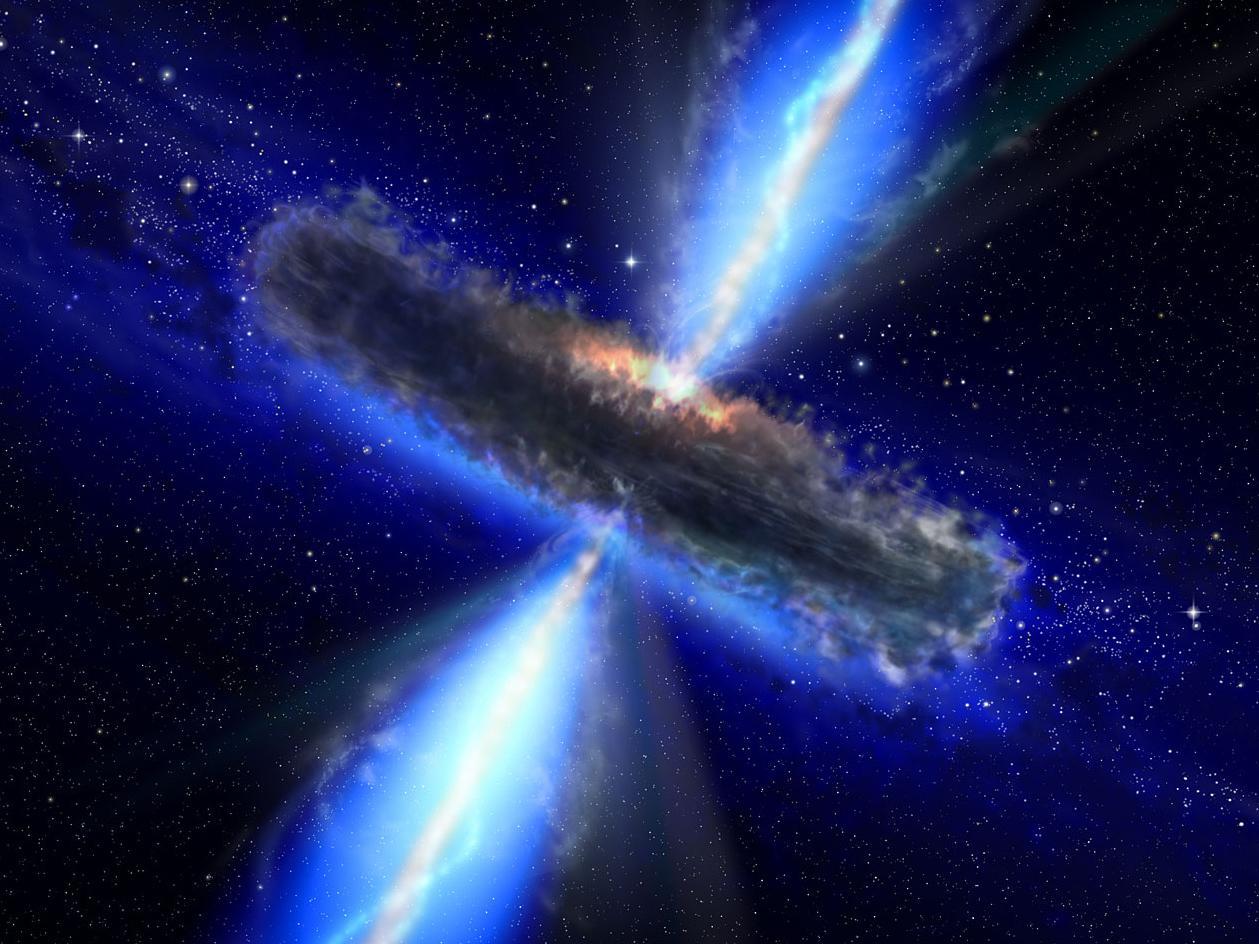
A quasar is not a star, despite the name's origin as a contraction of "quasi-stellar radio source." It is the blazing core of a galaxy, powered by a supermassive black hole actively feeding on surrounding gas and dust. As that material spirals inward, friction and gravitational stress heat it to extreme temperatures, and the resulting glow can outshine every star in the host galaxy combined. CBS News, reporting on the discovery, described two of the newly found quasars as shining "with the light of a trillion suns" — a description that captures both their extravagant luminosity and the reason they remain visible across billions of light-years of cosmic distance despite the black holes themselves being invisible.
That extreme brightness is precisely why quasars are useful to astronomers studying the early universe. A single ordinary galaxy from 13 billion years ago would be far too faint for most instruments to detect. A quasar, powered by an actively feeding black hole, can blaze brightly enough to be picked out even at the outer edge of the observable universe.
A puzzle that keeps getting harder
The discovery does more than pad a catalog — it sharpens a long-standing problem in astrophysics. Supermassive black holes, the kind capable of powering a quasar, are typically thought to require enormous amounts of time to build up their mass through gradual accretion of surrounding material. Finding fully formed, actively feeding supermassive black holes at just 670 million years after the Big Bang forces theorists to explain how that growth happened so quickly.
CBS News characterized the find as adding to an already "perplexing" mystery surrounding early black hole formation, quoting study co-author Joseph Hennawi's observation that "every step further back in time makes the puzzle more perplexing." The debate isn't new — recent years have produced a steady drip of surprisingly early, surprisingly massive black holes from observatories including the James Webb Space Telescope — but each new detection tightens the timeline theorists have to work with. Either black holes formed from unusually massive initial "seeds," or they grew far faster than standard models allow, or some combination of both. The 31 quasars in this Euclid sample, spanning a range of ages within the universe's first billion years, give researchers a broader statistical sample to test those competing explanations rather than relying on a handful of record-breaking outliers.
Why Euclid, and why now
Euclid was designed primarily as a cosmology mission, tasked with mapping the large-scale structure of the universe to study dark matter and dark energy across billions of galaxies. That design happens to make it well suited to turning up rare, faint, distant objects like early quasars: its wide field of view lets it survey huge swaths of sky, increasing the odds of catching the sparse population of galaxies that hosted actively feeding black holes in the universe's first billion years.
Phys.org, in its coverage of the discovery, reiterated the basic mechanism at play — gas and dust spiraling into a supermassive black hole and releasing enormous amounts of energy as they do — underscoring that the physics itself isn't new or mysterious. What's mysterious is the timing: how black holes got so big, so fast, when the universe had barely had time to form its first generations of stars and galaxies.
The University of Arizona's involvement, detailed in the University of Arizona News announcement, places local astronomers within a genuinely international effort. Steward Observatory researchers, including astronomer Xiaohui Fan's team, used the university's large ground-based telescopes — among them the Large Binocular Telescope in southern Arizona — to take long exposures of faint quasar candidates and confirm their distances through spectroscopic follow-up. The paper's publication in Astronomy & Astrophysics, a peer-reviewed journal, signals that the findings have already been vetted by outside experts rather than announced solely through press materials — a distinction worth noting given how much early-universe black hole news arrives via preprint or conference presentation well ahead of formal review.
Why It Matters
Every early quasar found is a data point in one of astronomy's most contested debates: how did the universe build black holes weighing millions or billions of times the mass of the sun within its first several hundred million years? The standard picture of black hole growth — slow accretion over cosmic time — struggles to explain objects this massive appearing this early. A sample of 31 quasars, rather than one or two isolated detections, gives theorists something sturdier to test their models against. It also matters because NASA says these findings will help inform plans for the Nancy Grace Roman Space Telescope, which is expected to add fresh insight into the mystery of dark energy once it begins its own wide-field survey. Euclid's success here also demonstrates that a wide-field survey not originally designed to hunt for early quasars can still turn up scientifically valuable numbers of them — a proof of concept relevant to future missions searching for objects even closer to the Big Bang than the 670-million-year mark Euclid just reached.
Sources
- ESA's Euclid Space Telescope Finds Universe's Most Ancient Quasars - NASA Science
- Euclid telescope spots oldest quasars ever discovered, adding to 'perplexing' space mystery - CBS News
- Euclid discovers the most ancient quasars in the universe - Phys.org
- The two most distant quasars ever observed: U of A astronomers help shatter cosmic record - University of Arizona News
