
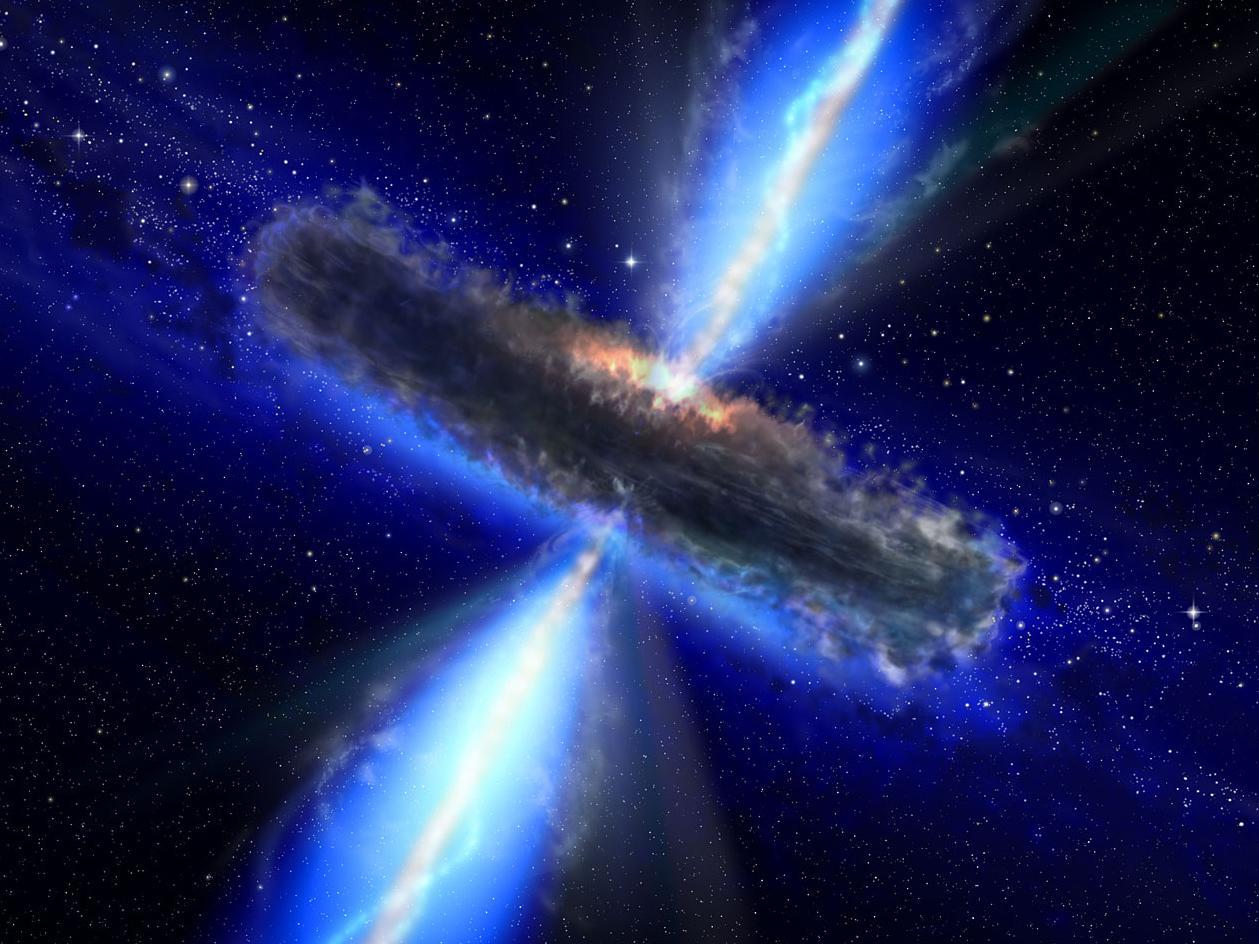
Somewhere out past 13 billion light-years, in a universe barely 670 million years old, two black holes were already gorging themselves into brilliance. Their light has been crossing the cosmos ever since, arriving at Earth only now as two faint smudges in data from the European Space Agency's Euclid telescope — and forcing astronomers to once again reckon with a question that has dogged the field for years: how do you build something so massive, so fast?
The two objects, catalogued with the utilitarian names EUCL J172902.75+641018.1 and EUCL J125308.55+705432.3, are quasars — the blazing cores of galaxies where supermassive black holes are actively feeding on infalling gas and dust, releasing so much energy in the process that they can outshine every star in their host galaxy combined. At redshifts of 7.77 and 7.69, respectively, they are the most distant, and therefore most ancient, quasars ever confirmed, edging out the previous record holder at redshift 7.64.
In a paper published July 6, 2026 in Astronomy & Astrophysics, a team led by Daming Yang of Leiden University reports that Euclid has newly identified 31 quasars from the universe's early history, 12 of them at redshifts of 7 or beyond, placing them within the universe's first 770 million years. According to Antonio La Marca, an ESA Research Fellow on the Euclid team, that dozen more than doubles the previously known count of quasars this ancient: finding the first ten or so redshift-7-plus quasars took astronomers more than a decade, and Euclid matched that pace in a single year — arguably the biggest single addition to the early-quasar record book in years, and one that starts to look less like a scattering of oddities and more like a proper population to study.
Why It Matters
Quasars this old are a problem, in the best scientific sense of the word. A quasar's brightness comes from its central black hole, and for a black hole to blaze this fiercely, it typically needs to have already grown to enormous size — hundreds of millions to billions of times the mass of the Sun. According to ESA, the two record-setting quasars were shining with the combined light of a trillion Suns when the universe was just 5% of its current age. Standard models of black hole growth, built on gas falling in and radiation pressure pushing back, struggle to explain how that much mass can accumulate in such a short window following the Big Bang. Every new early quasar is effectively another data point constraining — or complicating — the menu of proposed solutions, from unusually large "seed" black holes to periods of runaway accretion that bend the normal rules.
The discoveries also matter for a different reason: timing. These quasars formed during the epoch of reionization, which ESA describes as the period when the universe shifted "from being cold and dark (the 'dark ages') to hot and 'ionised' (split apart by energetic light)." Antonio La Marca says the new haul amounts to "a true 'census' of quasars at the dawn of the Universe for the first time" — a big step up from the handful of isolated detections that were all astronomers previously had to work with.
Finding needles in an enormous haystack
Part of what makes this result notable is not just what was found, but how. Ancient quasars are exceedingly rare and, from Earth's vantage point, extraordinarily faint, which has historically made them a needle-in-haystack problem for even the largest telescopes. Euclid's advantage is scale: it is designed to survey huge swaths of sky, and that breadth turns out to be exactly what's needed to catch these rare, distant beacons in meaningful numbers.
"Euclid is a true game-changer. Before, we could only find a handful of the very brightest ancient quasars, but Euclid lets us search far more efficiently across huge areas of sky to capture much fainter light. It's a unique tool for quasar hunting," Yang said, according to statements distributed by ESA and EurekAlert. That efficiency is what let the team move from a "handful" of known objects to a sample of 31 in one release — and, crucially, to catch not just the brightest outliers but a broader range of quasars representative of the actual population at cosmic dawn.
Confirming candidates at these distances isn't purely an automated process. ESA credits Research Fellow Antonio La Marca and researcher Silvia Belladitta with contributing the follow-up observations needed to verify the quasar identifications and pin down their redshifts — the measurement, based on how much a distant object's light has been stretched by the expansion of the universe, that lets astronomers translate "very red and faint" into "we are looking 13-plus billion years into the past." Valeria Pettorino, ESA's Euclid Project Scientist, is also credited in connection with the mission's role in the discovery.
What comes next
Euclid is still relatively early in its survey — the mission is designed to eventually map more than a third of the sky, primarily to study dark matter and dark energy through the distribution and shapes of billions of galaxies. Ancient quasars are, in a sense, a bonus catch: bright, easily flagged beacons that happen to fall out of a survey built for other purposes. If 31 confirmed quasars have emerged from the portion of sky Euclid has covered so far, the mission's eventual full dataset could push the census of cosmic-dawn quasars considerably higher, giving theorists a real statistical sample instead of a scattering of exceptional cases to explain away one at a time.
That statistical heft is what researchers say they need most. A single record-breaking quasar can be dismissed, if uncomfortably, as a rare fluke — an unusually large seed black hole that got lucky with an early growth spurt. Thirty-one of them, with more likely to come, start to look like a signal that theories of early black hole formation and growth need to bend to fit the evidence, rather than the other way around.
