
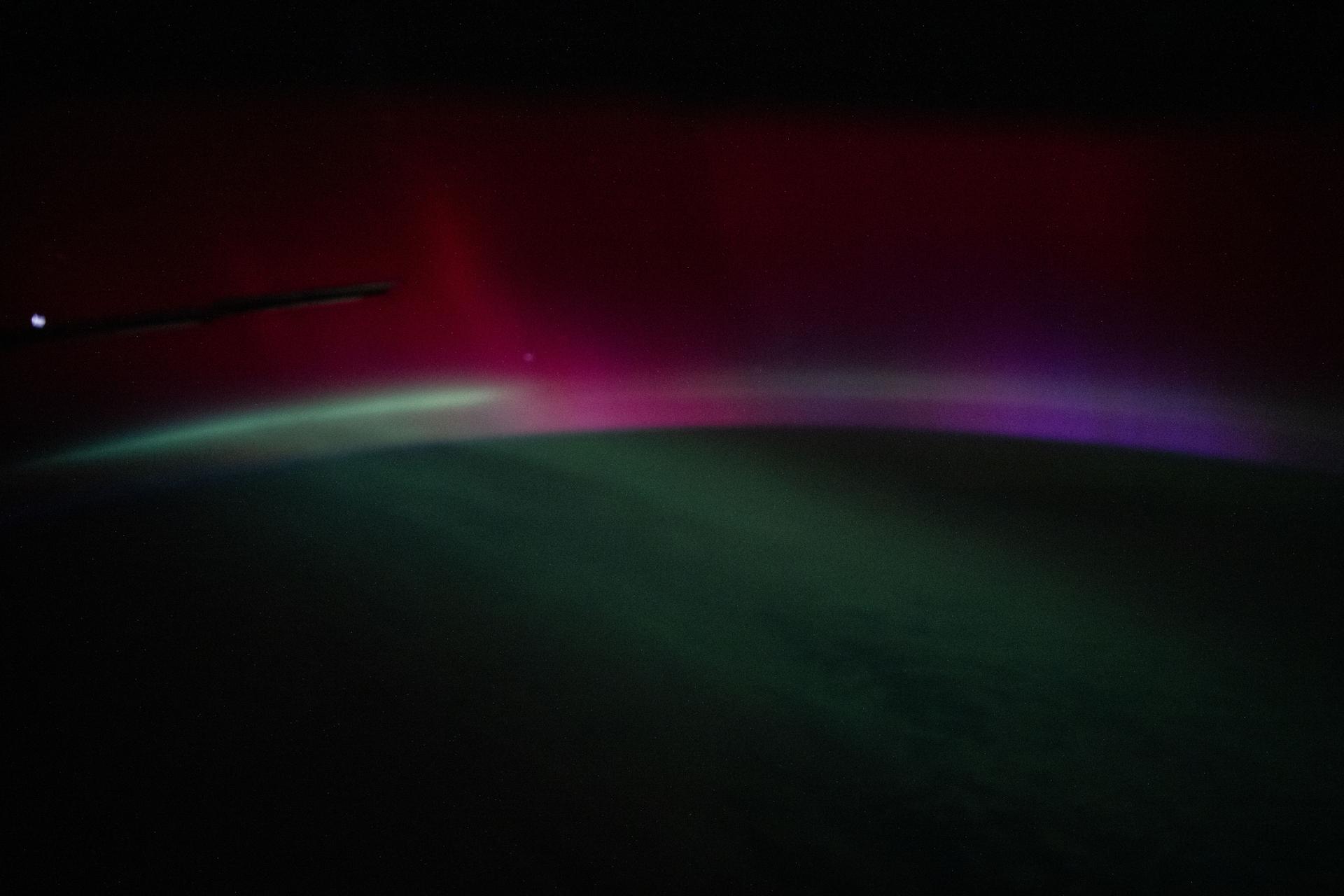
Skywatchers who set alarms for a modest aurora show over the July 4th weekend got more than they bargained for. A coronal mass ejection (CME) that forecasters expected to deliver a middling G1-to-G2 geomagnetic storm instead punched through to G3 (Strong) on NOAA's five-step storm scale, dragging the northern lights far south of their usual haunts and into the skies over Utah, Colorado and Nevada just as fireworks were going off below them.
The storm's roots trace back to June 30, when sunspot region AR4479 let loose an X1.1-class solar flare at 20:50 UTC. X-class flares are the most powerful category the Sun produces, and this one came bundled with a CME — a cloud of magnetized plasma flung outward from the corona at roughly 1,500 kilometers per second, or more than 3.3 million miles per hour (about 930 miles per second), according to EarthSky's tracking. That cloud spent the next several days crossing the roughly 93-million-mile gap to Earth, arriving late on July 3 and into July 4.
How a G1-G2 Forecast Became a G3 Storm
Heading into the holiday weekend, NOAA's Space Weather Prediction Center had geomagnetic storm watches posted for July 3-4 at G1-G2 levels, based on modeling of the AR4479 CME. The UK Met Office was more cautious, flagging a "slight chance" of G3 conditions developing. That caveat turned out to be the accurate call.
According to tracking published by EarthSky, the storm reached full G3 strength — a planetary Kp-index of 7 — at 5:09 UTC on July 4, overshooting the U.S. forecast. The mismatch is a reminder that CME forecasting, while much improved over the past decade, still carries real uncertainty: the exact strength, timing, and orientation of a CME's embedded magnetic field aren't fully knowable until the cloud is directly measured by spacecraft in space, often not long before it reaches Earth.
The AR4479 flare didn't fire in isolation. EarthSky's monitoring showed the Sun stayed busy through the runup to the storm, producing 24 flares in the 24 hours ending at 11 UTC on July 4 — 13 of them M-class and 11 C-class — including an M6.7 flare at 18:11 UTC on July 3, an M6.3 flare, and an M4.1 flare at 3:42 UTC on July 4 itself. That's a notably active stretch, consistent with a Sun still riding high in its current activity cycle.
Where the Aurora Showed Up
Ahead of the storm, Forbes reported that NOAA's original G1-G2 outlook put the aurora within reach of up to 26 U.S. states extending south from the Canadian border, with Montana, North Dakota and Minnesota rated most likely to see a show and states as far south as Kansas, Missouri, Virginia and Maryland listed as possible only if conditions escalated to G3.
They did escalate — and the visibility line moved with them. EarthSky reported aurora sightings as far south as Utah, Colorado and Nevada on the night of July 3 into July 4, well beyond the Kansas-Missouri-Virginia-Maryland "possible" tier flagged in pre-storm forecasts. For a holiday famous for its own light shows, a naturally occurring one dancing overhead in the Mountain West was an unplanned bonus.
Why the Timing Is Notable
G3 storms aren't the most extreme the Sun can produce — NOAA's scale tops out at G5 — but they sit firmly in "Strong" territory, capable of inducing voltage irregularities in high-latitude power grids, occasionally forcing corrections to spacecraft orientation, and degrading high-frequency radio and low-frequency navigation signals in the affected regions. None of the sources here report specific infrastructure impacts from this event; the visible effect that mattered to most people was the aurora itself, pushed unusually far from the poles by the storm's strength.
Why It Matters
This event is a compact case study in why space weather forecasting remains an inexact science even as it's grown more important. A flare and CME can be observed, measured, and modeled the moment they leave the Sun, yet the storm they ultimately produce on Earth can still outrun the forecast by a full step on NOAA's scale — the difference between an aurora confined to the Canadian border and one visible from Nevada driveways. As solar activity stays elevated, that gap between forecast and outcome matters not just to skywatchers chasing a photo, but to grid operators, airlines rerouting polar flights, and satellite operators who plan around the same G-scale numbers. July 4's storm is also a reminder that "strong" solar storms are becoming a more regular feature of the news cycle — worth watching, but, based on what's been reported here, not yet a cause for alarm.
What to Watch Next
With the broader stretch of solar activity showing no signs of quieting — 24 flares in a single day is a lot of flares — NOAA's alerts page is the place to watch for whether another watch gets issued. Real-time G-scale and R-scale (radio blackout) tracking is updated continuously on the agency's site, and it's the same data stream that flagged this weekend's watches in the first place, even if the final storm strength ran ahead of the initial call.
