
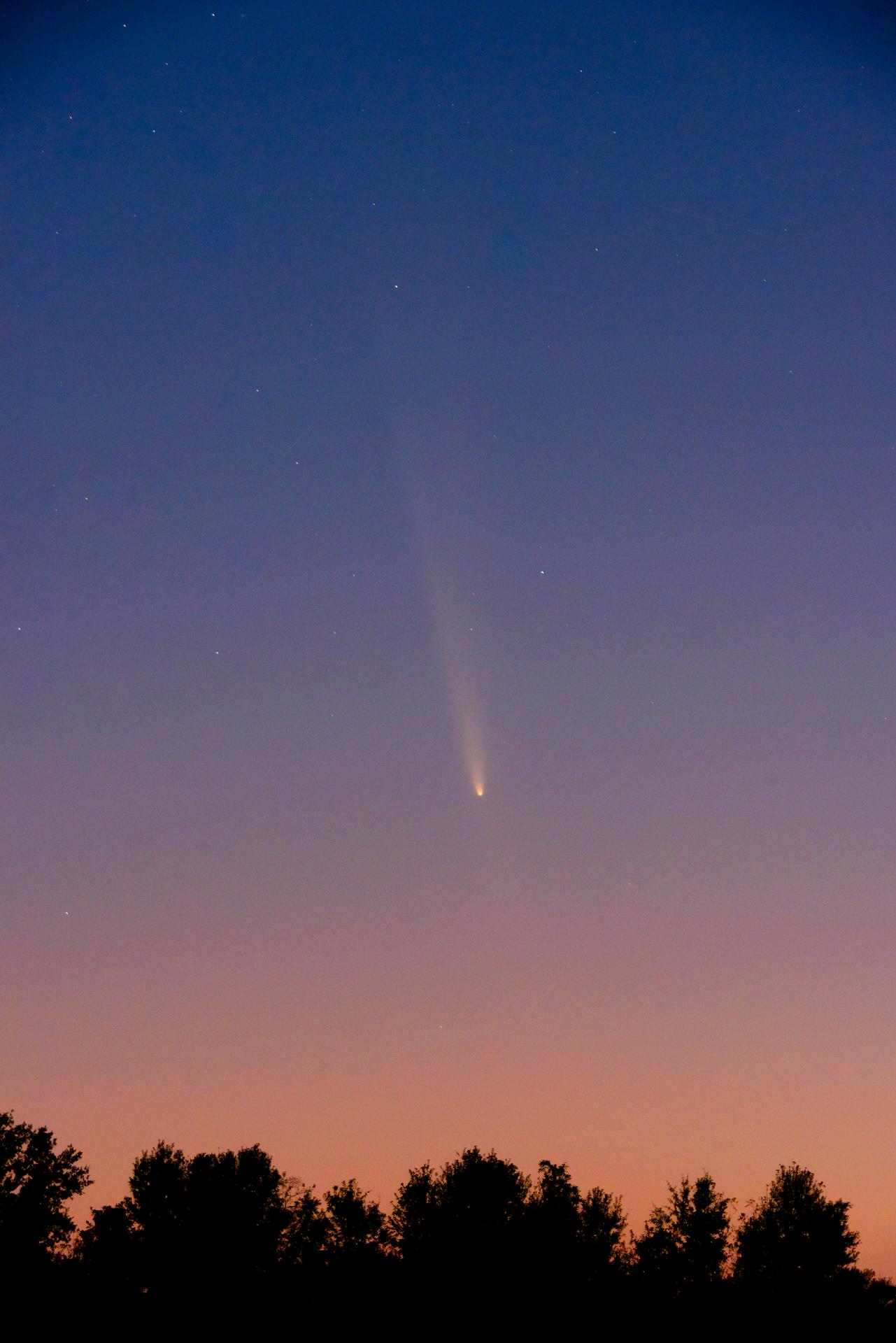
Every 5.5 years or so, a modest lump of ice and dust named 10P/Tempel 2 swings back through the inner solar system, brightens for a few weeks, and fades again without much fanfare. This summer is the exception. According to Astronomy magazine, the comet is expected to peak in brightness across July and August 2026, reaching roughly 7th magnitude — its brightest apparition since 1967. For a short-period comet that usually stays a telescope-only curiosity, that is a genuine milestone, and it anchors an unusually busy July sky.
NASA's What's Up: July 2026 guide folds the comet into a month that also serves up Saturn's rings tilted to an unusually thin edge, a tight pre-dawn gathering of the Moon, Mars, and Saturn, and some of the best Milky Way viewing of the year. Here is what is actually worth setting an alarm for, and what you will and won't be able to see with your own eyes.
The comet: where and when to look
Do not expect a naked-eye spectacle. At around 7th magnitude, 10P/Tempel 2 sits just below the threshold of unaided human vision under dark skies, which means you will want binoculars or a small telescope. NASA describes the target as a small fuzzy glow with a bright central knot — the coma surrounding the comet's nucleus — rather than the sweeping tail that pop culture trains people to expect. Astronomy magazine likewise frames it as a good binocular or small-telescope object.
The comet is currently working its way through the constellation Capricornus. Your best window is around the new moon on July 14, when the absence of moonlight gives faint objects their best contrast against a genuinely dark sky. Capricornus is a dim, low-slung constellation with no bright anchor stars, so a star chart or a planetarium app will save you a lot of squinting. Find a dark site, let your eyes adapt for at least 20 minutes, and sweep slowly — a comet at this brightness reveals itself as a soft smudge that refuses to snap into a sharp point of light the way a star does.
Why does this apparition beat every one since 1967? The short answer is geometry: the alignment of the comet's orbit, the Earth, and the Sun this time around brings it to a more favorable position than in the intervening returns, boosting how bright it appears from the ground. Nearly six decades of quieter passes make this the one worth catching now rather than waiting for the next go-round.
Pre-dawn on July 11 and 12: Moon, Mars, and Saturn
If you would rather not stay up past midnight, flip your schedule. On the mornings of July 11 and 12, NASA points to a waning crescent Moon parked near Mars, with Saturn nearby in the same stretch of pre-dawn sky. It is a photogenic grouping and an easy one — the Moon and both planets are naked-eye objects, so no equipment is required to appreciate the lineup.
Uranus is also lurking in that neighborhood, but it does not join the naked-eye club. At its brightness you will need binoculars or a telescope to pull it out, and even then it registers as a small, faintly blue-green disk rather than anything dramatic. Consider it a bonus target for observers who want to tick off an ice giant while they are already outside.
Saturn's rings, turned nearly edge-on
Saturn is the month's quiet standout for anyone with a telescope. This month, NASA notes, the planet's rings appear unusually thin — the result of a shallow tilt in how the ring plane presents to us from Earth. When Saturn's rings are angled wide open, they are the single most jaw-dropping sight in a backyard scope. When they narrow toward edge-on, as they are doing now, the planet takes on a stranger, more austere look: a bright ball bisected by a thin, bright line.
It is a reminder that the rings are staggeringly flat — vast in width but only meters thick in places — so a modest change in viewing angle transforms the whole scene. If you have watched Saturn through a telescope in past years and remember fat, obvious rings, this is a good month to look again and see how different the same planet can appear.
The Milky Way's core season peaks
July is prime time for the bright central bulge of our own galaxy. NASA singles out the dark, moonless night of the July 14 new moon as the best opportunity to see the Milky Way's core arching up near the constellations Scorpius and Sagittarius. From a location free of light pollution, the galactic center resolves into a mottled band of star clouds and dust lanes — the densest, most luminous slice of the sky the Northern Hemisphere summer has to offer.
This is not a NASA-only observation. National Geographic's roundup of July night-sky events flags the same galactic-core season alongside twin meteor showers, and Forbes' July 1 sky column highlights the summer Milky Way as one of the month's naked-eye draws. When three independent outlets converge on the same target, it is a strong signal that a clear, dark night in mid-July is worth planning around.
The rest of the month's calendar
A few dates to keep handy. The Moon runs through its usual cycle: last quarter on July 7, new moon on July 14, first quarter on July 21, and the Full Buck Moon — the traditional name for July's full moon — on July 29. The new moon on the 14th is the linchpin for faint-object hunting, doing double duty for both the comet and the Milky Way.
Planet watchers get more than the pre-dawn trio. Astronomy magazine details additional planet visibility across the month, and Forbes notes Venus making appearances in the sky. Between the comet, the planets, and the galactic core, July 2026 rewards observers at both ends of the night — the pre-dawn crowd and the after-dark crowd alike.
Why It Matters
Bright comet apparitions are, by their nature, fleeting. 10P/Tempel 2 will not present this favorably again for a long time — the geometry that makes 2026 its best showing since 1967 does not repeat on any convenient human timescale. That combination of a genuinely rare peak and a low barrier to entry (binoculars, a dark sky, and a star chart) makes this a rare accessible-astronomy moment rather than a specialist-only event. It also underscores a broader point: short-period comets like Tempel 2 are the predictable, well-tracked members of the comet family, and following one through an exceptional return is a hands-on way to understand why orbital geometry — not just a comet's intrinsic size — governs whether we get a good show. Pair that with edge-on Saturn rings and peak Milky Way season, and July 2026 is an unusually rich month to simply look up.
Sources
- What's Up: July 2026 Skywatching Tips from NASA (NASA Science)
- July 2026: What's in the sky this month? (Astronomy magazine)
- 8 night sky events to see in July, from twin meteor showers to the Milky Way's glittering core (National Geographic)
- See The Milky Way, Venus And A Full Buck Moon: July's Night Sky (Forbes)
