
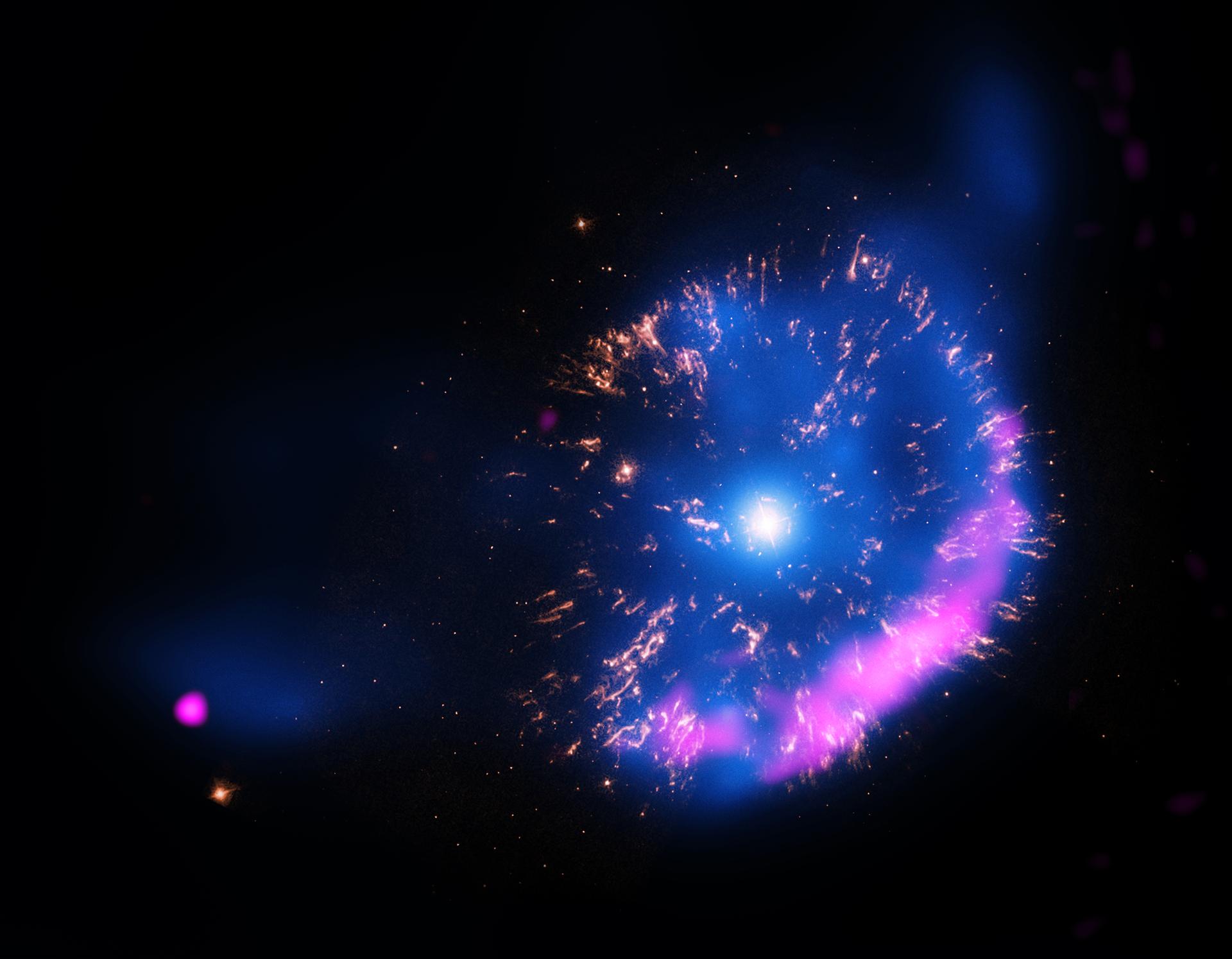
There is a star in the constellation Corona Borealis that, by all accounts, should be one of the most boring objects in the night sky. At magnitude 10, T Coronae Borealis sits well below the threshold of human vision, a faint smudge accessible only through binoculars or a small telescope. Most nights, it does nothing. It has done nothing, as far as the naked eye is concerned, for roughly eighty years.
And yet for more than a year now, astronomers and amateur observers have been watching it with the kind of attention usually reserved for a kettle about to boil. The reason: T CrB — nicknamed the "Blaze Star" — is a recurrent nova, a stellar system primed to erupt into naked-eye brightness on a schedule measured in human lifetimes. When it goes, it will become, briefly, a "new" star visible without any equipment at all. The question that has hung over the astronomy community since 2024 is not whether it will happen, but when. And as of late June 2026, the honest answer remains: not yet.
What's actually out there
To understand the watch, it helps to understand the machine. According to NASA, T Coronae Borealis lies about 3,000 light-years from Earth and is not a single star but a binary system — a tightly bound pair consisting of an aging red giant and an Earth-sized white dwarf. The two are close enough that the white dwarf, the dense burned-out core of a former star, steadily pulls gas off its bloated companion. That stolen material piles up on the white dwarf's surface, accumulating pressure and heat.
Eventually, the buildup crosses a threshold and ignites in a runaway thermonuclear eruption. The surface flashes; the system flares; and from 3,000 light-years away, a star that was invisible to the unaided eye suddenly shines at roughly the brightness of Polaris, the North Star. Then, over the following days, it fades back toward obscurity, and the slow process of accumulation begins again.
This is what distinguishes a recurrent nova from the more cataclysmic events that share part of its name. The white dwarf is not destroyed. The system survives to do it again. And in the case of T CrB, the cycle runs at roughly once every 80 years. NASA notes documented eruptions in 1946, 1866, and 1787, with a probable earlier event in 1217 — a pattern stretching back through centuries of human observation, long before anyone understood the physics driving it.
The date that came and went
The current frenzy traces back to a specific, quantified prediction. An analysis published in the Research Notes of the AAS in October 2024 examined the system's behavior and identified June 25, 2026, as a statistically likely outburst date — a best-guess peak in the probability distribution rather than a guarantee. That single date gave the watch a focal point, and as it approached, coverage intensified.
On June 25 itself, Forbes ran a piece bluntly headlined that the Blaze Star "could explode tonight," walking readers through exactly where to look. But the same reporting carried the deflating caveat: the star had not yet erupted. It remained near its baseline magnitude, quiet as ever. The statistically favored night arrived, and the white dwarf declined to perform on cue.
That is not a failure of the science so much as a reminder of what a probabilistic prediction actually means. A "statistically likely" date is the center of a spread of possibilities, not a deadline the universe is obligated to honor. The same Forbes coverage flagged the next likely window — around February 8, 2027 — as the fallback if June came and went without fireworks. Which, of course, it did.
Where to look, and what you'll see
If you want to catch it, the target is Corona Borealis, the "Northern Crown" — a small, distinctive semicircle of stars tucked between the brighter constellations Boötes and Hercules. The eruption, when it comes, will not require a telescope. As Space.com's coverage emphasizes, the whole appeal of T CrB is that it crosses from invisible to naked-eye visible, a genuine "new star" appearing where moments before there was apparently nothing.
Brightness is the part worth managing expectations on. This will not be a blazing beacon dominating the sky. At peak, T CrB is expected to reach roughly the brightness of Polaris — clearly visible to anyone who knows where to look, unmistakable to a practiced eye, but not an event that will stop traffic or trend on its own visual drama. The significance is not in raw brilliance. It is in the fact of a point of light materializing in a familiar constellation, then fading away over the following nights.
Why It Matters
The roughly 80-year cycle is the entire point. For most people alive today, the next eruption of T Coronae Borealis is a once-in-a-lifetime event — see it now, or wait until the 2100s. That framing, repeated across Space.com and Forbes coverage, is what has turned a faint variable star into a sustained public watch.
It also offers something increasingly rare in modern astronomy: an event you can witness with nothing but your own eyes and a clear sky, no equipment required, no observatory time, no subscription to a telescope feed. The recurrent nova is a chance to see stellar physics — accretion, thermonuclear runaway, the violent intimacy of a binary system — play out on a timescale a human can actually catch. And because the eruption is unpredictable within its window, the watch rewards persistence rather than luck or hardware.
The lesson of June 25 is patience. The prediction was sound; the star simply has not obliged yet. The white dwarf is still accumulating, still approaching its threshold, still on a hair-trigger. It could happen tonight. It could happen next winter. The only certainty is that the alternative to watching now is waiting another lifetime — so the binoculars stay pointed at the Northern Crown, and the watch goes on.
