
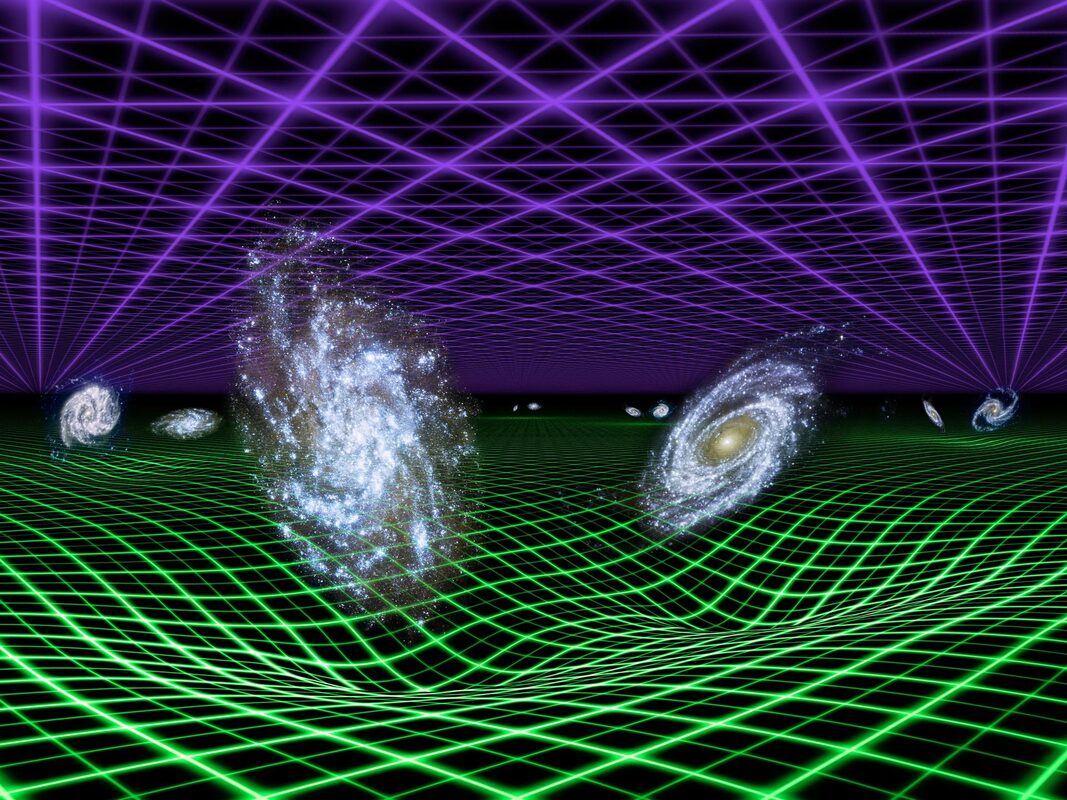
For nearly a century, cosmology has rested on a single, sweeping act of faith: that the universe, viewed on a large enough scale, looks the same everywhere and in every direction. Zoom out far enough, the assumption goes, and the clumps and voids average out into a smooth, featureless broth. This is the cosmological principle — the mathematical spine of the standard model of cosmology — and a new study argues the data may no longer support it.
In a paper published in Nature on June 30, 2026, researchers report that galaxies do not smooth out the way the principle requires. Instead, they remain organized into coherent, directional structures spanning several billion light years. Drawing on observations from the Dark Energy Spectroscopic Instrument (DESI) and the Euclid space telescope, the analysis finds that these large-scale patterns are stronger and more persistent than the standard Lambda-CDM model — and its simulations — predict. If the result holds, it would represent a direct violation of one of cosmology's foundational assumptions.
What the researchers actually found
The work was led by Marco Galoppo, a PhD candidate at the University of Canterbury, and Francesco Sylos Labini, a research director at the Enrico Fermi Research Institute, who described their findings in an accompanying article in The Conversation. Their central observation is deceptively simple: galaxy pairs are not randomly oriented. They line up.
Rather than scattering with no preferred direction — as a truly homogeneous, isotropic universe would demand — galaxies trace coherent filaments and walls that stretch across billions of light years. These are not small local eddies in the cosmic flow. They are vast, aligned architectures that persist across distances where, according to standard cosmology, any such organization should have long since washed out into randomness.
That distinction matters. The cosmic web — the sprawling network of filaments, sheets, and voids that threads galaxies through space — is not itself a surprise; it is a well-established feature of the universe and a prediction of structure formation. The claim here is more pointed. It is that the coherence and directionality of these structures extends further, and holds together more tightly, than the reigning model can accommodate.
Why the cosmological principle is such a big deal
The cosmological principle is not a minor bookkeeping assumption. It is the load-bearing wall. When physicists write down the equations that describe an expanding universe, they typically begin by assuming homogeneity (the same everywhere) and isotropy (the same in all directions). Those two assumptions are what make the mathematics tractable in the first place. They are baked into the models used to infer the age of the universe, the behavior of dark energy, and the total inventory of matter.
Related to it is the Copernican principle — the humbling idea that we occupy no special place in the cosmos, that our vantage point is not privileged. A universe with genuine large-scale directionality, a preferred axis or orientation, would strain both ideas. It would mean the cosmos has a structure and a geometry that the standard framework simply does not capture.
This is why the finding is being framed not as a tweak but as a potential demand for a radical rethink — the phrase the authors themselves invoke. The study suggests matter maintains organized, large-scale patterns across greater distances than standard models can explain — a result that, taken at face value, undermines the very principles cosmologists have built upon.
The instruments behind the claim
Two of the most capable survey machines ever pointed at the sky underwrite this result. DESI, mounted on a ground-based telescope, measures the spectra of millions of galaxies, pinning down their distances and building a three-dimensional map of cosmic structure. Euclid, the European Space Agency's space telescope, images enormous swaths of sky to chart the distribution and shapes of galaxies across cosmic time.
Together they provide exactly the kind of wide, deep, precise dataset needed to ask whether the universe really does smooth out on large scales — or whether it stubbornly refuses to. The researchers' answer, based on this combined data, is that the alignment signal is real, and that it does not match what Lambda-CDM simulations produce.
Reasons for caution
It is worth stating plainly what the authors themselves emphasize with the phrase "if confirmed." Extraordinary claims about the foundations of physics have a long history of dissolving under scrutiny — traced back to subtle instrumental systematics, selection effects in how galaxies are sampled, or statistical flukes that look compelling until a larger dataset arrives. The history of anomalies in cosmology is littered with signals that seemed to challenge the standard model and then faded.
What gives this particular result weight is the quality of the data and the specificity of the comparison: the observed structures are measured against Lambda-CDM simulations and found to be more coherent and more persistent than those simulations generate. That is a concrete, falsifiable mismatch rather than a vague sense of unease. But a single paper, however carefully done, is the start of a conversation, not the end of one. Independent teams will now want to reproduce the analysis with their own methods and, eventually, with even larger galaxy catalogs.
Why It Matters
If galaxies really do stay aligned into coherent structures across billions of light years — more tightly than the standard model allows — the consequences ripple straight down to the deepest questions in the field. The researchers point specifically to implications for what dark matter is and how gravity shapes matter on the largest scales. Both are inferred, in part, through models that assume the universe is uniform. Loosen that assumption and the inferences shift with it.
A confirmed violation of the cosmological principle would not merely add an asterisk to the textbooks. It would force cosmologists to reconsider how they extract fundamental numbers from their maps of the sky, and it would join a growing list of tensions — the persistent disagreement over the universe's expansion rate chief among them — that hint the standard model may be incomplete. Whether this becomes the crack that widens or another anomaly that closes, it is a direct, data-driven challenge to the assumption that the universe is the same in every direction. And that assumption is one cosmology can scarcely do without.
