
Before a rover ever touches soil on the Moon or Mars, something has to decide — in the final seconds of descent, with no time for a phone call to Earth — whether the ground below is safe. NASA is testing an early piece of that decision-making hardware not in deep space, but 24 miles over the plains of eastern New Mexico.
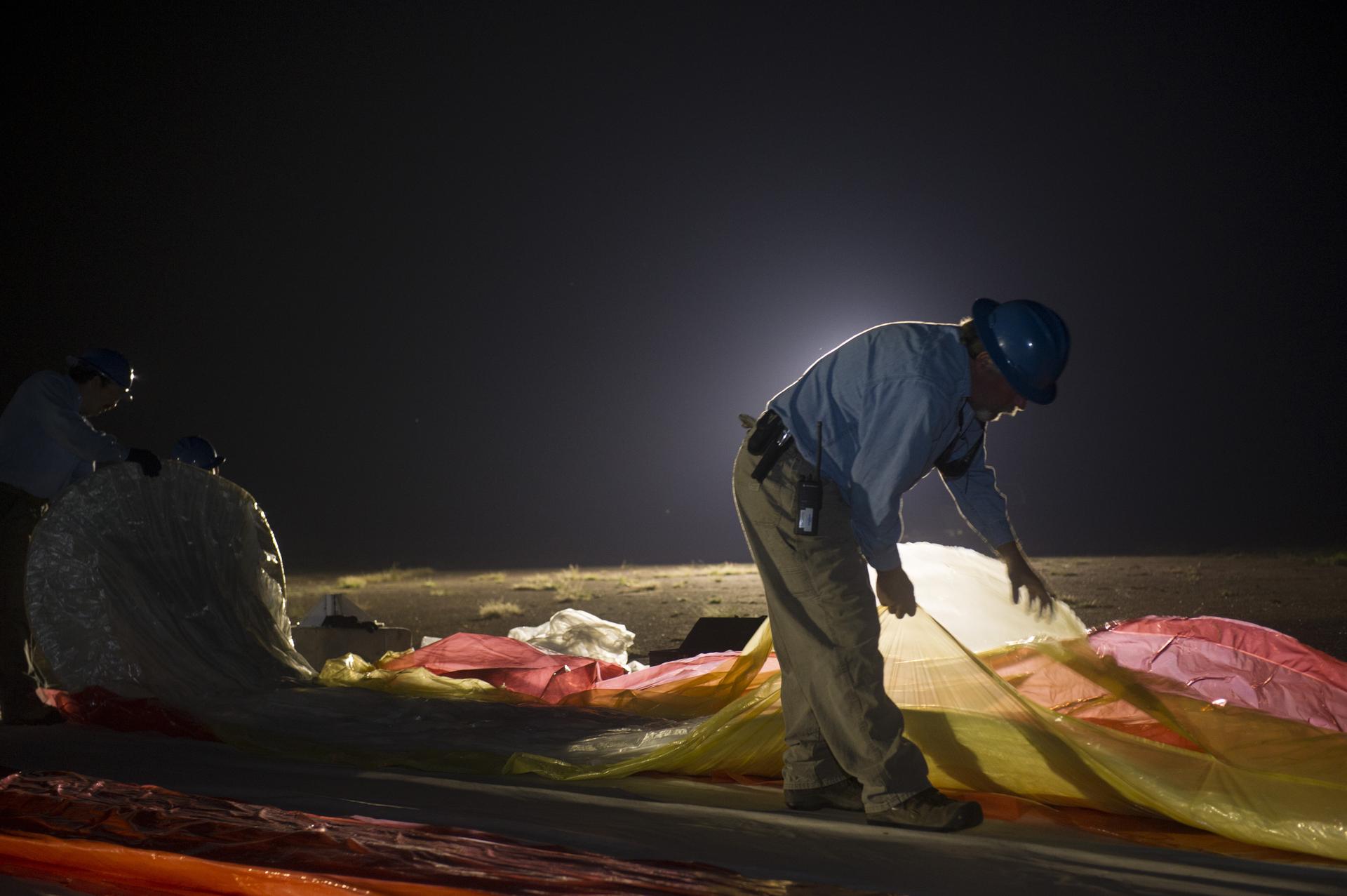
On August 24, 2026, a balloon called CLIC 2 — short for Compact Large-sensor Imaging Camera — lifted off by hand from the agency's Fort Sumner launch site at 7:16 a.m. MDT. It carried a small camera system built to do real-time image processing: analyzing terrain as it flies over it and picking out features that would matter to a spacecraft trying to land, the kind of boulder fields, slopes, and craters that have ended more than one robotic mission early. The balloon floated up to roughly 126,000 feet, well into the stratosphere, and stayed aloft for 3 hours and 41 minutes before its flight ended.
CLIC 2 was the second flight of NASA's 2026 Fort Sumner campaign, following the Salter Test Flight two days earlier on August 22. That opening flight had a very different job: playing host to roughly 100 small experiments built by students aged 11 to 18 through NASA's Cubes in Space program, which packs classroom science projects into balloon-ready hardware and lets them fly for real. Four more flights are planned before the campaign wraps, for six total.
Why a landing camera needs a balloon ride
Testing a rover landing-camera system on a balloon rather than, say, a drone or an aircraft comes down to altitude and consequence. At 126,000 feet, the camera is operating in conditions that start to resemble the atmospheric thinness and lighting a spacecraft would encounter on the way down through a planetary atmosphere — or in the vacuum above one. It's also a low-stakes way to run software through its paces. If a real-time terrain-analysis algorithm chokes on a shadow or misreads a ridge line during a Mars landing, there's no second attempt. If it stumbles during a balloon flight over New Mexico, engineers get a data set, a debugging session, and another flight next campaign. That combination — near-space conditions, full recoverability, and a launch site that can turn a payload around in days rather than years — is what makes balloon campaigns like this one a standing fixture of NASA's testing pipeline, not a one-off stunt.
A launch site with a 40-year backstory
Fort Sumner's role in that pipeline goes back to 1986, when NASA opened the facility after a 1985 safety review flagged concerns at its previous balloon site in Palestine, Texas. The New Mexico location sits at about 4,000 feet elevation in De Baca County and has been launching balloons ever since, typically running two campaigns a year — one in May and June, another in September and October — timed to catch the easterly stratospheric winds that carry balloons across the region.
The site's infrastructure has grown to match. Its High Bay building offers a 12.2-meter ceiling and more than 600 square meters of floor space for assembling payloads, and it has used a mobile launch vehicle nicknamed "Big Bill," delivered in 1991 and operational since 1992, capable of handling payloads up to 3,636 kilograms — heavy enough for large scientific instruments, not just camera boxes and student cubesats.
Riding alongside student science
The Salter Test Flight that opened this year's campaign underscores how much of Fort Sumner's calendar is built around education as much as engineering. This year's campaign marks the 20th flight of NASA's High-Altitude Student Platform, a program that over two decades has flown payloads from more than 1,900 students across roughly 25 U.S. institutions. Cubes in Space, which supplied the roughly 100 experiments that flew August 22, runs on the same premise at a younger age band, giving middle- and high-schoolers a shot at flying an actual science payload rather than a simulation of one. Later in the campaign, a Wallops Arc Second Pointer flight will test an instrument built to study the solar corona — a precursor, according to NASA, to a future mission in Antarctica. Between the landing-site camera, the pointing instrument, and the student payloads, this year's six flights span the range of what a balloon program is for: proving out flight hardware, training the next generation of engineers, and giving already-built instruments a cheap dress rehearsal before they go somewhere far more expensive to reach.
Why It Matters
Landing on another world is still one of the least forgiving problems in spaceflight. A rover descending toward Mars or the Moon has minutes, sometimes seconds, to reconcile where its guidance system thinks it's headed with what the ground actually looks like — and by the time engineers on Earth would see the images, the vehicle has already landed, crashed, or tipped over. Real-time onboard image processing, the kind CLIC 2 is exercising, is the technology that lets a spacecraft make that call itself. Programs like this rarely make headlines the way a launch or a landing does, but they're where the actual risk gets retired. A camera system that can reliably flag hazardous terrain from a balloon at 126,000 feet is a system that's meaningfully closer to being trusted on a lander headed for a Martian crater or a landing zone near the Moon's south pole. Fort Sumner's dual role — flying hardware destined for other worlds while also training the students who will build the next generation of it — makes the campaign a small but concrete piece of NASA's broader push to put more rovers, and more people, safely on the ground somewhere that isn't Earth.
