
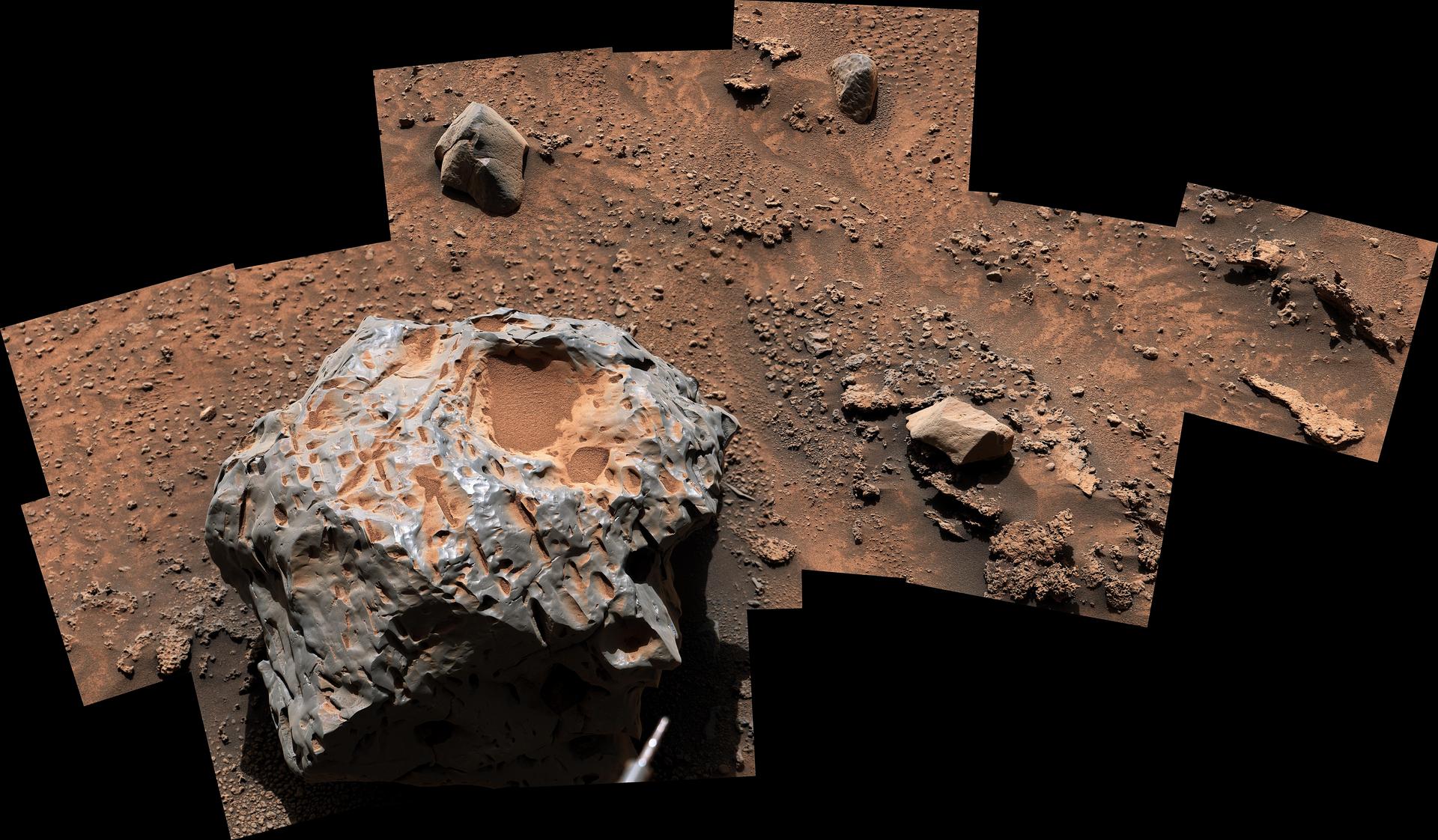
Curiosity has spent the last several years climbing through Gale Crater's layered foothills, and every so often the terrain throws something at the rover's science team that doesn't fit the pattern. During sols 4934 through 4940 — covering late June into early July 2026, per NASA's July 1 blog update — the team found itself parked on top of one of those anomalies: a light-toned rock unit whose surface is stamped with raised, interlocking polygonal ridges. In NASA's own description, the ground looks like "the top of a giant Martian honeycomb."
It's a striking image, and not just a poetic one. The polygons are a real textural feature of the outcrop, growing more pronounced — and more eroded — the deeper the rover moves into the unit, according to the mission's July 1 blog update. Planetary scientists have cataloged polygonal ground on Mars before, usually tied to fracturing from thermal contraction or the drying-out of mud, but each new occurrence has to be examined on its own terms, and this one is entangled with a second, arguably more intriguing mystery sitting right on top of it.
A Honeycomb With Something Living in the Cells
Scattered across the honeycomb unit are dark, pebble- to cobble-sized rocks that stand out against the pale host rock. One of them, nicknamed "Cortadera," became a focus target for the rover's instrument suite: the Alpha Particle X-ray Spectrometer (APXS) for elemental chemistry, the Mars Hand Lens Imager (MAHLI) for close-up texture, and ChemCam's laser spectrometer for a second, independent chemical read. William Farrand, a senior research scientist at the Space Science Institute who wrote the mission's blog update and was quoted by The Debrief, is the one who likened the scene to "the top of a giant Martian honeycomb" — a description that covers both the polygonal ridges and the dark clasts scattered across them, near features the team has informally named "Miraflores butte" and "Cordillera mesa."
The reason these particular dark rocks warrant instrument time rather than a drive-by photo is chemistry, not aesthetics. Previous measurements of similar dark "float" rocks in Gale Crater turned up nickel — an element that shows up abundantly in iron-nickel meteorites but only rarely in native Martian rock. That combination is exactly the kind of signal that makes a geologist pause.
Three Explanations, One Data Set
Nickel enrichment alone doesn't settle the question of what these rocks actually are, and the mission team has been careful not to jump to the most dramatic answer. As laid out in the July 1 blog post, there are three live explanations on the table:
- Local origin from higher up the stack. The dark rocks could be fragments shed from rock layers higher in Gale Crater's stratigraphy, transported downslope and now resting on the honeycomb unit as float debris rather than being native to it.
- Ejecta from a distant impact. Nickel-bearing material can also be delivered by an impact event elsewhere on Mars, with debris flung far enough to land in Gale Crater without the rock itself being a meteorite in the traditional sense.
- An actual meteorite. The straightforward reading — a metallic space rock that fell to the surface and has simply been sitting there, weathering slowly in the thin Martian atmosphere.
None of the three can yet be ruled out on the strength of composition alone, which is why the rover deployed its full trio of contact-science instruments rather than relying on a single measurement. MAHLI's close-up imagery can pick up textural clues — a fusion crust, a distinctive fracture pattern, metallic luster — that chemistry by itself won't reveal, while ChemCam's laser can sample composition from a distance and cross-check the APXS readings on grain-scale detail APXS can't resolve.
This isn't Curiosity's first rodeo with candidate meteorites. Back in 2016, the rover examined a golf-ball-sized rock nicknamed "Egg Rock" and, using ChemCam's laser spectrometer — the first time that instrument had ever been trained on a Mars meteorite — confirmed it was an iron-nickel object also carrying phosphorus, according to JPL's own reporting. JPL noted at the time that iron-nickel meteorites are a well-known class of space rock and that "previous examples have been seen on Mars" by rovers, placing Egg Rock within a broader, ongoing pattern rather than a one-off curiosity. That precedent is exactly why nickel readings from unremarkable-looking dark rocks get flagged for a closer look rather than dismissed: Mars has already proven it can preserve chunks of extraterrestrial iron in plain sight for a rover to stumble across.
Why It Matters
Distinguishing between these three origin stories isn't just a bookkeeping exercise. If the dark, nickel-bearing rocks turn out to be meteorites, they add to a small but growing inventory of extraterrestrial material recovered — remotely, at least — from the Martian surface, material that can record how long rocks have sat exposed and weathering in Gale Crater's environment. If instead they're impact ejecta or displaced local fragments, they tell a different story: one about the crater's more recent geologic history, the mixing of material across the landscape, and the processes that move rock fragments around long after they're deposited. Either way, sorting fact from happenstance in a handful of fist-sized rocks requires exactly the kind of patient, multi-instrument cross-checking Curiosity is built to do — a reminder that even a decade-plus into its mission, the rover is still turning up scenes, like a light-toned outcrop dressed in giant honeycomb ridges, that nobody predicted it would need to explain.
Sources
- Curiosity Blog, Sols 4934-4940: In the Land of the Polygons — NASA/JPL
- NASA's Curiosity Rover Is Investigating Unusual Polygon Structures That Look Like a 'Giant Martian Honeycomb' — The Debrief
- Curiosity Blog, Sols 4934-4940: In the Land of the Polygons (mirrored coverage) — Overlook Horizon
- Curiosity Mars Rover Checks Odd-Looking Iron Meteorite — JPL/NASA
