
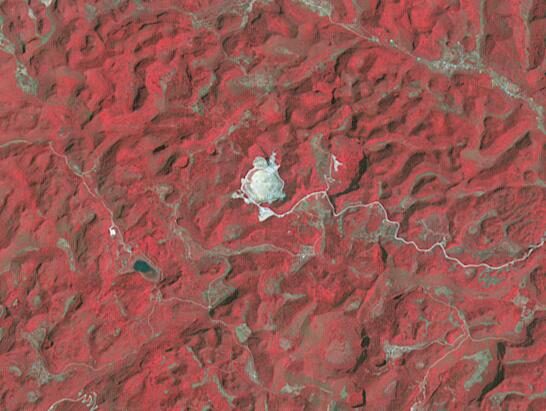
The Arecibo radio telescope in Puerto Rico was, for 53 years, the largest single-dish radio telescope in the world. At 305 meters in diameter, it could detect fainter radio sources, resolve finer structure, and survey the sky faster than any other instrument of its type. Then Arecibo collapsed in December 2020, and the title passed to a dish that had already been operating for four years in a karst depression in Guizhou Province, China: FAST, the Five-hundred-meter Aperture Spherical Telescope. FAST is not just 64 percent larger in diameter than Arecibo. Its collecting area — the surface that gathers radio waves — is roughly twice as large, making it correspondingly more sensitive. Faint signals that would have required days of Arecibo integration time can be detected by FAST in hours.
FAST uses a design that Arecibo pioneered but FAST extended: a fixed dish built into natural terrain, with a moveable receiver platform suspended above it by cables. The dish itself is active — it consists of 4,450 triangular aluminum panels that can be individually adjusted to focus a portion of the dish at different parts of the sky. By adjusting the panels and moving the suspended receiver, FAST can observe up to 40 degrees from zenith, covering a larger sky area than Arecibo's 20-degree limit.
Pulsar discoveries
The most immediate payoff of FAST's sensitivity has been in pulsar astronomy. Pulsars are rotating neutron stars that emit beams of radio emission, detectable on Earth as periodic pulses when the beam sweeps past. They are extraordinarily regular timekeepers — the best millisecond pulsars rival atomic clocks in stability — and they are powerful probes of gravity, plasma, and stellar evolution. FAST has discovered more than 800 new pulsars since it began science operations, more than doubling the number found by any previous instrument in comparable time. Among these discoveries are pulsars in globular clusters, millisecond pulsars in binary systems, and the first pulsar found in the Magellanic Clouds by a ground-based telescope operating at its operational site rather than a dedicated survey mode.
FAST has also contributed significantly to fast radio burst (FRB) science. The mechanism behind FRBs — millisecond-duration bursts of intense radio emission from cosmological distances — remains contested, though magnetars (highly magnetized neutron stars) are the leading candidate for at least some sources. FAST's sensitivity has allowed it to detect individual bursts from FRB sources that were previously too faint to study in detail, including bursts with complex time-frequency structures that constrain the emission mechanism. The repeating FRB source FRB 20121102A was observed by FAST to produce more than 1,600 bursts in 47 days in 2020 — an unprecedented observation that ruled out certain single-event models and provided the most detailed view of FRB burst statistics ever assembled.
SETI and the neutral hydrogen line
FAST is the most powerful instrument in the world for observing the 21-centimeter neutral hydrogen emission line, which permeates the galaxy and is the primary probe of the Milky Way's structure and kinematics. It is also the frequency range that early SETI researchers, including Carl Sagan, considered the most logical channel for interstellar communication — rational beings throughout the galaxy would know about the 21-centimeter line. FAST has conducted commensal SETI observations alongside its primary science programs, piggyback-recording data from all observed directions. No confirmed extraterrestrial signal has been found, but the surveys have placed new limits on the prevalence of strong narrowband radio emitters in the searched sky volume. The telescope will continue searching for pulses, lines, and structures that do not match anything in the catalog of known astronomical sources. So far, everything has matched. But the universe has surprised radio astronomers before — pulsars themselves were initially classified as a 'LGM signal' (Little Green Men) when Jocelyn Bell first detected them in 1967, before their physical nature was understood. FAST has the sensitivity to detect signals that no previous telescope could hear. What that means for the catalog of known sources depends on what the universe has been hiding at the threshold of prior instruments.
