
On April 28, 2020, a burst of radio energy shot across the Milky Way at the speed of light. It lasted about a millisecond. In that millisecond, it released as much energy as the Sun will radiate in a year. The source was SGR 1935+2154, a magnetar roughly 30,000 light-years away, and the burst it produced was similar in every measurable way to the signals astronomers had been detecting from billions of light-years away since 2007 — except they could now identify who fired it.
Fast radio bursts, or FRBs, had been a controlled mystery for thirteen years. They were real — multiple independent telescopes confirmed them. They were extragalactic — the way their radio frequencies dispersed as they traveled through intergalactic plasma showed they had crossed cosmological distances. They lasted milliseconds, which constrained the size of their source to something smaller than a few hundred kilometers. But in a universe full of exotic compact objects, a millisecond radio flash is not easily pinned to a single culprit. The 2020 detection of FRB 20200428A from SGR 1935+2154 was the first time a source had a name.
CHIME and the population problem
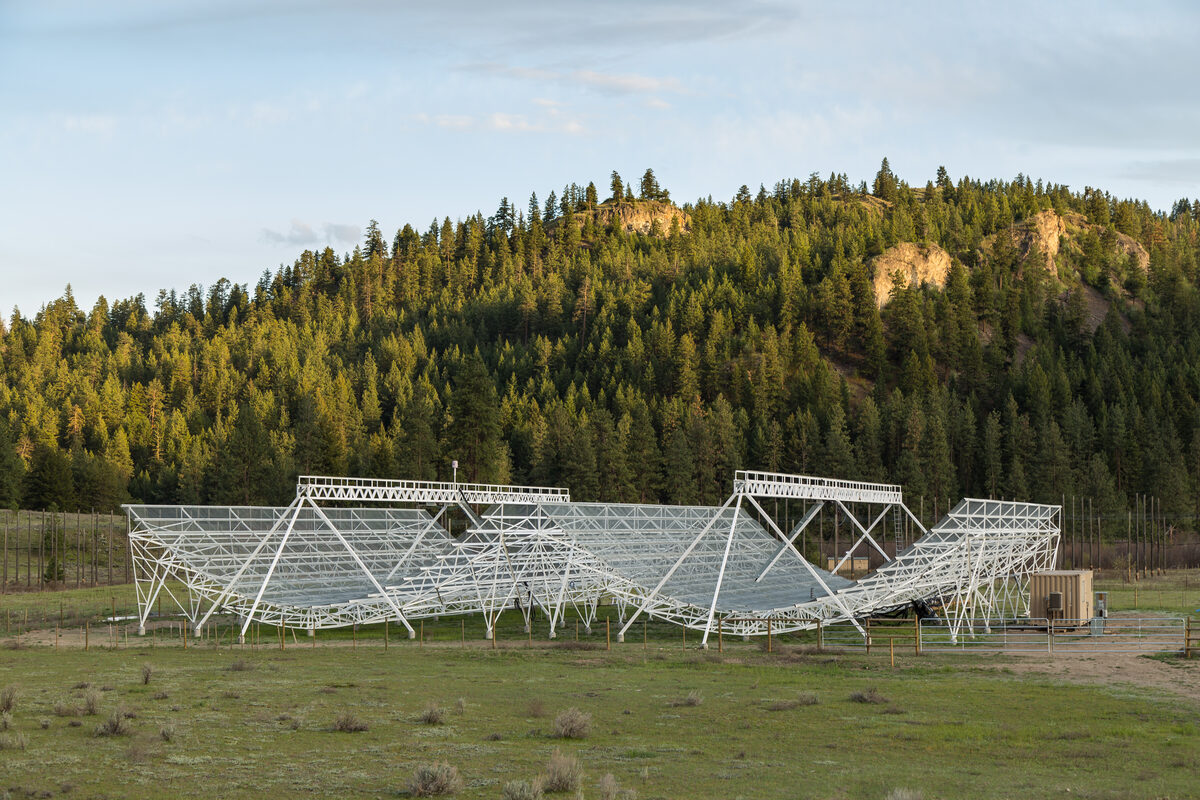
Before the Canadian Hydrogen Intensity Mapping Experiment came online in 2018, FRBs were rare events — a few dozen confirmed, each requiring telescope time to catch. CHIME changed the scale of the problem. The instrument is a set of stationary cylindrical radio antennas covering the entire sky above it as the Earth rotates, with no moving parts and no pointing delays. It detects roughly a thousand FRBs per year. The CHIME/FRB catalog now lists hundreds of well-localized events, and the rate implies there are thousands happening across the visible universe every day.
What the catalog revealed is that FRBs are not a single phenomenon. Most fire once and are never detected again — single bursts from unknown locations with no afterglow, no associated galaxy identification, nothing to follow up. But a subset repeat. FRB 20121102A, discovered in 2012 and still firing, has been localized to a dwarf galaxy 3 billion light-years away and sits inside an extreme magnetized environment near a persistent compact radio source. FRB 20190520B repeats and varies in ways that look like material falling toward or around a dense object. The repeating bursts often show sub-millisecond structure, implying something inside the source changes on sub-kilometer scales.
What the magnetar link tells us
SGR 1935+2154 does not settle the FRB question so much as sharpen it. The burst from the Milky Way magnetar was real but atypically faint — the same event from an extragalactic magnetar would have been detectable by CHIME but would have sat near the bottom of the population in energy. The most energetic FRBs are 10,000 times more powerful. If magnetars are the source, they must sometimes produce bursts far outside the range of anything SGR 1935+2154 has done — either through mechanisms not yet understood, or because a subset of FRBs come from magnetars in unusual states, such as newly formed millisecond magnetars following a neutron star merger.
Alternative models have not been ruled out. Young pulsars in supernova remnants, compact binary interactions, and even exotic scenarios involving cosmic string cusps have been proposed. The fact that most FRBs do not repeat is either because the source is destroyed in the burst, because the repetition rate is too low to observe, or because non-repeating FRBs have a different physical origin than repeaters. The field currently operates under the working assumption that FRBs may be a diverse population with more than one parent class, the way gamma-ray bursts turned out to be two distinct phenomena — long-duration from collapsars, short-duration from neutron star mergers — that had been lumped together by detection characteristics alone.
FRBs as cosmological probes
Whatever their origin, FRBs are now being used as tools. Each burst's radio signal is smeared in frequency by the free electrons it encounters on its path across the universe. That dispersion measure is a proxy for the integrated column of electrons — and therefore for the baryon density between source and observer. Because the standard cosmological model predicts how many baryons exist, FRBs provide an independent test of where those baryons live. The problem of the "missing baryons" — the gap between the baryons predicted by Big Bang nucleosynthesis and those observed in galaxies and their halos — appears to be partially resolved by FRB dispersion measurements that detect gas in the cosmic web filaments between galaxies. It was not a convenient coincidence that the most energetic millisecond events in the universe turned out to be useful rulers.
The next generation of instruments — DSA-2000 in the US, BURSTT in Taiwan, the Square Kilometre Array — will push the FRB detection rate from thousands to millions per year, and will localize a substantial fraction of them to host galaxies. The host demographics — dwarf vs. massive galaxies, star-forming vs. quiescent — will constrain the delay time between stellar death and FRB activity, and eventually distinguish between magnetar models that require young stellar populations and those that do not. The burst from SGR 1935+2154 was a first answer, not a final one.
