
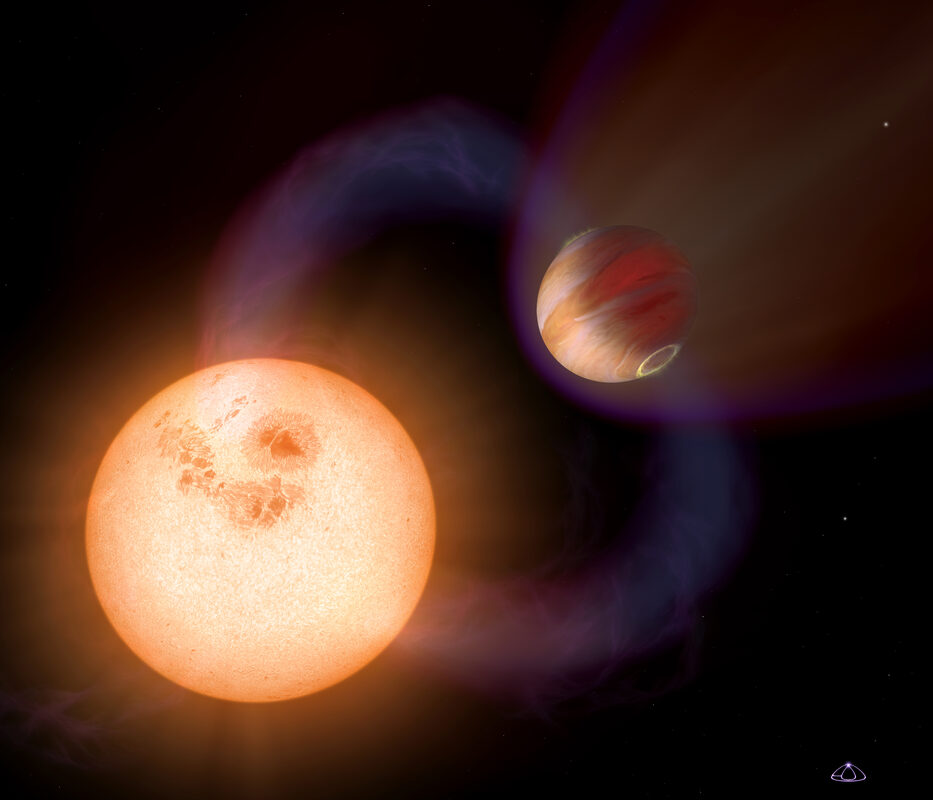
The first confirmed detection of carbon dioxide in an exoplanet atmosphere was announced on August 25, 2022 — less than eight months after Webb launched. The planet was WASP-39b, a hot Jupiter orbiting a sun-like star 700 light-years away. Transmission spectroscopy — measuring which wavelengths of starlight the planet's atmosphere absorbs as it transits its star — had been tried before with Hubble and Spitzer. But Webb's sensitivity in the near-infrared and mid-infrared is orders of magnitude better than its predecessors, and the CO₂ absorption feature at 4.3 microns emerged from the data with a confidence of 26 sigma, roughly speaking impossibly clear. Hot Jupiters had been detected, characterized, and dismissed as freaks of close-in migration; Webb turned one into a chemistry laboratory.
What followed in the first two years of Webb science operations is a systematic survey of exoplanet atmospheres across a range of planet types that had been barely studied. WASP-39b's atmosphere revealed not just CO₂ but sulfur dioxide, water vapor, potassium, and sodium — a detailed chemical inventory that matched some predictions of photochemical models and contradicted others, particularly in the ratio of carbon-to-oxygen that the models had assumed. The sulfur dioxide was especially significant: it forms by photochemistry when sulfur-bearing molecules interact with ultraviolet light from the host star, and its detection confirmed that photochemistry is detectable in exoplanet atmospheres with Webb. If photochemistry is visible, so too might be other photochemically produced species — including some produced by biology.
The sub-Neptunes and the habitable zone
Webb's most scientifically significant exoplanet targets are not hot Jupiters but smaller, cooler worlds. The TRAPPIST-1 system — seven rocky planets orbiting an M dwarf star 40 light-years away — has been at the top of the Webb target list since before launch. Early results from TRAPPIST-1c, the second planet, placed limits on its atmospheric thickness: if it has an atmosphere at all, it is thin, not a thick Venus-like blanket. TRAPPIST-1b, the innermost planet, showed no significant atmosphere at all at the measured wavelengths. The outer planets, including the three in the habitable zone, remain largely uncharacterized at the atmospheric level and will require many transit observations to accumulate enough signal.
The K2-18b result, announced in September 2023, was the most controversial. This planet, 8.6 times Earth's mass, orbits in the habitable zone of its star and had previously shown signs of water vapor in its atmosphere. Webb's observations detected methane and CO₂ at expected levels for an ocean-bearing world — consistent with a "hycean" model of a planet with a hydrogen-rich atmosphere overlying a liquid water ocean. More contentiously, the data also showed a statistical hint of dimethyl sulfide (DMS), a molecule produced almost exclusively by marine microorganisms on Earth. The team was careful to present it as a tentative detection requiring confirmation, not a biosignature claim. It has not yet been confirmed.
What comes next
Webb's exoplanet atmosphere program is constrained primarily by time: each transit event is a fixed observational window that cannot be scheduled on demand, and multiple transits are required to accumulate sufficient signal-to-noise for most targets. The telescope's expected operational lifetime of 20 years means thousands of transit observations are achievable. The current focus on individual worlds will give way to comparative studies — the same technique applied systematically across planet populations to understand how atmospheric composition correlates with planet mass, stellar type, orbital distance, and age. That comparative dataset is what will eventually let astronomers identify statistical biosignature patterns too subtle to detect in any single observation. The transition from individual detections to population statistics marks the maturation of exoplanet atmosphere science from a discipline of firsts to one of averages and distributions. The first CO₂ detection in 2022 will eventually be remembered the way the first exoplanet discovery in 1995 is remembered: as the moment the field became possible, not the moment it became complete.
