
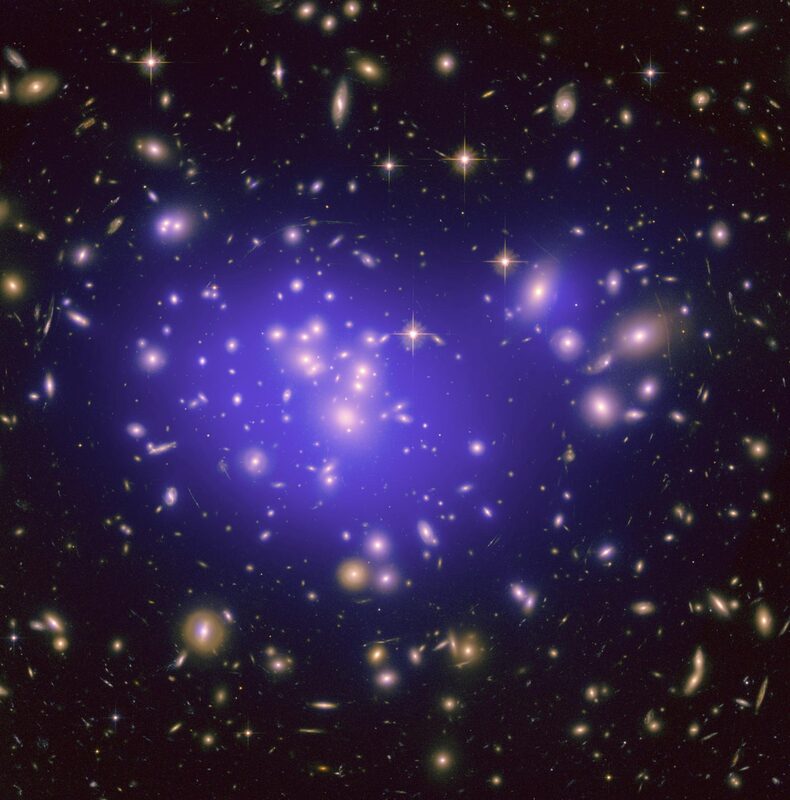
Strong gravitational lenses are rare. A massive foreground galaxy has to sit almost exactly in line with a more distant object for its gravity to bend that light into arcs, rings or multiple images. Hrishabh Srivastava, a doctoral student at the University of British Columbia, was quoted by Universe Today as saying the odds of finding one were about one in 10,000. For decades the result was a small sample. Before Euclid, astronomers had fewer than a thousand confirmed lenses.
That has now changed. Alongside the European Space Agency's first major Euclid data release, DR1, on 12 November, the Euclid Collaboration posted a paper describing the first strong lens catalogue built from the mission's data. It lists 15,072 high-confidence strong lens candidates. On the numbers above, that is many times more than every confirmed lens known before the mission, although these are candidates rather than confirmed lenses. ESA says the catalogue is bigger than all previous lens catalogues combined.
"Over 10 years ago, we forecast that Euclid would revolutionise the field of strong lens discovery. That day is finally here," said Natalie Lines of the University of Portsmouth, quoted by ESA.
A search across 68 million sources
The paper, titled "Euclid Data Release 1 (DR1). Euclid Lens Identification Pipeline and Scientific Exploration (ECLIPSE) A: Strong lens catalogue overview" and submitted on 11 November, covers about 2,000 square degrees of sky. ESA gives the DR1-Foundation Euclid Wide Survey footprint as 1,900 square degrees. DR1 contains roughly 900 million sources. The team searched the 68 million that passed its catalogue selection, which is still far too many for people to inspect one by one.
The search therefore ran in stages. A discovery pipeline combined scores from five machine-learning models with visual classifications from around 7,000 citizen scientists and 67 strong lensing experts. The algorithms cut the haystack down, and human eyes help decide which of the remaining shapes are really lensed light.
Each candidate received a grade. The 15,072 high-confidence objects are made up of 6,073 grade A ("sure lens") candidates and 8,999 grade B ("probable lens") candidates. Another 9,010 grade C ("possible lens") candidates are published alongside them but sit outside that headline figure. These are less certain and will need more scrutiny before anyone relies on them.
What the lenses look like
The catalogue also describes the typical lens. The foreground galaxies doing the bending, called deflectors, are mostly massive quiescent galaxies, meaning galaxies that are no longer forming many stars. Their stellar mass is given as log M* = 11.39, their photometric redshift is 0.68, and their typical Einstein radius is 0.85 arcseconds. The Einstein radius is the angular scale of the lensed ring or arcs. At less than an arcsecond, these features are small enough that the image sharpness of a space telescope matters.
The sample also contains rarer kinds of lens:
- 84 candidate double-source-plane lenses. In these systems a single deflector lenses two background sources at different distances. The paper calls this an exotic class with few previously known examples.
- More than 1,000 candidate disc lenses. Here the deflector is a disc galaxy, not the more common massive quiescent type. This is also a class with few previously known examples.
- Several hundred candidate lensed active galactic nuclei and quasars. These are the bright cores of distant galaxies, seen through the foreground galaxy.
The authors say the sample turns strong lensing from a field of rare discoveries into a statistical tool. With only a few examples of each subclass, the classes could not be studied as groups. With thousands of candidates they can.
Why It Matters
Strong lenses do two jobs. As Universe Today explains, they magnify background objects, so astronomers can see distant objects that would otherwise be beyond observing. They also act as scales. How strongly a lens bends light depends on the total mass of the foreground object, not just its visible mass. That makes lenses a way to measure the presence of dark matter and to map where it sits around galaxies.
With fewer than a thousand confirmed examples, lens studies were limited by small samples. Any population-level result about how dark matter is distributed in massive galaxies had wide error bars, and rare configurations were often single cases. A sample of 15,000 candidates changes that. Researchers can split lenses by deflector mass, redshift or type and still have useful numbers in each group, provided the candidates hold up.
The word "candidates" matters, though. The 15,072 objects have been graded as high-confidence by algorithms and human classifiers, but they have not all been confirmed. Turning candidates into confirmed lenses with measured properties generally requires follow-up work. The grade C list, more than 9,000 objects, is graded only as "possible lenses" and is the least certain part of the release. The team does provide automated lens models for the combined grade A and B systems, along with photometric redshifts and stellar population properties for the deflector galaxies.
Part of a much larger release
The lens catalogue is one product of the DR1-Foundation release. According to ESA's announcement, the release includes over 900 million galaxies, around 15,000 strong gravitational lensing candidates, over 60 million quasar candidates and spectra from more than 160 million sources, in a total of 1.7 million gigabytes of data. ESA describes it as the foundation for Euclid's largest-ever 3D map of the cosmos.
DR1 is also only the first part of the survey. The ECLIPSE A team extrapolates by area to more than 100,000 high-confidence lens candidates in the full Euclid Wide Survey, and Universe Today reports the same expectation of more than 100,000 strong lenses over Euclid's nominal six-year mission. If that holds, the current catalogue of 15,072 would be roughly 15 percent of that eventual total, or about one in seven.
