
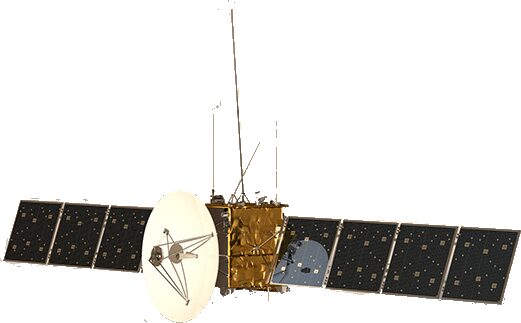
Launching a spacecraft directly to Jupiter from Earth requires more energy than most mission budgets allow. So JUICE took the long way. ESA's Jupiter Icy Moons Explorer, launched on April 14, 2023, will spend eight years threading five planetary flybys before arriving at Jupiter in 2031 — using gravity to bend its trajectory and add speed without burning fuel, turning the solar system's gravitational landscape into a precision navigation tool. By the time JUICE enters Jovian orbit, it will have traveled 6.6 billion kilometers, passed Earth twice, Venus once, and the Moon in ways no spacecraft has quite managed before.
The mission's central target is not Jupiter itself but its moons — specifically the three largest Galilean moons that are suspected of harboring liquid water beneath their icy surfaces. Ganymede, Callisto, and Europa together contain more liquid water than all of Earth's oceans combined, sequestered under crusts of ice that range from a few kilometers to tens of kilometers thick. Whether any of those subsurface oceans are in contact with rocky seafloors, and whether any of them contain the chemical gradients that drive biology on Earth, are among the most consequential open questions in solar system science. JUICE was designed to address them without landing — at least not in this mission.
The gravity-assist sequence
The trajectory JUICE follows is a work of orbital mechanics. In August 2024, the spacecraft flew past both the Moon and Earth in a dual flyby, a maneuver that had never been attempted before: approaching the Moon first, then using its gravity to set up a precisely targeted Earth flyby 36 hours later. The Moon flyby is too weak to provide meaningful trajectory change on its own, but it bends JUICE's path in a way that makes the Earth flyby far more efficient — and the combined maneuver added roughly 11 kilometers per second to JUICE's solar-relative velocity at the cost of no propellant. In August 2025, JUICE flew past Venus. In September 2026, it returns to Earth for a second flyby. A final Earth flyby in November 2029 sends it on its terminal leg toward Jupiter.
The Jovian system tour begins in July 2031. JUICE will spend more than three years in the Jovian system, performing 21 flybys of Ganymede, 21 of Callisto, and 2 of Europa — Europa is limited by radiation exposure, as it orbits within the most intense part of Jupiter's radiation belts. The mission culminates in late 2034, when JUICE transitions to a Ganymede orbit. This is the mission's signature achievement: becoming the first spacecraft ever to achieve orbit around a moon other than our own Moon, circling Ganymede from an altitude of 500 kilometers before descending to 200 kilometers in the final phase.
What JUICE is listening for
JUICE carries ten scientific instruments. The Radar for Icy Moon Exploration (RIME) will penetrate the ice crusts with a 9-MHz radar signal, searching for liquid water reservoirs or briny pockets in the first 9 kilometers of depth. The JANUS camera system will map each moon's surface in multiple wavelengths. The Magnetometer (J-MAG) will measure Ganymede's intrinsic magnetic field — unique among the moons of the solar system — and detect the electromagnetic signature of Ganymede's subsurface ocean through the way it responds to Jupiter's changing magnetic environment. The JUICE UVS and MAJIS spectrometers will characterize the composition of the surfaces and thin exospheres of each moon.
For Ganymede specifically, the ice thickness above the ocean is estimated at 80 to 170 kilometers — far too deep for current radar to probe directly. What JUICE can measure is the induced magnetic signature of the ocean's response to Jupiter's field, which varies with the ocean's salinity and depth. Combined with geodetic measurements of how Ganymede's shape responds to Jupiter's tidal pull — detected through precision radio science — the team expects to constrain the ocean's properties within a factor of two. This will not be detailed enough to characterize habitability, but it will settle whether the ocean is in contact with the rocky mantle below, which is the critical question: water-rock contact, driven by tidal heating, is the template for the hydrothermal chemistry that drives life on Earth's ocean floors.
JUICE arrives at a time when every new data point from the outer solar system adds to an emerging picture of habitable environments as remarkably common. The mission cannot answer whether those environments host life. But it will determine which questions are worth asking — and which moon deserves a lander next.
