
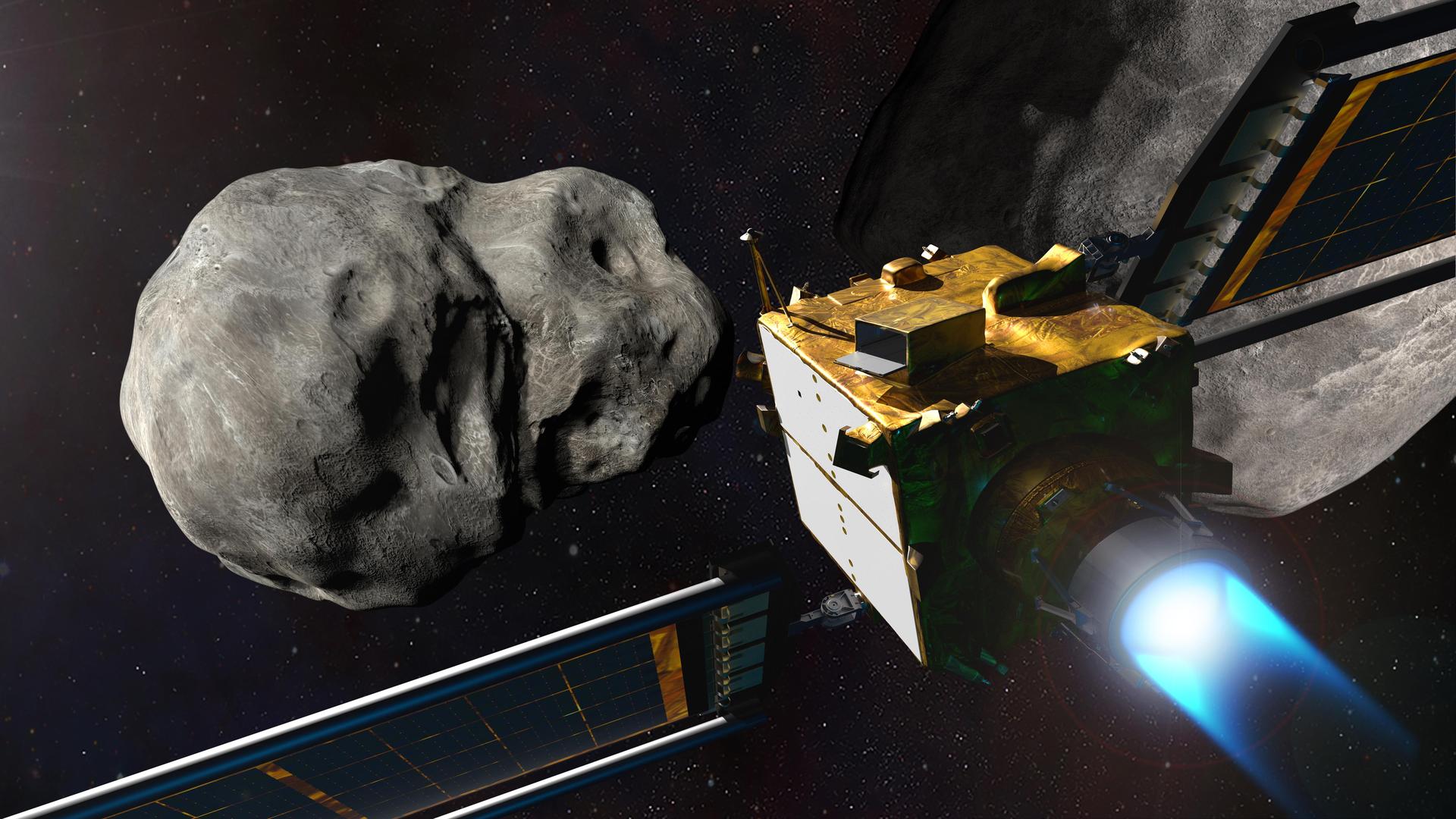
In a cleanroom at OHB Italia in Milan, a spacecraft that until now existed mostly as calculations, simulations and unit tests has drawn electrical power for the first time. ESA has confirmed the first switch-on of Ramses, the planetary-defence mission it is building with Japan's space agency JAXA to meet the asteroid Apophis when it sweeps past Earth in 2029. The event is modest to look at, since it is a computer and its supporting electronics coming to life inside the spacecraft body. In a schedule this tight, though, it is exactly the sort of milestone that shows whether the plan is holding.
What Was Switched On
According to ESA, the test energised the Core Module, the central part of the spacecraft, which is being built at OHB Italia. First power went to the On-Board Computer along with its Mass Memory Unit, the Power Conditioning and Distribution Unit, and the Remote Terminal Units. Together these form the spacecraft's brain, its data storage and its electrical backbone: the units that decide what the spacecraft does, remember what it has seen, and route power to everything else.
ESA's account includes comments from lead engineer Ingo Gerth, Arnaud Bourdoux, OHB Italia's Giuseppe Filomeno and ESA project manager Paolo Martino. Powering these units together is the first time the integrated subsystems have been shown to work as a system rather than as separate boxes, and it opens the way to the integrated functional testing that follows.
A Build in Two Halves
Ramses is being assembled in parallel. The Core Module comes together in Milan, while the Propulsion Module is being dressed at ArianeGroup in Lampoldshausen, Germany. Universe Today describes the approach as a two-part parallel build, with the core module in Milan and the propulsion module in Germany.
The two halves will meet next spring at ESTEC, ESA's technical centre in Noordwijk, the Netherlands, where they will be mated into a single spacecraft. After that comes a thermal vacuum test, which ESA says will take two to three weeks. The test exposes the assembled spacecraft to the airless, temperature-swinging conditions it will face in space.
An OHB Italia release dated July 31, 2026, which is a company source and used here only as background, gives further context. It says the flight panels were ready for spacecraft integration after just four weeks of assembly, integration and test activities. It also puts Ramses' launch mass at about 1,250 kg and says the spacecraft is designed for velocity changes of up to 1,650 m/s. Those figures come from the manufacturer rather than ESA.
The Calendar Is the Constraint
Most spacecraft programmes can slip a few months if a component arrives late. Ramses cannot, because its target does not wait. ESA says the spacecraft must reach space by spring 2028 to rendezvous with Apophis as the asteroid passes Earth on Friday, 13 April 2029. Universe Today puts Apophis' closest approach at about 32,000 km from Earth's surface.
The timeline is short. ESA notes that the project runs to under 3.5 years from contract signing to liftoff. Universe Today reports that preliminary contracts were signed in October 2024 and that the full construction contract followed on Feb. 10, 2026. OHB Italia's release adds that launch is scheduled for April 2028, with rendezvous with Apophis in February 2029, two months before close approach.
The launch vehicle is Japan's H-3 rocket. Ramses will not fly alone: ESA says two CubeSats will accompany it on the launch in spring 2028.
Why It Matters
Apophis is a rare opportunity. An asteroid passing within about 32,000 km of Earth's surface gives scientists the chance to observe a large near-Earth object during a very close encounter, and to do so with a spacecraft already alongside. Planetary defence depends on knowing how asteroids behave, and a close encounter is a natural experiment that no one has to engineer.
The switch-on also matters as a test of process. Building a deep-space spacecraft in under 3.5 years, with modules built in different countries by different teams and joined only in the spring, leaves little room to discover integration problems late. Getting the computer, memory, power distribution and terminal units to work together this early should give engineers time to find those problems while they can still be fixed. It is a step, not a guarantee: the mating at ESTEC, the thermal vacuum campaign and the launch all remain ahead, and the launch date is fixed by orbital mechanics, not by convenience.
