
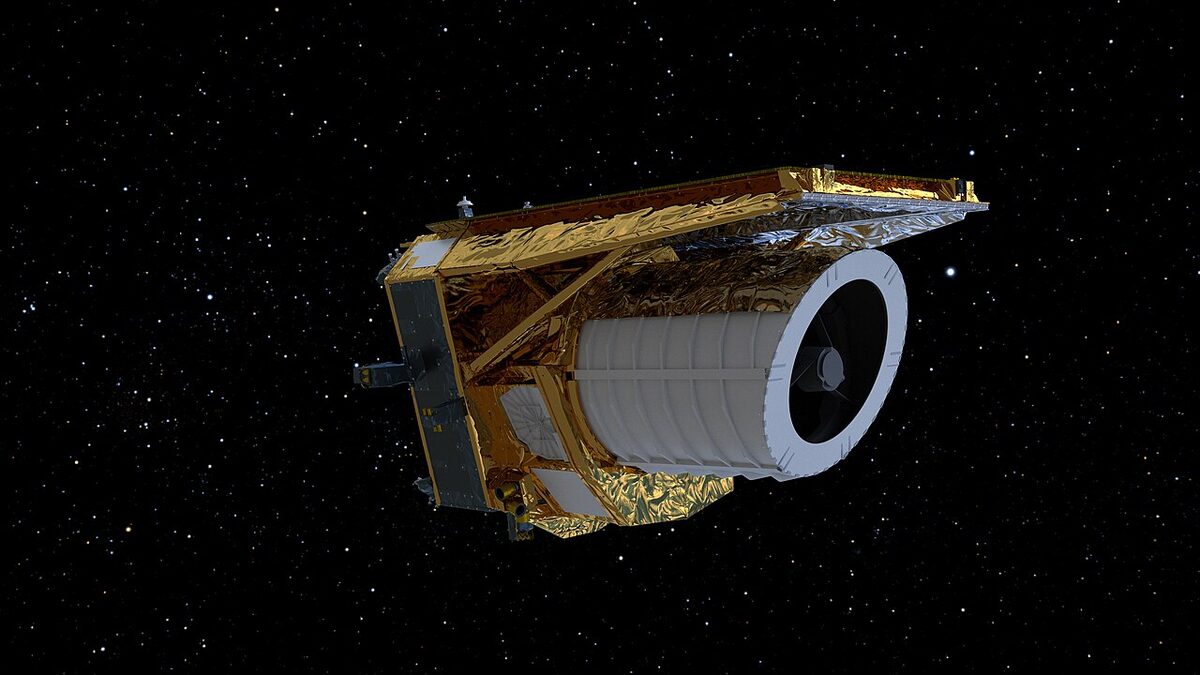
Here is the uncomfortable truth at the centre of modern cosmology: everything we can see — every star, planet, and glowing cloud of gas — adds up to only about five percent of the universe. The rest is dark. Roughly a quarter is dark matter, an unseen substance that betrays itself only through gravity, and the remaining two-thirds is dark energy, the even more mysterious influence driving the universe to expand at an accelerating rate. We do not know what either one is. The European Space Agency's Euclid telescope was built to study them the only way we can: by their effects on the things we can see.
Mapping the invisible by watching the visible
Euclid, launched in July 2023 and now in routine operation, is surveying an enormous swath of the sky with two complementary tricks. The first is weak gravitational lensing. Dark matter has mass, and mass bends light, so the gravity of dark matter between us and distant galaxies subtly distorts the shapes of those galaxies — squashing and stretching them by tiny amounts. By measuring the shapes of billions of galaxies and statistically teasing out that distortion, Euclid maps where the dark matter actually sits, in three dimensions, across cosmic time. The second trick measures how galaxies cluster on the largest scales, a pattern imprinted in the early universe that acts as a cosmic ruler — letting astronomers track how fast the universe has expanded at different epochs, and therefore how dark energy has behaved.
The scale of the survey is what makes it powerful. Over its mission Euclid aims to chart the shapes and distances of billions of galaxies spanning roughly ten billion years of history — a third of the observable universe. No survey has ever combined this breadth, depth, and precision. The telescope pairs a wide field of view with sharp vision, capturing in single exposures vistas that would take other observatories countless pointings.
The hardware is tuned for the task. Euclid's 1.2-metre telescope feeds two instruments: a visible-light camera that measures the precise shapes of galaxies for the lensing analysis, and a near-infrared spectrometer and photometer that gauges their distances — the third dimension that turns a flat image into a map of cosmic structure through time. The observatory works from the Sun–Earth L2 point, the same gravitationally stable spot a million and a half kilometres out where the James Webb Space Telescope sits, far from the heat and glare of Earth, where it can stare into the dark with the stability such delicate measurements demand.
From first glimpses to the real test
Euclid has already offered tantalizing previews. An early data release in 2025 unveiled deep-field images and a catalogue of hundreds of new gravitational-lens candidates — galaxies whose light is warped by intervening mass — nearly all of them previously unknown, a hint of the sheer volume of discovery the full survey will yield. But the previews are not the point. The mission's first major cosmology data release is scheduled for October 2026, and that is when the science the telescope was built for begins in earnest: precise measurements of how cosmic structure has grown, which translate directly into constraints on the nature of dark energy.
The stakes are conceptual rather than practical. If Euclid's map of cosmic growth matches the predictions of the standard model — in which dark energy behaves like a constant, an unchanging property of space itself — that model is reinforced. If it deviates, even slightly, it would be a signpost toward new physics, a hint that dark energy changes over time or that gravity behaves differently on the largest scales than Einstein's theory predicts. Either way, Euclid is doing something audacious: charting, in detail, a universe that is mostly invisible, by reading the faint fingerprints the dark leaves on the light. The first definitive results are now only months away.
