
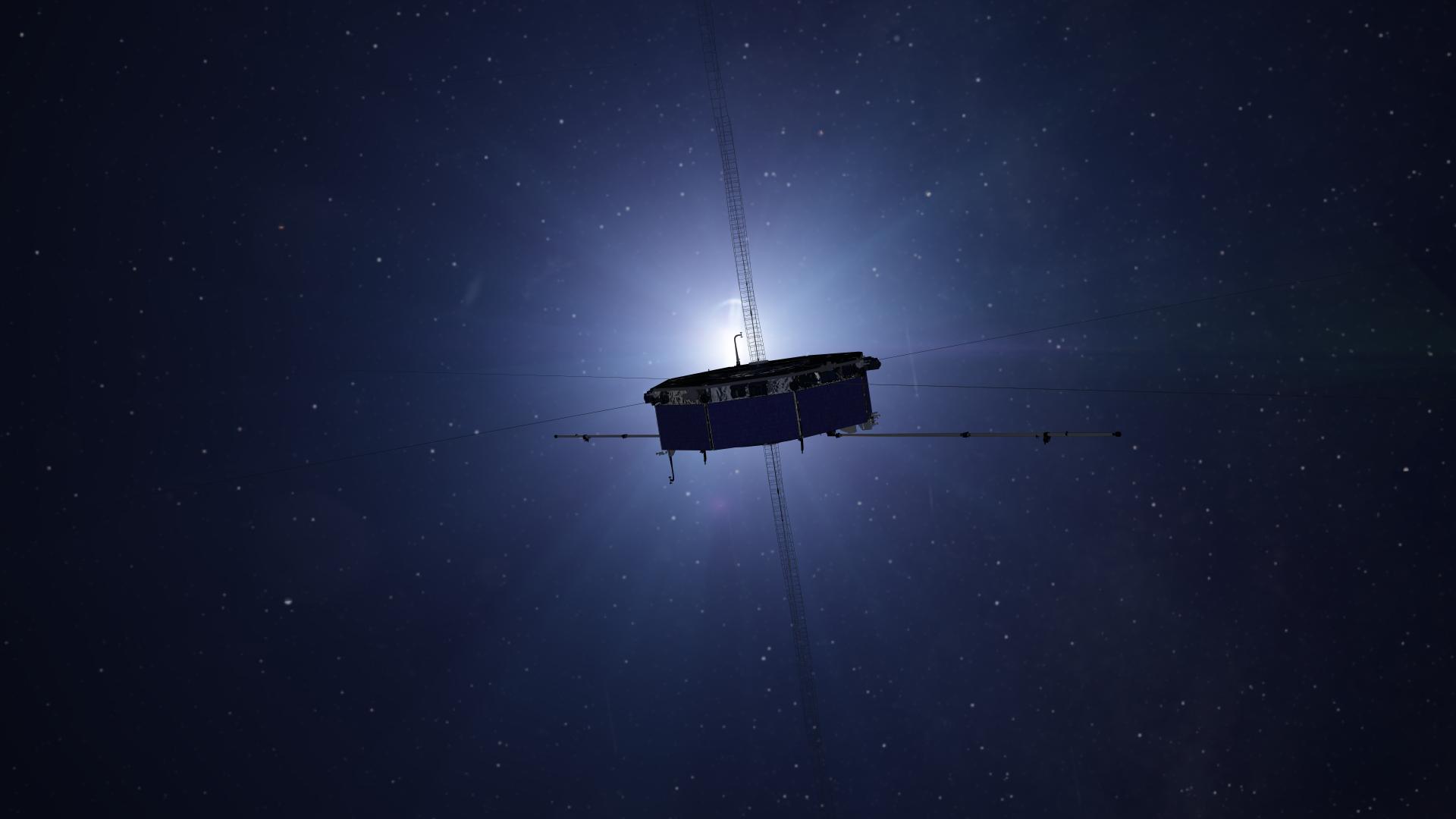
Four months after a Vega-C carried it off the pad in Kourou, the joint ESA-Chinese Academy of Sciences Smile mission has been declared ready to do science. The approval came on 23 September 2026, and ESA announced it. One of the spacecraft's two imagers is already delivering. The other is waiting for a stray-light problem to fade.
From launch to science orbit
Smile launched on 19 May 2026. According to Tech Times' launch-day coverage, the Vega-C lifted off from Kourou at 05:52 CEST and placed the spacecraft in a 707 km parking orbit. Solar arrays were confirmed to be generating power by 06:49 CEST, as reported through the New Norcia ground station. The spacecraft reached its science orbit on 20 June, and ESA says it went from pieces of hardware to collecting science data in just over two years. A documentary, Let's Smile, covers the period from June 2024 to May 2026.
Tech Times describes Smile as the first satellite to image Earth's magnetosphere in X-rays.
Four instruments, two cameras
The payload has four instruments, as listed by ESA and by UCL's Mullard Space Science Laboratory:
- SXI, the soft X-ray imager. It pairs a wide-field lobster-eye micropore optic with a CCD and images the dayside magnetosheath. Its principal investigator is Steve Sembay of the University of Leicester.
- UVI, the ultraviolet imager. It observes in the Lyman-Birge-Hopfield band and images the polar cap and auroral oval. Its principal investigator is Xiaoxin Zhang of China's National Center for Space Weather.
- LIA, which measures solar wind and magnetosheath ions.
- MAG, a magnetometer.
The X-rays SXI is built to see come from solar wind charge exchange, in which solar wind ions interact with neutral atoms such as hydrogen in Earth's exosphere, according to the MSSL payload page. That is what should let the instrument outline the boundary where the solar wind meets Earth's magnetic field.
What is working
The UV imager is the success story so far. Its first footage was taken on 24 July 2026, two weeks after switch-on, and shows an auroral substorm. ESA says UVI is the first camera since 2008 to capture the full northern auroral ring in ultraviolet. It now records for 45 hours at a time. Tech Times puts Smile's orbit at 48 hours, so that is most of each orbit.
SXI has also returned first test images. They include Cassiopeia A and a supernova remnant in the Large Magellanic Cloud, which are useful targets for checking that the optic and detector behave as designed. ESA says the camera itself is working very well.
What is not working yet
When SXI points at Earth, it detects too much stray light. ESA says specific settings and software updates are being implemented onboard, helped by the instrument's design, which can be adjusted remotely. ESA also says the unwanted light is reducing naturally: Smile is steadily pointing farther away from Earth, and less light is emitted by the North Pole as the year moves toward northern winter. It is due to reach a minimum in mid-October. At that point, ESA says, SXI would take its first good image of the magnetopause or the northern polar cusp. The mid-October minimum is the date to watch.
Why It Matters
Earth's magnetosphere is usually studied by spacecraft that sample it at one place at a time. Smile is designed to image it, with SXI looking at the dayside magnetosheath while UVI watches the aurora that results from the same interaction. Putting an X-ray view of the boundary together with a continuous UV view of the auroral oval is the mission's central idea. So far only half of it has been demonstrated: UVI is delivering, and SXI is still waiting on the stray-light decline before it can take the images the mission was built for.
ESA Director of Science Carole Mundell is quoted in the agency's announcement on the milestone, saying Smile is now approved to begin science operations. The formal declaration of readiness marks the end of the in-space commissioning period, with the most important open question being how SXI performs once the stray light is at its minimum.
