
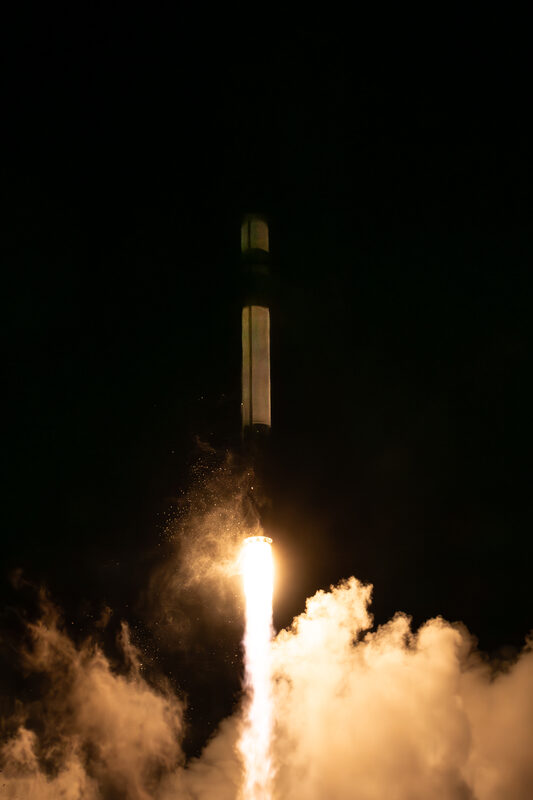
A German rocket has spent months at Scotland's SaxaVord Spaceport, still waiting to prove it can survive its own engines. On September 23, the European Space Agency said it would put up €2.7 million more to help get it there — money aimed not at the rocket itself, but at the test stands needed to certify the hardware underneath it.
The funding, awarded under ESA's Boost! commercial-launch program and channeled through the UK Space Agency, will finish infrastructure at SaxaVord Spaceport: dedicated hot-fire stands for individual Helix 1.0 engines, plus a separate rig for fully integrated second stages of Rocket Factory Augsburg's RFA ONE vehicle. It's infrastructure money, not launch money — but for a company whose rocket has already been pulled apart once after a test went wrong, it's the difference between a static pad and a working test campaign.
What actually got funded
RFA ONE is a modest vehicle by orbital-rocket standards: about 30 meters tall, 2.15 meters in diameter, designed to carry roughly 500 kilograms to a 500-kilometer sun-synchronous orbit. That puts it squarely in the small-launcher class competing for a slice of the smallsat market alongside Rocket Lab's Electron and a crowd of similarly sized European hopefuls.
What makes RFA ONE notable isn't its payload capacity — it's the flag it would be flying. No orbital rocket has launched vertically from UK soil. SaxaVord, built on the northern tip of Shetland specifically to host that milestone, has spent years assembling the regulatory approvals and physical infrastructure for a launch that keeps slipping.
The new €2.7 million is earmarked specifically for the ground systems that let RFA test before it flies: stands that can hot-fire a single Helix 1.0 engine in isolation, and separately, a rig sized for a complete, integrated RFA ONE second stage. According to ESA's announcement and reporting from European Spaceflight, this extension pushes RFA's cumulative Boost! funding — spread across German, Portuguese, and UK components of the program — past €33 million.
Why the first stage had to be rebuilt
RFA's path to this point hasn't been smooth. European Spaceflight's coverage traces the delay to an August 2024 static-fire test that destroyed the original RFA ONE first stage built for the mission. RFA built a replacement, and by July 2026 had a fully integrated RFA ONE erected on the pad ahead of a planned static-fire test — only for the company to hit a new, unspecified issue after about a week of testing and decide to destack the vehicle for further investigation. As of European Spaceflight's September 24 report, RFA had given no update on when the rocket would return to the pad; ESA's own announcement a day earlier said only that the first RFA ONE is already at SaxaVord Spaceport and that hot-fire tests of the complete rocket are coming "soon."
That kind of setback is common in first-time orbital programs, but it's expensive in a way that's easy to underestimate: every hot-fire test that goes wrong doesn't just cost hardware, it costs pad time, range coordination, and — as this funding round makes clear — infrastructure that has to be built to survive repeated static fires rather than a single clean shot.
Who said what
ESA's own announcement quotes a trio of officials whose interests intersect at SaxaVord: UK Space Minister Baroness Lloyd, RFA Chief Development Officer Stefan Brieschenk, and ESA's Jorgen Bru. The framing from all three, per ESA's release, centers on the same near-term goal — keeping momentum toward RFA's first test flight from British soil, not a specific launch date. Space Brief's September 24 roundup corroborates the funding figure and the stated purpose: hot-fire stands and second-stage integration testing, explicitly framed as preparation for what would be the first vertical orbital launch from UK soil.
None of the three source reports offer a firm launch date, and that omission is itself informative. After a 2024 failure and a mid-2026 destacking, nobody involved is committing to a schedule — only to finishing the test infrastructure that has to work before a schedule means anything.
Why It Matters
Europe's institutional space agencies have spent the past several years trying to seed a domestic commercial launch sector to reduce dependence on Arianespace's Ariane 6 and, implicitly, on non-European providers for smallsat rideshare. Boost! is ESA's mechanism for doing that: rather than owning launch vehicles, the agency co-funds private companies' infrastructure and demonstration flights, betting that a handful of them reach orbit reliably enough to become customers ESA and European governments can rely on.
RFA is one of the furthest along in that cohort, and SaxaVord's push for the UK's first vertical orbital launch carries weight beyond one company's balance sheet — it's a test of whether a purpose-built European spaceport, backed by a mix of national and multinational funding, can actually turn a permitted site into an operational one. The repeated hardware setbacks are a reminder that "first launch from UK soil" has been treated as an achievable near-term headline for a while now, and each round of additional funding is as much an admission of how much ground infrastructure work remains as it is a vote of confidence in RFA's rocket. The €33 million in cumulative Boost! support for RFA alone suggests ESA still sees the investment as worthwhile — but the money is going toward test stands, not a launch date.
Sources
- Rocket Factory Augsburg: ein weiterer 'Boost!' zur Vorbereitung der ersten Starts — ESA
- ESA Awards RFA €2.7 Million in New Funding for SaxaVord Operations — European Spaceflight
- ESA Funds RFA's SaxaVord Launch Buildup, Space Brief 24 Sep 2026 — KeepTrack Space Brief
