
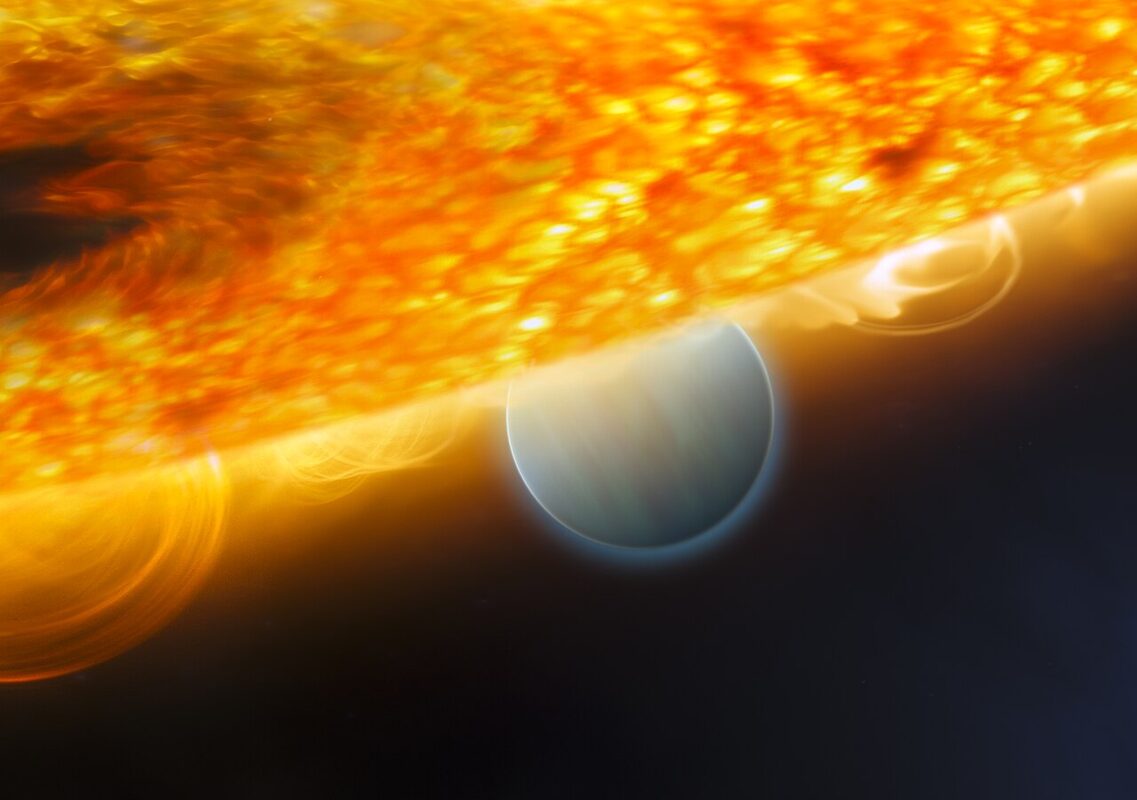
Nearly every exoplanet whose atmosphere we have studied is hot, often absurdly so — worlds roasting at hundreds or thousands of degrees, chosen because their heat and proximity to their stars make them easy to observe. Epsilon Indi Ab is the rare exception, and that is what makes it interesting. Using the James Webb Space Telescope, astronomers have directly imaged this cold giant planet next door and found something the models did not predict: signs of water-ice clouds.
Epsilon Indi Ab is a heavyweight — about 7.6 times the mass of Jupiter — but no wider than Jupiter itself, and remarkably cold, with a temperature somewhere between roughly 200 and 300 kelvin. That is frigid by exoplanet standards, closer to the chill of the outer Solar System than to the infernos JWST usually inspects. It is also close to home, orbiting one of the nearest stars to the Sun, which is why it can be imaged directly rather than inferred from a star's flicker.
How you photograph a planet
Directly imaging a planet means physically separating its faint glow from the overwhelming glare of its star — a bit like spotting a firefly next to a searchlight. A team led by Elisabeth Matthews at the Max Planck Institute for Astronomy used JWST's mid-infrared instrument, MIRI, with a coronagraph that masks the central star's light, letting the planet's own infrared emission come through. They compared new images taken at a wavelength of 11.3 micrometers against earlier observations from 2024 at 10.6 micrometers.
The comparison turned up a puzzle. Given the planet's mass and temperature, atmosphere models predicted it should be rich in ammonia gas. The measurements showed less ammonia than expected. Something was hiding it.
Clouds the models left out
The best explanation the team found is clouds — specifically, thick but patchy clouds of water ice, hanging in the planet's atmosphere like high cirrus on Earth. Such clouds could mask the ammonia signal and account for the shortfall. If confirmed, they would be a notable first: water-ice clouds detected on a giant planet outside the Solar System.
The result lands as a gentle rebuke to the models. Many published descriptions of giant-planet atmospheres deliberately leave clouds out, because clouds are messy and computationally inconvenient — they form, drift, and clear in ways that are hard to simulate. Epsilon Indi Ab suggests that omission has consequences. On a world cold enough for water to freeze in the air, clouds are not a complicating detail to be ignored; they are a central feature shaping what we see.
The planet's home matters as much as the planet. Epsilon Indi is a K-type star slightly smaller and cooler than the Sun, lying only about twelve light-years away — one of our closest stellar neighbors, and a system astronomers have studied for years. Epsilon Indi Ab was first pinned down through direct imaging only recently, after a long hunt that had earlier picked up the star's gravitational wobble. That nearness is precisely what lets JWST resolve the planet from its star at all; a similar world ten times farther would be lost in the glare. It makes Epsilon Indi Ab a kind of stepping stone — the nearest cold giant we can actually photograph, and therefore the obvious place to refine the techniques that will eventually be aimed at smaller, fainter targets.
Because it is cold, nearby, and bright enough to image directly, Epsilon Indi Ab is poised to become a benchmark — a rare chance to study a giant planet under conditions closer to those of Jupiter and Saturn than to the scorched hot Jupiters that dominate the catalog. The hint of icy clouds is an early sign that these temperate giants will not behave the way the textbooks, written largely from hot-world data, quietly assumed.
