
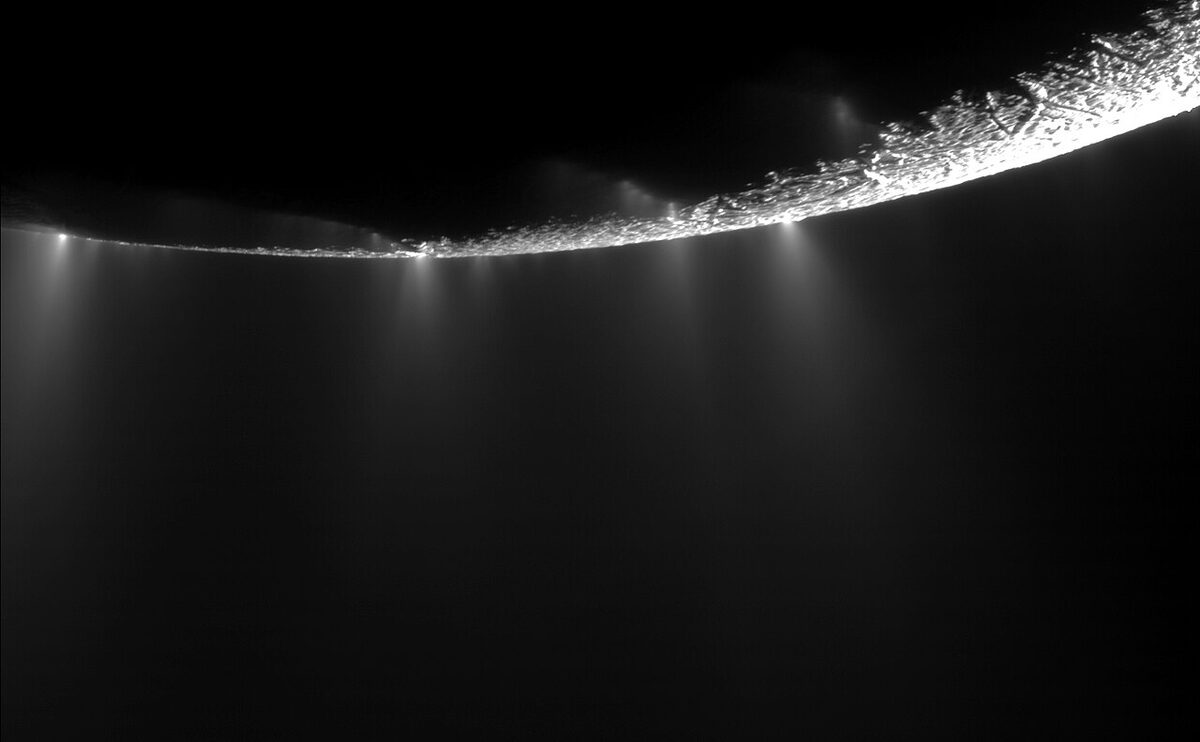
Among the dozens of moons orbiting Saturn, one small, brilliantly white world has quietly become one of the most compelling places in the solar system to look for life. Enceladus is only about 500 kilometres across — small enough to fit inside many countries — and its surface is a shell of clean water ice that reflects almost all the sunlight hitting it, making it one of the most reflective bodies known. Beneath that shell lies a global ocean of liquid saltwater. And remarkably, that ocean is not sealed away. Enceladus vents it into space.
A spacecraft tasted an alien ocean
From great cracks near its south pole, nicknamed "tiger stripes," Enceladus erupts towering geysers of water vapour and ice grains, feeding a plume that sprays hundreds of kilometres into space and even supplies one of Saturn's rings. This is extraordinary because it means the ocean is accessible. NASA's Cassini spacecraft, which orbited Saturn from 2004 to 2017, flew directly through those plumes and analyzed what they carried — in effect sampling a hidden alien ocean without ever landing. What it found reads like a checklist for habitability.
The plumes contain water, of course, but also salts, silica, and a striking inventory of organic molecules, including complex carbon-bearing compounds. Cassini detected molecular hydrogen, which on Earth is produced where hot water reacts with rock at hydrothermal vents on the ocean floor — and those vents host thriving ecosystems that need no sunlight, drawing energy from chemistry alone. More recently, scientists identified phosphates in the plume material, supplying the last of the elements considered essential for life as we know it. Put together, Enceladus appears to have liquid water, a source of chemical energy, and the right raw ingredients, all at once.
There is a puzzle worth pausing on: how does a moon so small stay warm enough to keep an ocean liquid, so far from the Sun? The answer is tidal heating. As Enceladus orbits Saturn on a slightly stretched path, the giant planet's gravity flexes and squeezes it, and that constant kneading generates heat deep inside — enough to keep a subsurface sea from freezing solid and to drive the hydrothermal activity at its floor. The same gravitational tug-of-war that powers the geysers powers the ocean's chemistry, turning a body that should be a dead lump of ice into one of the most active small worlds in the solar system.
The careful distance between ingredients and life
It is important to be precise about what this does and does not mean. None of it is evidence of life. It is evidence of habitability — that the conditions life requires may be present. The leap from "a place where life could exist" to "a place where life does exist" is enormous, and Cassini was not built to make it; it had no instruments designed to detect living organisms or their unambiguous signatures. What it did was transform Enceladus from an obscure ice ball into one of the few worlds where the question of life is concrete and testable.
That is why Enceladus features prominently in proposals for future missions — concepts to fly back through the plumes with instruments specifically designed to hunt for biosignatures, or even, in the more ambitious dreams, to land near the tiger stripes and sample fresh material directly. The appeal is hard to overstate: at almost every other potentially habitable ocean world, the ocean is locked beneath kilometres of ice, requiring some heroic future drilling mission to reach. Enceladus does the hard part for us, launching its ocean into space on a continuous fountain a spacecraft can simply fly through. In the search for life beyond Earth, a small moon that hands you a sample of its sea is a gift that no other world is known to offer. For now that gift is being mined from the data Cassini left behind — but Enceladus has all but guaranteed it will draw a spacecraft back.
