
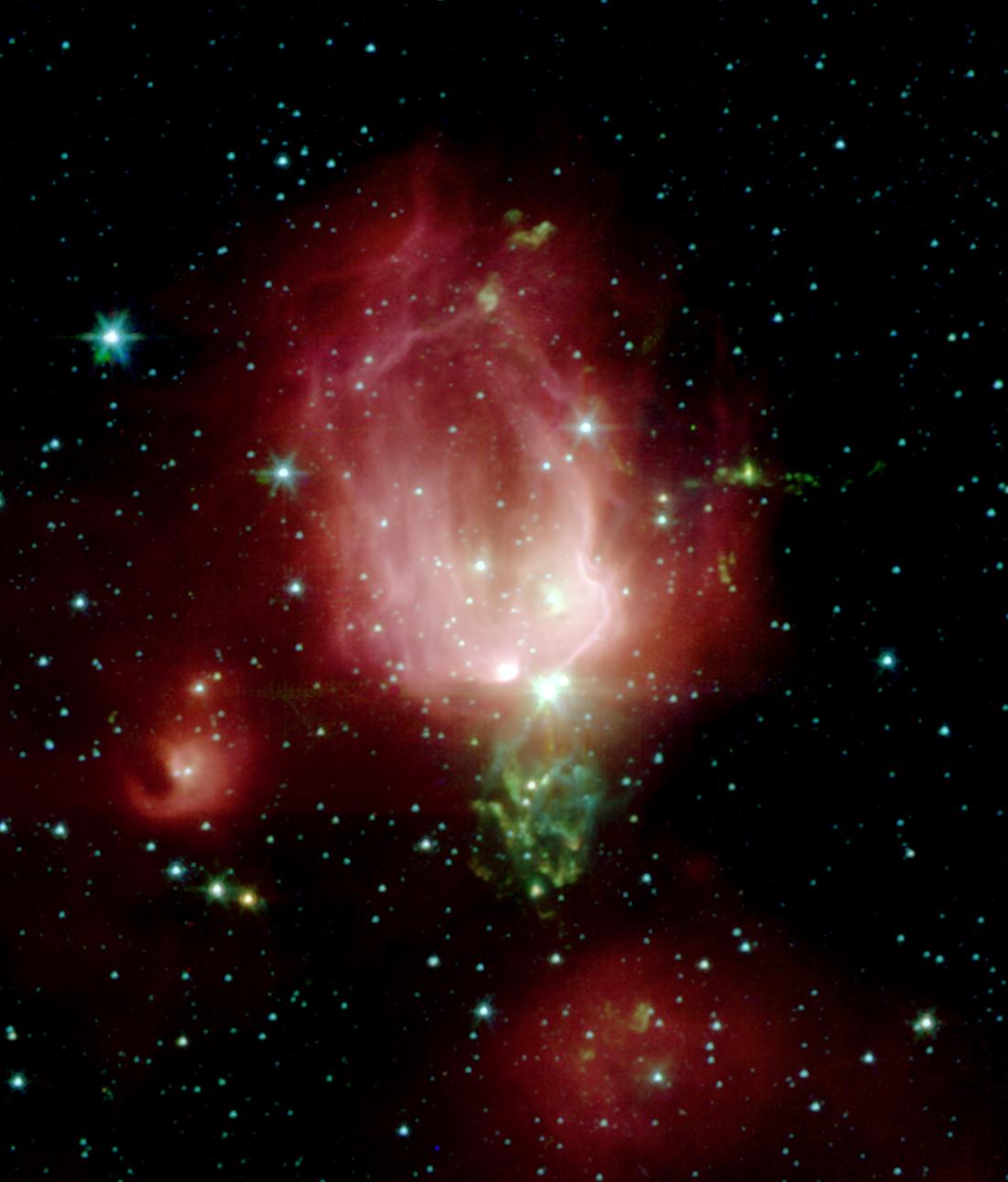
Star formation is a messy business, and most of the mess is hidden. The dust that collects around newborn stars blocks visible light, so telescopes that cannot capture infrared light often see little of what is inside. A new image from the James Webb Space Telescope, released October 6, 2026, gets around that problem. It shows NGC 7129, a star-forming region about 3,300 light-years from Earth, as a crowded field of glowing gas, young stars and the jets and outflows they are blowing into their surroundings.
NASA titled its release "Webb Captures Commotion From Nebula's Stellar Jets," and the image fits the name. ESA's version of the announcement calls it a "technicolor dreamscape." Look past the color, though, and the picture works like a record of how young stars push back against the cloud that formed them.
The star at the center of it all
The brightest object in the frame is easy to find. LkH-alpha 234 produces the image's most prominent diffraction pattern, the spiky starburst that Webb's optics create around bright point sources. According to NASA, it is a pre-main-sequence star weighing around 5 to 8 times the mass of our Sun. Stars at this stage have mostly finished gathering mass and are contracting under gravity, which raises their temperatures. In time, this one will fuse hydrogen like the Sun does.
To its left is a golden cavity about 3.5 light-years across. NASA and ESA/Webb both say outflows from an earlier stage of LkH-alpha 234's life carved into the dense molecular cloud there. Both the outflows and the star's light energize the gas and make it glow. Much of that hydrogen is blown away, but a large amount is compressed, creating conditions for even more stars to form.
Reading the colors
The colors in a Webb image are assigned by image processors, but they map to real physical differences. In this image, processed by Alyssa Pagan of the Space Telescope Science Institute, golden tones show hot atomic hydrogen. Red shows cooler molecular hydrogen that has been shocked by embedded protostars.
That split is useful. Atomic and molecular hydrogen sit in different places in a star-forming region, and the line between them says a lot about what the stars are doing to their surroundings. NASA's release points out a photodissociation region in the image, a boundary where molecules of hydrogen break down into atoms. The central and embedded stars create a hot environment that pushes against the colder, denser molecular gas outside the cavity, and that pressure forms the sharp ridge at the top of the golden cavity. By influencing the temperature and chemistry of the region, the stars offer insight into how these molecular clouds will gradually erode over millions of years.
Bow shocks, protostars and a shadow
The cavity next to LkH-alpha 234 has other occupants. A few stars are visible inside it, and several of them are also pre-main-sequence stars that emit stellar winds. Where those winds push into the energetic gas they form bow shocks, the curved compressed gas near the stars, and the winds carve their own smaller cavities.
The region to the right of the central star tells a different story. The clumpy red matter there hides much younger objects: protostars. As protostars accumulate matter, they eject outflows of superheated material, which interact with the dense gray matter wrapped around them and create shocks that give the scene its textured look. The red glow is also a result of that interaction. Multiple outflows from multiple stars overlap from our point of view, which gives the scene its chaotic appearance.
In the upper left of the frame sits a blue nebula. Its center hosts a protostar surrounded by a donut-shaped disk of material, and that disk casts a shadow against the surrounding nebula. NASA says the effect is reminiscent of a structure known as the "Bat Shadow," which was observed by the Hubble Space Telescope.
Taken together, NGC 7129 holds stars at several stages of life in one view, a point ESA's release makes directly. There are embedded protostars still wrapped in their birth material, a massive young star whose earlier outflows have already carved a large cavity, and other stars in that cavity whose winds are shaping the gas now.
What Spitzer saw, and what Webb adds
NASA published the new image beside a view of the same region from the Spitzer Space Telescope, which NASA has since retired. Spitzer observed the gas and dust in NGC 7129 too. The difference is resolution. According to NASA, Webb's improved resolution shows more detailed gas and dust filaments, along with many background galaxies.
NASA also says Webb's high spatial resolution reveals many rich structures in the region's gas, building on earlier research done with Spitzer. Filaments, shock fronts and cavity edges are the kind of structures that show where energy is going and how material is moving, which is why the sharper view is useful to astronomers studying the region.
Why It Matters
Stars do not form quietly and then move on. As they grow, they launch outflows and winds that carve cavities, shock the surrounding gas and break up molecules. Some of the gas is blown away, and some is compressed into conditions that can lead to more stars forming nearby. NGC 7129 shows that feedback at work across different stages of stellar life.
The region is a good place to study it because so many processes are visible at once: a cavity about 3.5 light-years wide cleared by one star's earlier outflows, bow shocks from stellar winds, a photodissociation region, and a protostar with a disk substantial enough to cast a shadow. According to ESA/Webb, astronomers will continue to use these data to study how the stars and protostars in the region influence the surrounding gas and dust.
The release has also been picked up beyond the agencies. Earth.com, in coverage by Chrissy Sexton, described Webb peering through thick cosmic dust to reveal hidden young stars, protostars, glowing gas and powerful outflows. The science lies in the details: which gas is hot, which is shocked, and where the boundaries fall. With Webb's infrared view, those details in NGC 7129 are now there to be studied.
