
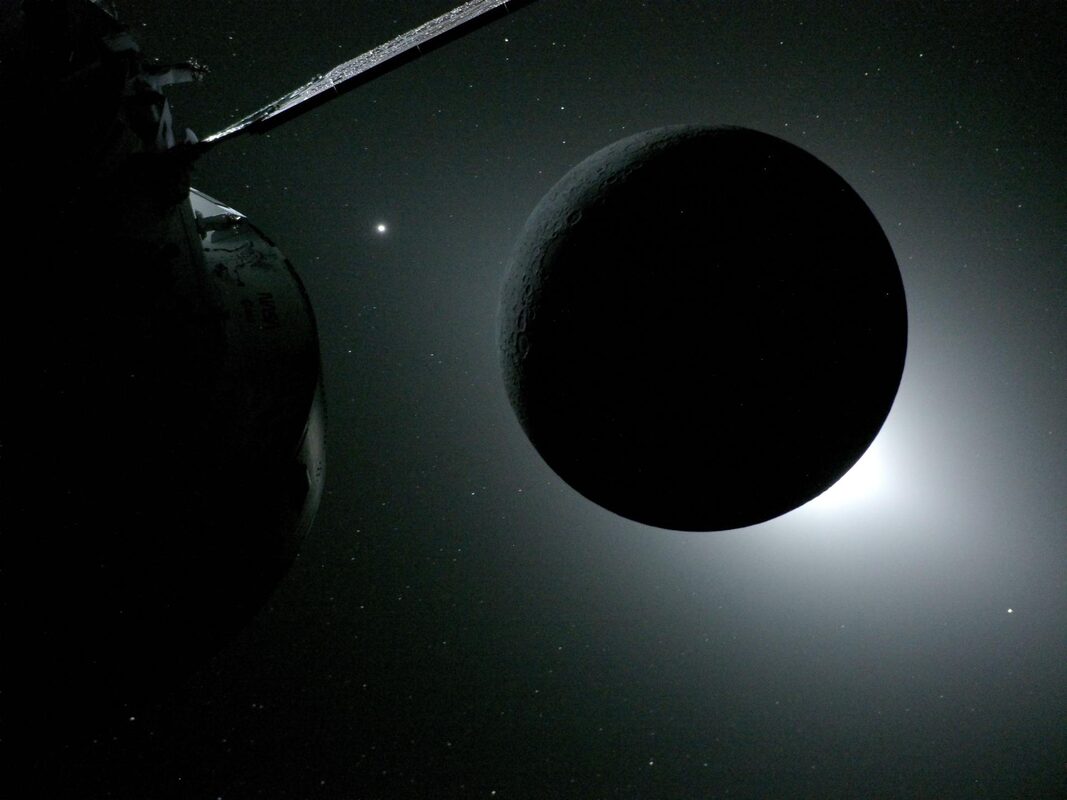
Every spacecraft with solar panels already carries a crude light meter. Its power system watches array output constantly, because the maximum power point tracking (MPPT) electronics that squeeze the most energy out of the panels need to know how much sunlight is arriving. When the spacecraft slides into a planet's or moon's shadow, that output drops. When it comes back out, the output recovers. Engineers have mostly treated those dips as a power-budget problem. A new preprint argues they should be treated as navigation data.
The paper, "Eclipse Observables for Navigation in Cislunar Space," was posted to arXiv on October 17, 2026. Its authors are Ian Down of Advanced Space, James McElreath of Space Exploration Engineering, and Manoranjan Majji of Texas A&M University. Their proposal is simple to state. If you know when your spacecraft entered and left a shadow, and you know where the Sun and the shadowing body are, you have learned something about where you must have been. Do that repeatedly and fold it into an orbit estimate, and you get a navigation measurement that needs no camera, no star tracker and no radio link to the ground.
The problem it is trying to solve
Most deep-space navigation today relies on radio tracking: ground antennas measure a spacecraft's range and line-of-sight velocity, and flight dynamics teams turn those measurements into an orbit. For missions beyond low Earth orbit, NASA's Deep Space Network carries much of that load. As Universe Today notes in its coverage of the paper, the DSN is increasingly overwhelmed by tracking requests. More spacecraft heading to the Moon means more competition for the same tracking resources.
That makes any measurement a spacecraft can collect on its own valuable, and eclipse timing has a useful property: it costs nothing extra. The telemetry is already being recorded. The paper describes onboard eclipse detection as an "opportunistic" measurement, something that supplements an existing state estimate whenever geometry delivers a shadow crossing. It is not pitched as a replacement for radio tracking.
How a shadow becomes a measurement
A shadow cast by a spherical body lit by an extended source like the Sun has two regions. In the umbra, the Sun is fully blocked. In the surrounding penumbra, it is only partly blocked, and the light fades gradually. Each region is bounded by a cone whose shape and orientation follow from the positions of the Sun and the occulting body, which planetary ephemerides supply with high accuracy.
The authors model those boundaries as second-order shadow cones, quadric surfaces that can be computed from the ephemerides at any instant. At the exact moment a spacecraft crosses a boundary, its position must sit on that surface. Mathematically, that is a constraint that evaluates to zero at the event time, and the paper formulates each penumbral or umbral entry and exit as an "implicit zero-measurement." Those measurements are processed in an unscented Kalman filter, a standard estimation tool that handles the nonlinear geometry of the problem without requiring the equations to be linearized by hand.
One crossing does not pin down a spacecraft's position. It tells the filter the spacecraft was somewhere on a particular surface at a particular time. Combined with a dynamical model of the orbit and other crossings, however, those constraints shrink the uncertainty in the estimate. Universe Today's summary puts the end result plainly: the timestamps of the voltage drop and recovery at shadow boundaries can be used to recover a three-dimensional position.
Where the error comes from
Shadows are not perfectly sharp-edged geometric objects, and the paper spends real effort on what blurs the timing. The authors identify three main sources of event-time uncertainty, all of them effects left out of a simple spherical-body model:
- Telemetry sampling. If power data is logged at fixed intervals, the true crossing happened somewhere between two samples. The coarser the sampling, the looser the timing.
- Earth's atmosphere. When Earth is the occulting body, its atmosphere blurs the Sun's edge and enlarges the shadow, making it harder to pin down the geometry.
- Topography and oblateness of the occulting body. Neither Earth nor the Moon is a smooth sphere. Earth is slightly squished at the poles, and the Moon's topography matters too.
The Moon is an interesting case. Because it has no atmosphere, its shadow is not blurred the way Earth's is. Instead, as Universe Today explains, the lunar shadow edge is jagged, following the profile of mountains and craters on the limb. Each of those features can shift the timing of a contact by a few seconds. That sounds small, but for a measurement built entirely on timing, a few seconds is a real error term, and it has to be modeled rather than ignored.
Testing it in simulation and in flight
The team evaluated the method two ways. First, in simulation, for a spacecraft in a halo orbit around the Earth-Moon L1 point. Second, and more convincingly, with real flight data from NASA's CAPSTONE mission.
CAPSTONE was a 12U CubeSat and the first spacecraft to operate in a near rectilinear halo orbit around the Moon, characterizing that orbit for future spacecraft. It entered lunar orbit on November 13, 2022, and NASA's activities on the extended mission concluded in June 2026. Over its life it validated communications, networking and autonomous navigation techniques, including peer-to-peer ranging with NASA's Lunar Reconnaissance Orbiter, all aimed at reducing risk for future Artemis missions.
For the paper, the authors used CAPSTONE's flight telemetry and its orbit-determination products from the January 2026 lunar eclipse. Because CAPSTONE's trajectory was already independently known from conventional orbit determination, the researchers could compute where the shadow boundaries should have been crossed and compare that against what the power data showed. The result: umbral contacts derived from the power telemetry agreed with the geometric contacts to within one sample interval. In other words, the measurement was about as good as the spacecraft's logging rate allowed it to be.
The paper also reports that the eclipse measurements are useful for reducing uncertainty, particularly when the starting orbit solution is degraded. That is the case that matters most operationally. A spacecraft with an excellent orbit estimate does not gain much from a few shadow crossings. One that has gone a while without tracking, or whose estimate has drifted, has more to gain.
Why It Matters
The appeal here is not that eclipse timing beats radio tracking. It does not, and the authors do not claim it does. The appeal is that it is free. Any spacecraft with solar arrays and power telemetry already has the sensor. The remaining pieces are ephemerides, which are widely available, and software in the navigation filter. For small missions without a budget for optical navigation cameras, that is an attractive trade.
It also fits the direction cislunar operations are heading. With demand on the Deep Space Network rising, every measurement a spacecraft can make for itself could reduce how often it needs a scarce antenna pass. A navigation filter that quietly absorbs shadow crossings between tracking sessions could keep an orbit estimate healthier for longer, or recover faster after a gap.
There are limits. The method only produces data when the geometry produces an eclipse, so how often it helps depends heavily on the orbit and the season. The timing errors from atmospheric blurring, oblateness and lunar terrain all have to be modeled, and the precision ultimately depends on how often a spacecraft samples its power data. The CAPSTONE validation is also a single eclipse event from a single spacecraft. Still, a flight-data result that matches geometry to within one telemetry sample is a solid first test for an idea that asks almost nothing of the hardware. As traffic around the Moon grows, a spacecraft able to read its position from its own power readings is a useful thing to have.
