
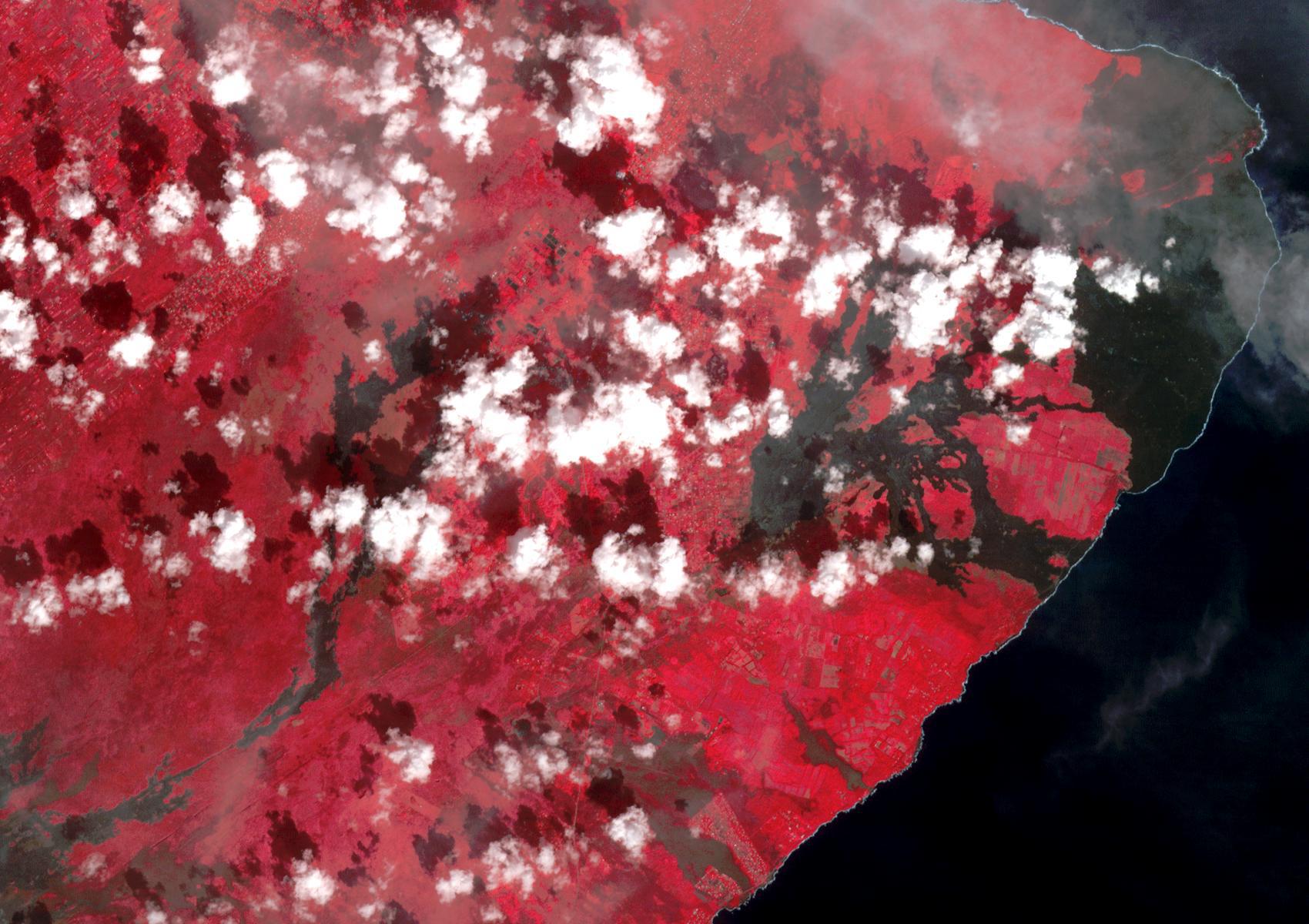
Most of Earth's carbon may not be in the oceans, the atmosphere or the rocks under our feet. It may be locked in the planet's iron core. A new study suggests that this deep carbon was not made locally either. According to researchers at Columbia University's Lamont-Doherty Earth Observatory and Yale University, it came from the outer solar system, and the evidence comes from lava erupted in Hawaii over the past few centuries.
The work, published in the Proceedings of the National Academy of Sciences (PNAS) and described by Yale News, was led by Yves Moussallam of Lamont-Doherty, who is also affiliated with the American Museum of Natural History, with Yale's Damanveer Grewal as a co-author. Universe Today and Universe Magazine have since carried the result to a wider audience.
A Problem You Cannot Drill Your Way Out Of
The core can't be sampled directly, so anything we know about its chemistry comes from indirect evidence. Both Yale and Universe Magazine note that observing "deep carbon" and analyzing its isotopic composition had previously been considered impossible. That matters because the numbers are large, and they are uncertain. Universe Today reports that the core is estimated to hold between 0.09 and 2.0 percent carbon by weight, which works out to roughly two-thirds of Earth's total carbon budget. The range spans more than an order of magnitude. The isotopic makeup of that carbon, the ratio of heavier carbon-13 to the more common carbon-12, works as a fingerprint for where an element came from.
Grewal calls the new result "the first observational estimate of the isotopic composition of carbon in Earth's core." The important word there is observational. Universe Today notes that scientists had long believed Earth's carbon originated in the inner solar system, like its silicate and metal. This study starts from material that came out of the ground and reaches a different answer.
Reading the Core Through a Volcano
The team analyzed melt inclusions, tiny bits of molten rock caught inside crystals that form in magma. Yale describes each droplet as something of a message in a bottle: a snapshot of what the magma looked like when it was deep within the Earth.
The samples come from two Hawaiian eruptive episodes: the Keanakakoi eruptions, which ran from 1500 to 1840, and the 1959 eruption of Kilauea Iki. Universe Magazine's summary describes them as lava erupted by Hawaiian volcanoes over the past few centuries. The volcanic record is young, but the researchers argue it carries a much older signal.
The researchers found a uniquely heavy carbon-13 signature in magma they believed came from parts of certain plumes representing the boundary between the core and the mantle, the rocky upper layer. "We interpret this as carbon leaking from the core," Grewal said.
That is the step in the argument most worth scrutiny. The isotope measurements are data. Assigning the heavy signature to core leakage is an interpretation, and Grewal's own wording frames it that way. The conclusion depends on the link between a melt inclusion in Hawaii and the boundary between core and mantle far below it.
Too Heavy for the Neighborhood
Once the core carbon's isotopic fingerprint is in hand, the next question is which known source matches it. The researchers found that the carbon was too heavy to have come from the rocky, carbon-poor material of the inner solar system that built most of Earth. It was a match for carbonaceous chondrites, carbon-rich meteorites from the outer solar system that contain organic compounds and water.
Universe Magazine puts the headline version plainly: most of Earth's carbon originated in the outer solar system and arrived only during the later stages of the planet's development.
A Narrow Delivery Window
The study also says something about timing. Grewal, who led this part of the research, noted that there was only one window of opportunity for carbonaceous chondrites to become a permanent part of the core: the final stage of Earth's main assembly. If the carbon had arrived earlier, much of it would have been sent back into space during subsequent collisions. If it had arrived later, the core would already have been closed.
Universe Today ties this period to the giant impact or late accretion phase, which culminated about 4.5 billion years ago when Theia, a Mars-sized protoplanet, collided with Earth and gave rise to the Earth-Moon system. That is Universe Today's framing of the timeline. Neither the Yale account nor Universe Magazine says the carbon was carried by Theia itself.
Why It Matters
Carbon is one of the crucial building blocks of life, and where Earth got its carbon is part of the larger question of how a rocky planet close to its star ends up with the ingredients for biology. If the inner solar system's rocky material was carbon-poor, as the researchers found, then Earth's carbon had to come from somewhere else. These results point to the outer solar system and to a specific stage of Earth's assembly.
The result also changes how we think about the core. If the team's interpretation is right, the core holds a large share of the planet's carbon, and some of it leaks toward the surface in plumes that feed Hawaiian volcanoes. Yale adds that the study may have implications for the role of core carbon during episodes of intense volcanic activity.
The study also shows a method. Geologists can't reach the core, but the team devised a way to make observations of core carbon by examining Hawaiian lavas. If that approach holds up, it offers a way to probe a reservoir that was long thought to be out of reach, one whose carbon content is still uncertain by a factor of more than twenty.
What to Watch
The main open question is whether the core-leakage interpretation holds up. Independent tests would help settle whether the heavy carbon signature really comes from the core or has some other explanation. For now, the study gives the first measurement-based look at the isotopic character of the core's carbon, and it points outward, to the region of the solar system where carbon-rich bodies formed.
