
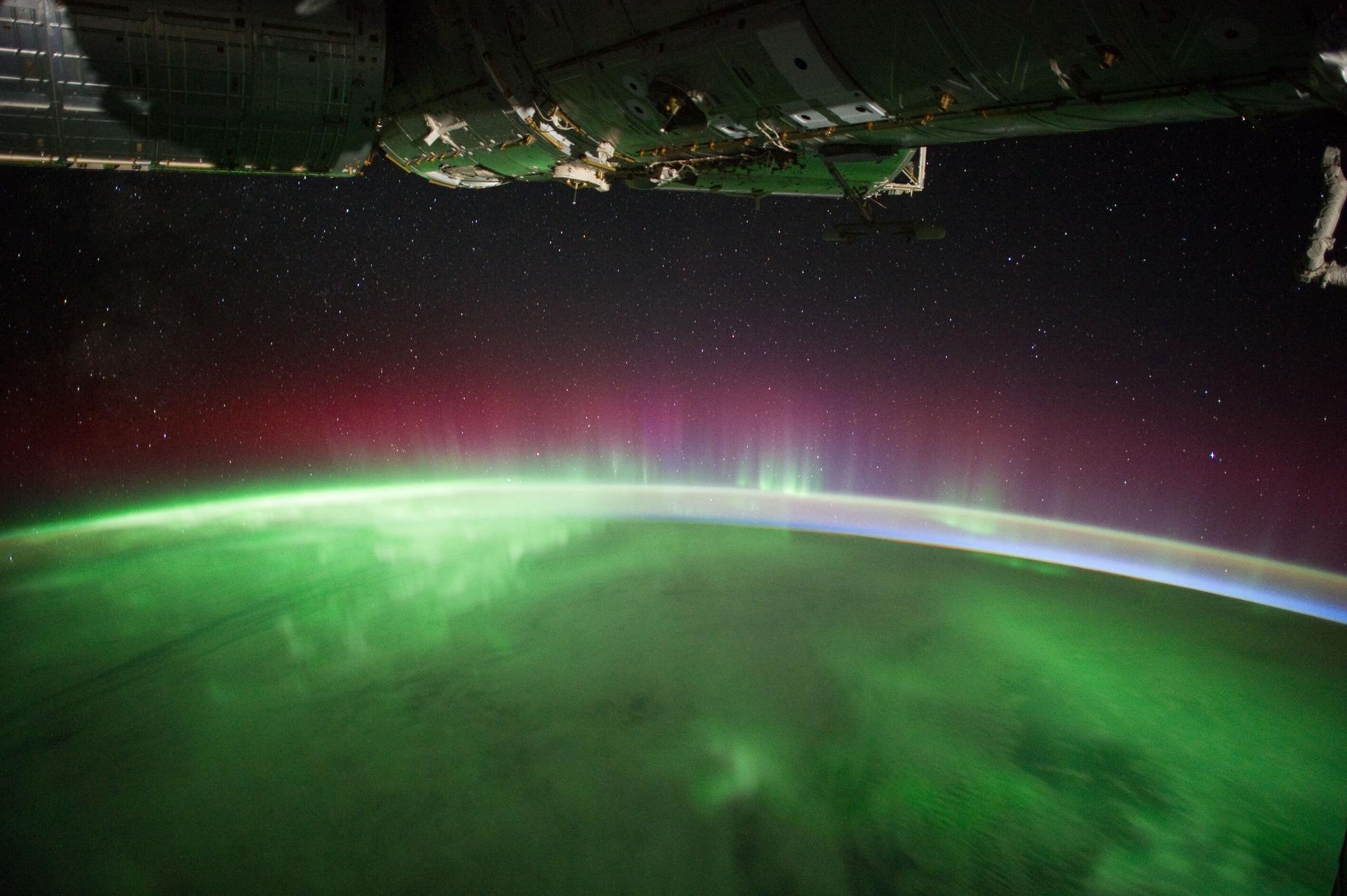
The sun has been busy this week, and Earth is about to feel it. A flurry of eruptions from an active sunspot region has sent multiple clouds of magnetized plasma outward on a collision course with our planet, and space weather forecasters say the resulting geomagnetic disturbance could be strong enough to nudge the aurora borealis — and its southern counterpart — toward latitudes that don't normally get a show.
NOAA's Space Weather Prediction Center (SWPC), the U.S. government's official forecasting arm for solar storms, is tracking the incoming clouds of plasma and updating its forecasts as the picture develops. As of this week, SWPC's homepage was also showing an active R1 (Minor) radio blackout, a reminder that the same solar activity driving the aurora forecast is also capable of disrupting high-frequency radio communications on the sunlit side of Earth. The agency's Aurora Dashboard and 3-Day Geomagnetic Forecast tools are the ones to watch if you want a real-time read on how the storm develops.
What Actually Happened on the Sun
The activity traces back to active region AR4530, which has been throwing off flares for several days. According to EarthSky's solar-activity tracker, AR4530 was the top flare producer of the stretch, putting out a C1.0 flare — its strongest — that peaked at 14:33 UTC on September 14, plus two weaker B-class flares. A separate B5.5 flare peaked at 15:16 UTC on September 15, but EarthSky attributes that one to an unnumbered sunspot near the sun's northeast limb rather than AR4530, and at B-class it was weaker than AR4530's C1.0, not stronger. Separately, FoxWeather reported a more powerful M6.9-class flare that triggered its own coronal mass ejection (CME) — a burst of billions of tons of solar plasma and magnetic field hurled into space.
The bigger wildcard, though, came from the sun's southwest, where a filament — a long, dark, cooler ribbon of plasma suspended above the solar surface by magnetic fields — erupted violently on September 13. That eruption, along with the flare activity in the region, launched multiple CMEs. Forecasters now expect at least two distinct solar wind streams to reach Earth on a staggered schedule: one that could arrive as early as September 16, with a second following close behind by September 17. That's the "dueling" part of this stretch of space weather — rather than a single clean hit, Earth's magnetic field is set up to absorb consecutive punches.
How Strong a Storm, and Who Might See It
Geomagnetic storms are ranked on NOAA's G-scale, from G1 (Minor) to G5 (Extreme). Based on the incoming CMEs, EarthSky's forecasters are calling for G1 storm levels on September 16, likely with a chance of G2 and a slight chance the storm intensifies briefly to G3 (Strong). At G1-G2, aurora sightings are typically confined to high-latitude locations; a G3 pulse can push the visible band noticeably farther from the poles. Under that forecast, aurora watchers in Scotland and southern New Zealand have the best odds on the night of September 16, with a slight chance of visibility extending as far as northern England and Tasmania. FoxWeather's coverage of the earlier M6.9 flare and its associated CME similarly flagged the potential for a "minor geomagnetic storm," noting that only a limited number of locations in North America would be positioned to catch the display — generally those closest to the auroral oval, though FoxWeather did not specify which states or provinces.
None of the outlets are promising a blockbuster, continent-spanning aurora event. What they agree on is that the combination of a filament eruption and multiple stacked CMEs gives this particular stretch of space weather more punch than a routine solar wind gust, and that the forecast carries real uncertainty until the CMEs' magnetic orientation can be measured as they pass instruments positioned between the sun and Earth.
Why It Matters
Aurora forecasting matters for more than photogenic skies. The same geomagnetic disturbances that paint the sky green and red can also induce currents in long conductors — power grids, pipelines, and undersea cables — and degrade GPS accuracy and high-frequency radio propagation, which is why SWPC was already logging an R1 radio blackout even before the CMEs arrive. Airlines flying polar routes, satellite operators, and grid managers all watch the same 3-Day Geomagnetic Forecast that backyard aurora chasers use, just for different reasons. A forecast G1-G2 storm with a chance of G3 is well short of anything that threatens infrastructure, but it's a useful reminder that space weather is a continuous, monitored phenomenon — not just an occasional headline when a "big one" hits. For skywatchers, it's also a rare, low-stakes chance to see the aurora without traveling to the Arctic Circle, provided skies stay clear and light pollution stays low.
What to Watch For
If you're hoping to catch a glimpse, the practical advice is the same as always: get away from city lights, give your eyes time to adjust, and check NOAA's Aurora Dashboard shortly before you head out, since the exact timing and strength of a geomagnetic storm can shift as new CME data comes in. Because two separate solar wind streams are expected on consecutive days, there's effectively two chances to catch a display rather than one — useful if clouds spoil the first opportunity. A camera with a long exposure setting will often pick up faint auroral color that's difficult to see with the naked eye, so it's worth pointing one skyward even if the display looks unremarkable at first glance.
