
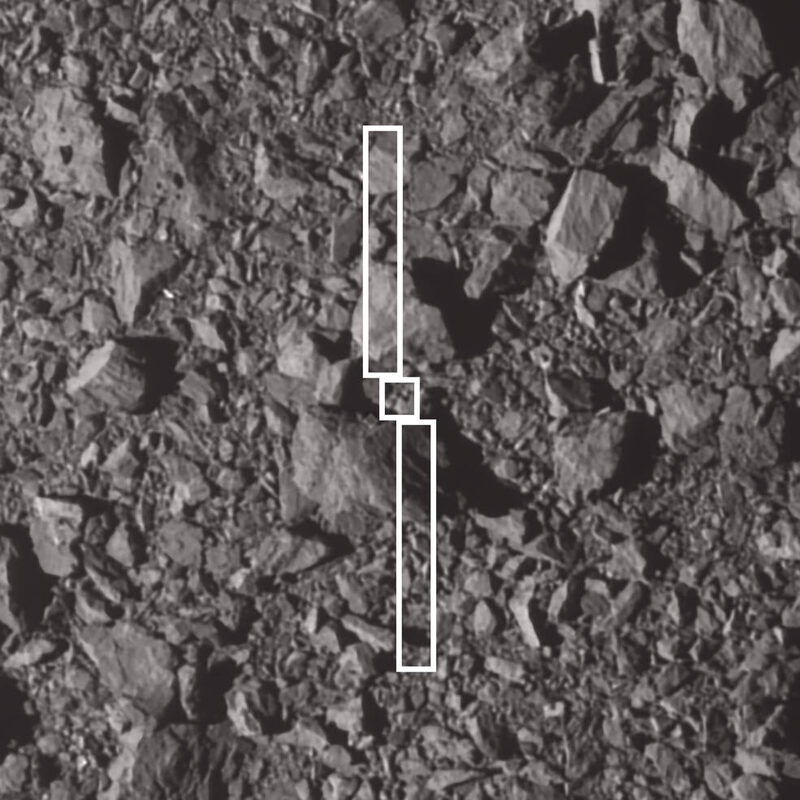
Planetary defense has a credibility problem. It is easy to design a mission to deflect an asteroid; it is harder to test one; and before September 26, 2022, it had never been done at all. The Double Asteroid Redirection Test resolved that. At 7:14 PM Eastern time, the DART spacecraft — traveling at 6.1 kilometers per second — impacted the surface of Dimorphos, a 160-meter moonlet orbiting the larger asteroid Didymos. The impact was observed by the Italian LICIACube cubesat flying nearby, by ground-based telescopes worldwide, and by the Hubble and James Webb space telescopes. The result exceeded every projection.
Dimorphos orbited Didymos with a period of 11 hours and 55 minutes before impact. After impact, astronomers monitoring the system's light curve — the cyclical brightness variation as Dimorphos passed in front of and behind Didymos — measured the new period at 11 hours and 22 minutes. The deflection had shortened Dimorphos's orbit by 33 minutes, more than four times the minimum threshold that would have constituted mission success and well outside the pre-impact uncertainty range of most models. The mission had worked, dramatically.
Why it worked so well
The scale of the deflection surprised mission scientists because it exceeded what the kinetic impact alone would have produced. A spacecraft hitting an asteroid transfers its own momentum to the target — that is the basic physics of kinetic impact deflection. But the amount of additional momentum transferred depends on the ejecta: material thrown off the asteroid by the impact carries momentum in the opposite direction, amplifying the net push. Pre-impact models predicted a momentum transfer factor (called beta) of 1 — meaning no ejecta amplification — as a conservative lower bound, with more optimistic models predicting beta values of 2 to 5. The measured beta for the DART impact was approximately 2.2 to 4.9, depending on the model used to interpret the orbital change.
The high beta value means that Dimorphos's surface is loosely consolidated — more rubble pile than solid rock — and responds to impact by generating large ejecta clouds. LICIACube images captured a plume extending for thousands of kilometers. Hubble images tracked the ejecta evolution over days and weeks, showing a complex tail structure similar to a comet's dust tail. Webb images measured the thermal emission of the ejecta in the infrared. Together, the observations provided the most detailed portrait of an asteroid impact ever assembled.
What HERA will confirm
ESA's Hera mission, launched in October 2024 and arriving at the Didymos system in late 2026, will provide the ground truth that DART's remote observations could not. Hera will map Dimorphos's surface in detail, measure its mass (which DART's pre-impact observations could not determine), characterize the crater left by the impact, and assess how Dimorphos's interior structure changed. The mass measurement is particularly important: the momentum transfer calculation depends on knowing the mass, and the current estimates carry significant uncertainty. Hera's results will allow a precise beta value to be computed and compared against numerical simulations, validating the models that planetary defense planners would use to design a future real-world deflection mission.
DART demonstrated that kinetic impact deflection works in practice, not just in theory. Dimorphos was not a threat to Earth — the Didymos system's orbit is well-characterized and safe — but it was a physical object with the kind of rubble-pile structure that many potentially hazardous asteroids share. The success means that a similarly sized object on a collision course could, given years of warning, be deflected with a single mission. The planetary defense community's question is no longer whether the technique works; it is what the operational infrastructure needs to look like to be ready when a real threat is identified.
