
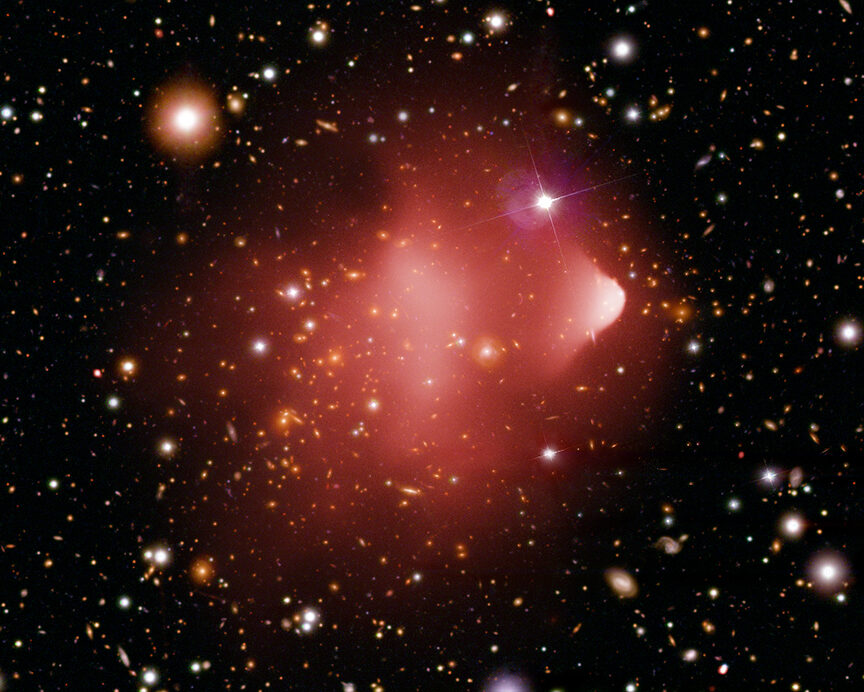
The first strong evidence that most of the universe's mass is invisible came not from a single experiment but from a convergence of independent observations that started in the 1930s and became irresistible by the 1970s. Fritz Zwicky noticed in 1933 that galaxies in the Coma Cluster were moving too fast to be gravitationally bound by the visible matter he could see — there had to be additional mass. Vera Rubin and Kent Ford showed in the 1970s that spiral galaxies rotate too fast at their outer edges — the rotation curves are flat where they should drop off, implying extended dark mass halos. Gravitational lensing measurements confirmed the pattern: galaxy clusters contain far more mass than their visible stars and gas account for. The universe is mostly something we cannot see.
The leading candidate for dark matter has been the WIMP — weakly interacting massive particle — a hypothetical particle with a mass roughly 10 to 1,000 times that of a proton, interacting with ordinary matter only through the weak nuclear force and gravity. WIMPs emerged naturally from supersymmetric extensions of the Standard Model as a generic prediction: if supersymmetry is real, the lightest supersymmetric particle is stable and would have been produced in the early universe in quantities consistent with the observed dark matter density. This coincidence — the "WIMP miracle" — drove experimental dark matter physics for four decades.
The silence of the detectors
Underground detectors filled with liquid xenon, germanium crystals cooled to millikelvin temperatures, and sodium iodide crystals monitored in deep mines have searched for the faint nuclear recoil that a WIMP collision with an ordinary nucleus would produce. The LUX-ZEPLIN detector in South Dakota, the XENONnT detector at Gran Sasso in Italy, and the PandaX-4T detector in China have collectively placed the strongest limits on WIMP-nucleus interaction cross-sections ever achieved. The results: nothing. Not a single confirmed WIMP signal. The WIMP parameter space — the region of mass and interaction strength the detectors are sensitive to — has been reduced by orders of magnitude. If WIMPs exist in the simple forms the models predict, they must be either far heavier or far more weakly interacting than originally expected.
This null result has shifted the field toward alternative candidates. Axions — hypothetical light particles originally proposed to solve a different problem in particle physics, the strong CP problem — are now the leading alternative. Axions have masses measured in microelectronvolts to millielectronvolts, many orders of magnitude lighter than WIMPs, and they interact with photons in the presence of a strong magnetic field, producing a faint microwave signal. The ADMX experiment at the University of Washington and the HAYSTAC experiment at Yale are searching for this signal in microwave cavities embedded in superconducting magnets. Both have found nothing, but they have covered only a small fraction of the theoretically motivated axion mass range.
Other possibilities
Primordial black holes — black holes formed in the early universe before the first stars — were once considered a promising dark matter candidate. Gravitational microlensing surveys have constrained their abundance across a wide mass range, and observations of the cosmic microwave background and 21-centimeter hydrogen line limit the fraction of dark matter they can constitute to small values across most mass ranges. Sterile neutrinos, ultra-light fuzzy dark matter (wave-like behavior on kiloparsec scales), strongly interacting massive particles, and self-interacting dark matter each have advocates and experimental programs. The particle physics community is entering a phase of acknowledged uncertainty about which candidate is correct — and considering seriously whether dark matter might not be a single particle species at all but a complex dark sector with its own interactions. The universe has a mass budget problem, and the accounting is not yet complete.
