
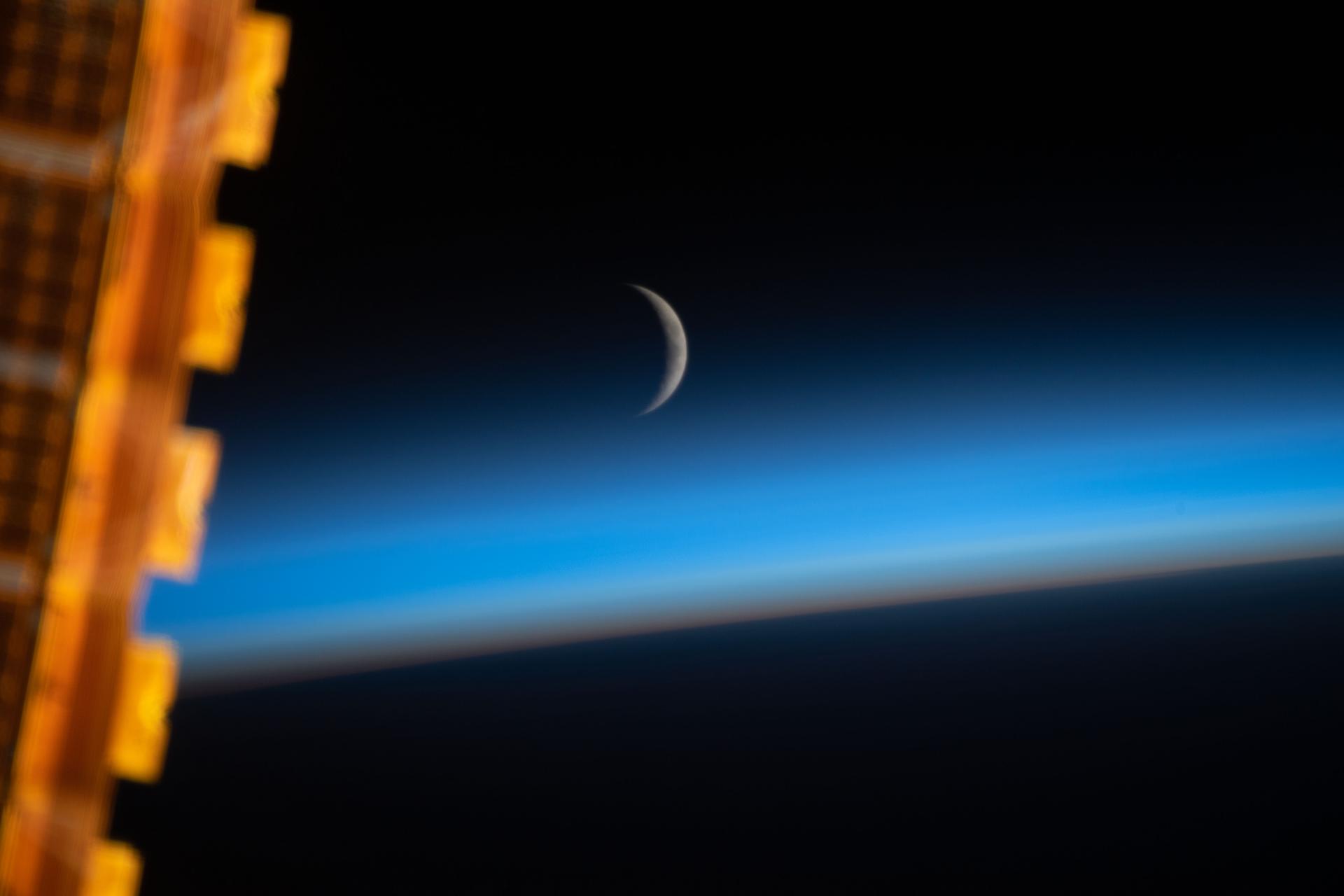
If you are willing to be outside an hour before sunrise this week, the sky is offering a tidy four-act play. A waning crescent Moon, thinning from about 20 percent illuminated, walks eastward past Mars on Sunday, splits the difference between Mars and Jupiter on Monday, lands almost on top of Jupiter on Tuesday, and then bows out low in the twilight on Wednesday before disappearing entirely as it heads toward new Moon. Running underneath all of it is a solar storyline: a coronal mass ejection launched Sept. 5 is due to brush Earth around Sept. 8, and depending on which forecast you read, that is either a non-event or a modest chance of aurora for the far north. We will take the Moon first, then untangle the forecast.
Sunday, Sept. 6: The Moon and Mars in Gemini
An hour before sunrise, the crescent sits roughly 47 degrees up in the east, comfortably high, with Mars 5.2 degrees below it, according to observing writer Jeffrey Hunt at When the Curves Line Up. Both are in Gemini: Hunt puts Mars 10.2 degrees to the upper right of Castor, and Castor, Pollux and the Moon form a nearly straight line, while Procyon and Betelgeuse frame the scene. The pair keeps closing after the sky brightens: Astronomy.com puts the actual conjunction, with the Moon 3 degrees due north of Mars, at 2 p.m. EDT, in full daylight for U.S. observers. So what you see before dawn is the approach, not the closest pass.
Two footnotes for Sunday. First, the Moon reaches perigee at 4:43 p.m. EDT, 228,825 miles from Earth, which means the crescent you are looking at is about as close as it gets this cycle. Second, temper any hopes of seeing detail on Mars. It rises around 2 a.m. local time and spans just 5 arcseconds, a small orange dot in almost any amateur telescope. Enjoy it as a color contrast against the Moon's gray, not as a target for magnification.
Jupiter, meanwhile, is 28 degrees to Mars's lower left, in Cancer about 7.2 degrees east of the Beehive Cluster (M44). At 32 arcseconds across with all four Galilean moons in view, it is the telescopic prize of the week. If you only put one planet under an eyepiece this week, make it that one.
For reference, Astronomy.com's times for 40 degrees north, 90 degrees west: sunrise 6:32 a.m., moonrise 12:58 a.m., moonset 4:53 p.m.
Monday, Sept. 7: Between Two Planets
Monday is the balanced morning. Hunt puts Jupiter 13.2 degrees to the Moon's lower left and Mars 9.7 degrees to its upper right, with the crescent still more than 30 degrees high. This is the one to catch if you want the whole sequence in a single glance: a crescent bracketed by a red dot and a white one, spanning a bit more than two outstretched fists. No optics needed.
Tuesday, Sept. 8: Jupiter, Earthshine, and the Photo Morning
Tuesday is the headline. Jupiter sits just 4.1 degrees to the Moon's lower left, close enough to fit in the same binocular field, with the Moon about 20 degrees high. Hunt flags this as an excellent morning to photograph earthshine, the faint glow on the Moon's night side lit by sunlight bouncing off Earth. Earthshine is visible to the unaided eye from a clear, dark site and considerably easier in binoculars; a thin crescent close to a bright planet, as on Tuesday, makes for the classic composition. A tripod and a few seconds of exposure will pull out the ghostly full disk behind the bright sliver.
Wednesday, Sept. 9: Last Call
By Wednesday the Moon has slipped past Jupiter and sits 10 degrees to the planet's lower left, just over 5 degrees above the east-northeast horizon, a 3-percent sliver you will need a low, clean horizon to catch. After Sept. 9 it is gone into morning twilight. New Moon follows a couple of days later, which opens the darkest skies of the month for deep-sky observers and anyone chasing the Milky Way.
Venus, Briefly
Venus is not part of the dawn show; it is an evening object at the moment, and When the Curves Line Up lists its greatest brilliancy for this apparition as Sept. 5. In other words, the planet is about as bright as it gets right now, and it will stay dazzling for weeks.
Now, the Sun
The solar disk is busy. EarthSky's latest update counts four numbered sunspot regions on the Earth-facing disk, with AR4524 a returning region that has just rotated back over the eastern limb after a trip around the far side, and AR4527 a newcomer on the northeast limb. SpaceWeather.com lists a sunspot number of 70 as of its Sept. 6 update, with no significant Earth-facing equatorial coronal holes. Solar wind was a sedate 365.6 km/s and Kp sat at 1.33, which is to say geomagnetically quiet.
The activity has been steady rather than spectacular. EarthSky's log shows an M1.2 flare from AR4524 at 7:45 UTC on Sept. 4 that caused a minor R1 radio blackout, with 11 flares in that update's 24-hour tally. The following day's tally was seven flares, five C-class and two B-class, the strongest a C7.1 from AR4525 at 11:29 UTC on Sept. 4. Two eruptions in quick succession that evening, a C6.7 from AR4524 at 19:30 UTC and a second blast from beyond the southeast limb about 90 minutes later, which EarthSky dubbed a "1-2 punch," launched CMEs initially judged not to be Earth-directed.
Then on Sept. 5, AR4524 produced a C9-class flare. SpaceWeather.com reports it hurled a CME toward Earth, with arrival expected Sept. 8 and the possibility of a G1-class geomagnetic storm and high-latitude auroras.
What "Possible G1" Actually Means
Here is where the forecasts diverge, and it is worth reading them side by side rather than picking the most exciting one.
NOAA's Space Weather Prediction Center, the official U.S. forecaster, issued its 3-day outlook at 0030 UTC on Sept. 6. It calls for Kp between 1.33 and 1.67 all day Sept. 6, rising through Sept. 7 to a peak of 3.67 in the 12-15 UT period, and topping out at Kp 4.00 in the 03-06 UT window on Sept. 8 before easing back to 3.67 and then 3.33 through that morning. (The forecast's own summary line quotes the greatest expected Kp as 3.67, a small internal inconsistency with the table.) The disturbance is attributed to a co-rotating interaction region ahead of a coronal-hole high-speed stream, plus CME influences, arriving Sept. 7-8. And then the line that matters: "No G1 (Minor) or greater geomagnetic storms are expected."
Kp 4 is "active," not "storm." G1 begins at Kp 5. So SWPC's official position is that Earth gets a nudge, not a hit.
EarthSky's forecast reads a little warmer. It expects Sept. 6-7 to run unsettled to active, Kp 3-4, from a combination of a possible weak CME arrival around 16:00 UTC on Sept. 6 and a coronal-hole high-speed stream, and it allows a slight chance of G1 intervals, with aurora potentially visible from the latitudes of Seattle, Edinburgh and southern Alaska. SpaceWeather.com's framing, "possibly sparking a G1-class geomagnetic storm," lands in the same place.
Note the timing mismatch, too. EarthSky's window is Sept. 6-7; SpaceWeather.com and SWPC's Kp peak both point at Sept. 8. That spread is itself informative. CME arrival times carry hours of uncertainty even a day out, and a glancing blow from a weak CME is exactly the kind of event where a few hours and a slightly different magnetic orientation are the difference between Kp 4 and a brief Kp 5.
The plain-language read: if you live at high latitude, keep an eye on real-time Kp on the nights of Sept. 7-8 and be ready to step outside if it ticks to 5. If you live in the mid-latitudes, this is not your event. Nobody in the forecast chain is predicting anything stronger than G1, and the official forecaster is not predicting G1 at all.
Two other lines from the SWPC forecast deserve a mention. The probability of a solar radiation storm (S1 or greater) was put at 75 percent for Sept. 6, dropping to 10 percent for Sept. 7-8. Radio blackout odds sit at 20 percent per day for R1-R2 events and 1 percent for R3 or higher. Neither affects naked-eye observing; both are worth knowing if you fly polar routes or work HF radio.
Odds and Ends From the Solar System
NASA's all-sky fireball network logged 38 meteors over the United States on Sept. 4, mostly sporadics, with two alpha Aurigids in the mix. SpaceWeather.com's tally of potentially hazardous asteroids stood at 2,349 as of Sept. 6, and asteroid 2026 RZ passed at half a lunar distance on Sept. 3. None of that changes your week; it is simply the ambient traffic report.
Why It Matters
Planet-Moon groupings like this are the on-ramp to observing. They require no equipment, they happen on a predictable schedule, and they teach the sky's scale: the crescent moves roughly its own diameter each hour against the stars, and watching it hop from Mars to Jupiter over four mornings makes that motion visceral in a way a diagram never will. The Sept. 8 Moon-Jupiter pairing in particular is a rare chance to see earthshine, a bright planet, and four Jovian moons in one binocular field.
The aurora forecast matters for a different reason. Solar activity coverage tends to amplify the most dramatic available scenario, and readers end up standing in a cold field at 2 a.m. for a Kp 3 night. Learning to read a SWPC forecast, what Kp means, where G1 starts, and how much slack a CME arrival time carries, is the single most useful skill an aurora hopeful can pick up. This week, with three credible sources disagreeing gently on timing and intensity, is a good case study in calibrated expectations.
Sources
- NOAA SWPC 3-Day Forecast, issued Sept. 6, 2026 0030 UTC
- SpaceWeather.com front page, Sept. 5-6, 2026
- The Sky Today on Sunday, September 6: The Moon and Mars in Gemini (Astronomy.com)
- 2026, September 6-9: Moon Passes Jupiter and Mars Before Sunrise. Earthshine Visible (When the Curves Line Up)
- Sun news: Bam bam! The sun issues a 1-2 punch (EarthSky, Sept. 4-6, 2026)
