
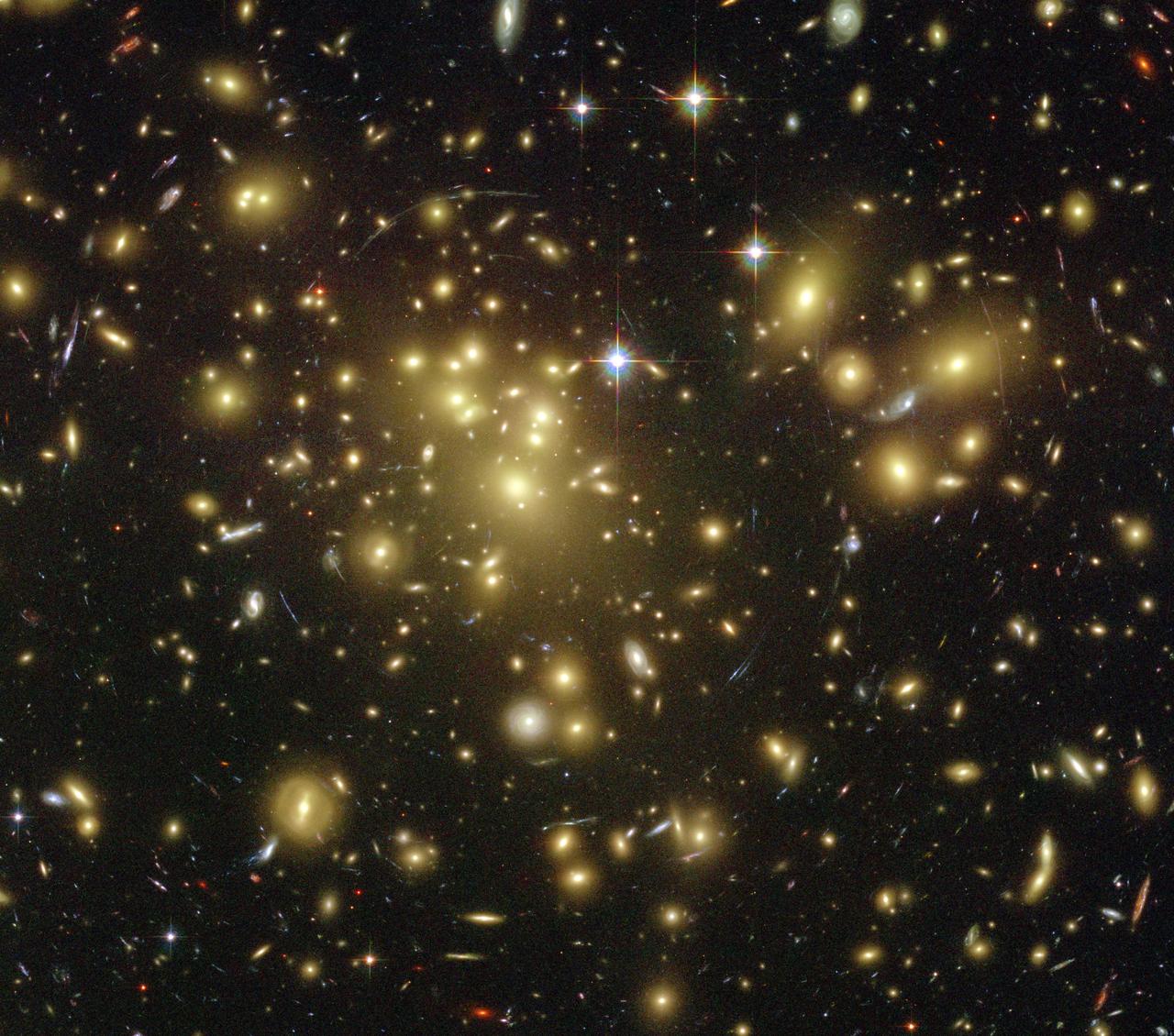
The universe is not smoothly distributed. Galaxies cluster into dense filaments and walls, separated by near-empty voids hundreds of millions of light-years across. This scaffolding — the cosmic web — is the largest structure in existence, and understanding how it assembled over 13.7 billion years is one of the central problems in cosmology. A new study using the James Webb Space Telescope has just produced the clearest picture of that structure ever made, tracking 164,000 galaxies from the present back to when the universe was barely a billion years old.
The work, led by researchers at the University of California, Riverside and published in May 2026, draws on the COSMOS-Web survey — the largest observing program Webb has undertaken. The field covers a contiguous patch of sky roughly three times the area of the full Moon. That sounds small, but at Webb's sensitivity and resolution, it reaches back in cosmic time in a way that earlier surveys simply couldn't, connecting the nearby web to its earliest precursors when density fluctuations were still young.
What the cosmic web is and why it's hard to map
The cosmic web emerged from quantum fluctuations in the first fraction of a second after the Big Bang. Regions that were slightly denser attracted more matter gravitationally; regions that were slightly emptier shed mass to their surroundings. Over billions of years, that small initial contrast amplified into the dramatic structure visible today: galaxy clusters at the intersections of filaments, galaxy groups and individual galaxies threading along the strands, and vast supervoids in between where almost nothing persists.
Mapping this structure comprehensively requires two things that are technically difficult to combine: a wide enough field to capture the large-scale geometry, and enough depth and sensitivity to catch faint, distant galaxies whose light has been traveling for billions of years. Ground-based surveys like DESI have mapped the web in our cosmic neighborhood with extraordinary statistical precision, but they lose completeness as you look farther back. Webb's infrared sensitivity, operating above Earth's atmosphere, extends that reach dramatically.
The COSMOS-Web result
The new map traces the web's evolution through multiple distinct epochs, allowing astronomers to compare how clusters and filaments looked when the universe was one billion years old, three billion years old, and progressively closer to the present. In the bright yellow dense regions of the visualization — the nodes where filaments intersect — galaxy formation was fastest. The dark voids were already largely empty early on, as gravity drained mass toward the filaments. But the detailed geometry of how that drainage happened, and how the typical size and density of filaments changed with time, was not previously measurable with this precision over this timespan.
The team released the full analysis pipeline, the complete galaxy catalogue of 164,000 sources, and a 3D video showing the web's evolution publicly alongside the paper — a decision that makes the dataset immediately available for secondary analyses by researchers worldwide.
One of the key scientific questions the map addresses is whether the web's evolution matches predictions from the standard cosmological model, which assumes dark matter provides the gravitational skeleton that normal matter falls into. So far, the results broadly confirm the standard picture: the web's large-scale structure at early times is consistent with what simulations predict given the measured initial conditions from the cosmic microwave background. But the level of detail now available means that deviations from standard model predictions, if they exist at the level of individual filament properties or void statistics, are now potentially resolvable in ways they weren't before.
How this differs from DESI and other surveys
DESI, which recently released the largest three-dimensional galaxy redshift survey in history, maps the web primarily in the nearby universe with extraordinary statistical power — millions of galaxies across a large fraction of the sky. COSMOS-Web trades that statistical volume for depth and resolution: fewer total galaxies, but reaching back farther, and with the spatial resolution to resolve individual structures at high redshift rather than treating galaxies as statistical point sources.
The two surveys are complementary rather than competitive. DESI constrains the geometry of the present-day web with precision that constrains dark energy. COSMOS-Web shows how the web's skeleton developed through the first half of cosmic time — a window into the conditions that produced the present-day distribution of galaxies and matter.
A related ongoing effort involves Roman Space Telescope preparatory observations by Hubble of galactic bulge fields, building a stellar catalog that will anchor Roman's microlensing survey. That survey targets a different structural question — the distribution of unseen compact objects within the Milky Way rather than the large-scale universe — but both are part of the broader effort to map what exists where, across scales from stellar masses to the largest coherent structures in the cosmos.
For the cosmic web specifically, the COSMOS-Web result means that the chaotic-to-ordered transition — the process by which the universe went from a nearly uniform hot gas to a network of filaments threading through vast emptiness — is now documented, in detail, across nearly all of cosmic time. What began as quantum noise in the first moments after the Big Bang has left a precise geometric signature, and Webb has now traced it further back than anything before it.
Why It Matters
The cosmic web is the skeleton of the universe — everything visible is threaded along its filaments or clustered at its nodes. Mapping how that skeleton grew from the chaotic early universe into the organised structure we live in today is not an abstract exercise: it constrains how gravity and dark matter shaped the distribution of matter, and tests whether our cosmological model correctly predicts structure formation across the full span of cosmic time. COSMOS-Web's 164,000-galaxy map, extending from the present back to the universe's first billion years, provides the observational baseline that future surveys — including Euclid and Roman — will need to interpret their own results in context.
