
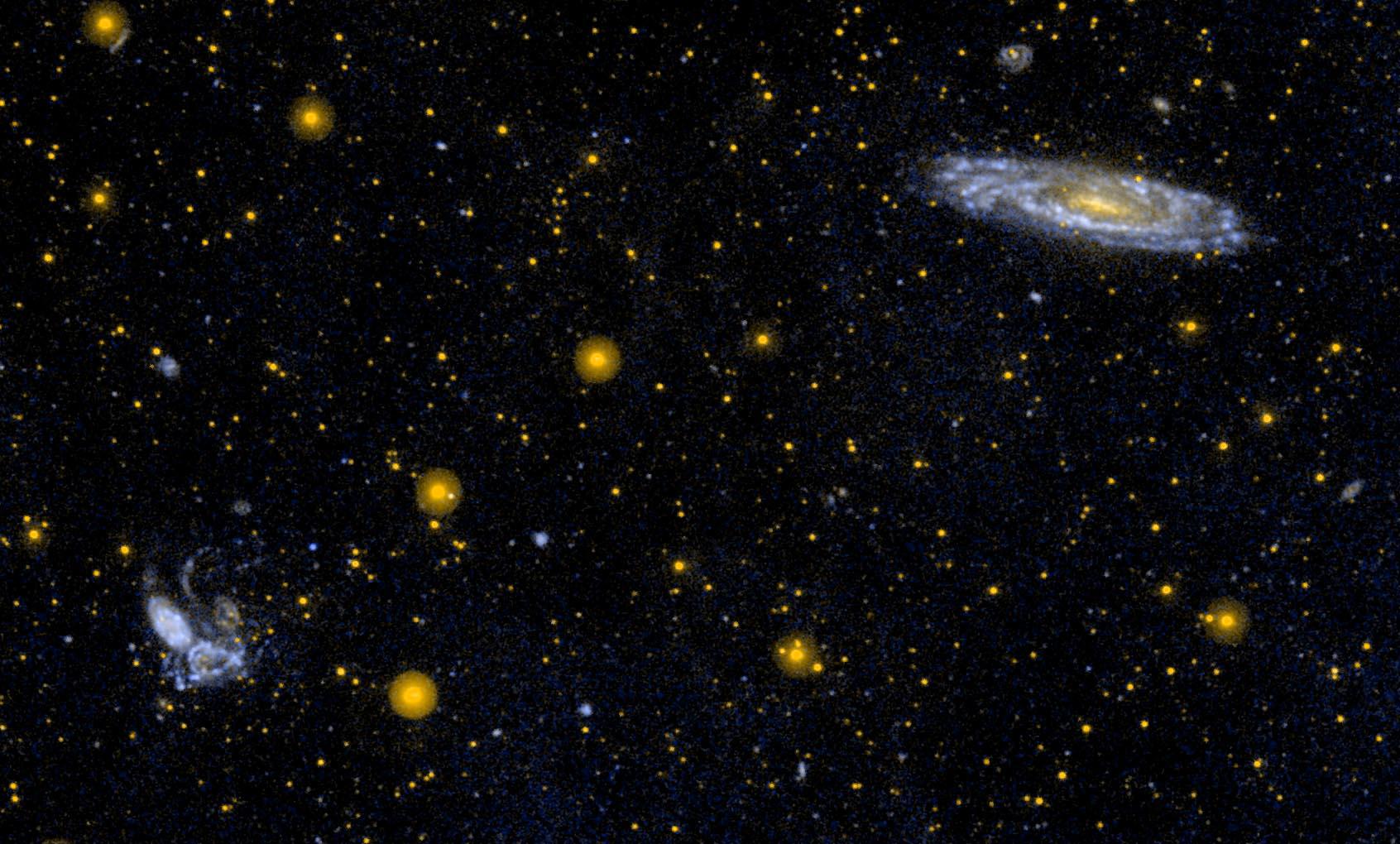
The universe is making far fewer stars than it used to. Around 10 billion years ago, during the period astronomers call Cosmic Noon, galaxies were forming stars at rates up to 30 times higher than they do now, and the cosmic star formation rate has fallen by about 97 percent since then. Our own Milky Way now produces only about six or seven stars a year. Something shut the factories down, and a new study points to one place where you can watch it happen: a crowded group of galaxies called COSMOS-Gr30.
The paper, led by Jonathan Freundlich of the University of Strasbourg Observatory and accepted by Astronomy & Astrophysics, measured the cold molecular gas in galaxies belonging to this group. That gas is the raw material for new stars. The result is clear: the group's galaxies are running low on it.
A crowded neighborhood at a cosmic crossroads
COSMOS-Gr30 sits at a redshift of about 0.7. ESO puts that at roughly 6.5 billion light-years away. It is a dense group located where filaments of the cosmic web intersect, which makes it a natural laboratory for asking whether a galaxy's surroundings decide when it stops forming stars, the process astronomers call environmental quenching.
The group was already well known for something unusual. In 2017, ESO highlighted a huge bubble of ionized gas in COSMOS-Gr30, mapped with the MUSE instrument on the Very Large Telescope. The structure spans more than 300,000 light-years, about three times the diameter of the Milky Way, and contains 10 galaxies. MUSE showed that this gas is not pristine material falling in from intergalactic space. It was thrown out of the galaxies themselves, by violent interactions or by superwinds driven by black holes and supernovae.
Universe Today, which covered the new work on Nov. 13, lists the mechanisms behind that expelled gas: star formation, outflows from active galactic nuclei (AGN), ram-pressure stripping as galaxies plow through the surrounding medium, and tidal interactions between neighbors. Those processes stir up the group, and the open question was what they had done to the cold fuel that stars actually need.
Weighing the cold gas
To find out, Freundlich and colleagues observed the CO(2-1) emission line of carbon monoxide, a standard tracer of molecular gas, using the IRAM NOEMA interferometer and the IRAM 30-meter telescope. Because molecular hydrogen is nearly invisible to radio telescopes, astronomers measure CO and convert it to hydrogen using a standard factor.
CO was detected in four galaxies at a signal-to-noise ratio above 5. For the remaining group members with secure spectroscopic redshifts, the team derived upper limits, and stacked measurements gave the average picture. The stacked gas content came out about 0.5 dex below what scaling relations for field galaxies predict. That is a factor of roughly three. Put another way, the group's members hold only 20 to 40 percent of the molecular gas fraction of typical main-sequence galaxies, the steadily star-forming systems that define "normal" at a given epoch.
The 30m observations of the giant ionized structure, which covers about 104 square kiloparsecs, placed an upper limit on the molecular gas associated with it: less than 2×10¹⁰ solar masses. The authors conclude that less than a third of the gas in the intragroup medium is in a cold, star-forming phase.
Why It Matters
Quenching is one of the central problems in galaxy evolution. Galaxies clearly stop forming stars, and the drop in the cosmic star formation rate since Cosmic Noon shows it happened on a grand scale. What is harder is tying a specific mechanism to a specific system. Universe Today notes that measurements of the gas supply in galaxy groups are rare, even though most galaxies live in groups.
COSMOS-Gr30 is useful because it lets astronomers measure the gas inside the galaxies and the gas between them at the same time. The galaxies are gas-poor compared with field galaxies of the same kind, and the gas that has been pushed out into the intragroup space is mostly not cold enough to form stars. The authors describe this as capturing quenching in action, and say the depletion of molecular gas within galaxies, combined with the extended gas structure, provides a consistent picture of environmental quenching.
The two measurements fit together. Lower gas reservoirs inside the galaxies leave less fuel for star formation, and a reservoir outside them that is mostly not cold means the expelled material is not an easy source of new fuel. Because most galaxies exist in groups, understanding what happens in places like this one bears directly on why the cosmic star formation rate declined, though one group cannot settle that on its own.
The caveats
This is one group, and the firm detections cover only four galaxies. The population-wide result depends on stacking, which gives an average and blurs galaxy-to-galaxy differences. The authors themselves say the uncertainties are significant, including those in the star formation rates and in using CO as a proxy for molecular hydrogen. The constraint on the intragroup medium is an upper limit, not a measurement, so the true cold-gas share could be well under one third. Several processes, including ram-pressure stripping, tidal interactions, star-formation feedback and AGN outflows, are plausibly at work in a place this crowded, and the study does not neatly separate their contributions.
Still, the study is a well-defined test case. It pairs cold-gas observations with an unusually detailed map of ionized gas in the same system. The authors say more precise star formation measurements and larger samples of groups will be needed to assess group-to-group variance, and that would show whether COSMOS-Gr30 is typical or an extreme example of how crowds starve their members.
Sources
- Freundlich et al., "Probing the molecular gas content of galaxies in an over-dense group at z~0.7: A test case for environmental quenching" (arXiv, accepted by A&A)
- Universe Today: Dense Galaxy Clusters Foster Mechanisms That Throttle Star Formation
- ESO Picture of the Week: the COSMOS-Gr30 ionised gas bubble
